
- Chandigarh UT
- Creative Corner
- Dadra Nagar Haveli UT
- Daman and Diu U.T.
- Department of Administrative Reforms and Public Grievances
- Department of Biotechnology
- Department of Commerce
- Department of Consumer Affairs
- Department of Industrial Policy and Promotion (DIPP)
- Department of Posts
- Department of Science and Technology
- Department of Telecom
- Digital India
- Economic Affairs
- Ek Bharat Shreshtha Bharat
- Energy Conservation
- Expenditure Management Commission
- Food Security
- Gandhi@150
- Girl Child Education
- Government Advertisements
- Green India
- Incredible India!
- India Textiles
- Indian Railways
- Indian Space Research Organisation - ISRO
- Job Creation
- LiFE-21 Day Challenge
- Mann Ki Baat
- Manual Scavenging-Free India
- Ministry for Development of North Eastern Region
- Ministry of Agriculture and Farmers Welfare
- Ministry of Chemicals and Fertilizers
- Ministry of Civil Aviation
- Ministry of Coal
- Ministry of Corporate Affairs
- Ministry of Culture
- Ministry of Defence
- Ministry of Earth Sciences
- Ministry of Education
- Ministry of Electronics and Information Technology
- Ministry of Environment, Forest and Climate Change
- Ministry of External Affairs
- Ministry of Finance
- Ministry of Health and Family Welfare
- Ministry of Home Affairs
- Ministry of Housing and Urban Affairs
- Ministry of Information and Broadcasting
- Ministry of Jal Shakti
- Ministry of Law and Justice
- Ministry of Micro, Small and Medium Enterprises (MSME)
- Ministry of Petroleum and Natural Gas
- Ministry of Power
- Ministry of Social Justice and Empowerment
- Ministry of Statistics and Programme Implementation
- Ministry of Steel
- Ministry of Women and Child Development
- MyGov Move - Volunteer
- New Education Policy
- New India Championship
- NITI Aayog
- NRIs for India’s Growth
- Open Forum
- PM Live Events
- Revenue and GST
- Rural Development
- Saansad Adarsh Gram Yojana
- Sakriya Panchayat
- Skill Development
- Smart Cities
- Sporty India
- Swachh Bharat (Clean India)
- Tribal Development
- Watershed Management
- Youth for Nation-Building
Share innovative ideas on circular economy in E-waste

Start Date :
Feb 01, 2022
Last Date :
Feb 15, 2022
23:45 PM IST (GMT +5.30 Hrs)
Innovative ideas on circular economy in E-waste ...
All Comments
Featured
New Comments
Showing 862 Submission(s)
SUTHAHAR P
4 years 2 months ago
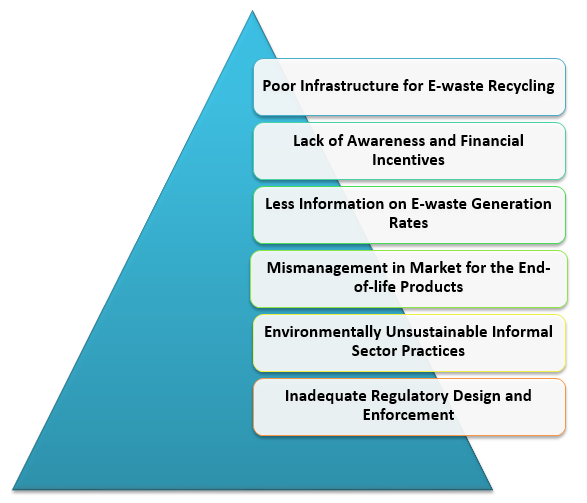
The heavy reliance on an informal sector for e-waste recycling gives rise to these key challenges, as mention below:
First, the attempt to impose financial penalties on non-compliance or violation of e-waste handling and processing rules is ineffective.
Second, broader public knowledge regarding market prices and health safety costs of e-waste recycling is less because less paid workers who do this work do not have proper training.
Third, despite the massive increase in the volume of e-waste generated every year, there is very little investment by large-scale industrial infrastructure for recovery and recycling.
Like
(10)
Dislike
(2)
Reply
Report Spam
SUTHAHAR P
4 years 2 months ago
E-waste recycles in India is predominantly an informal sector activity. There are thousands of poor households eking a living from scavenging materials from waste dumps. The common recycling practices for middle-class urban households, particularly for waste paper, plastic, clothing, or metal, is to sell out to small-scale, informal sector buyers often known as ‘kabadiwalas,’ and they further sort and sell these as an input material to artisanal or industrial processors.
Like
(10)
Dislike
(2)
Reply
Report Spam
SUTHAHAR P
4 years 2 months ago
The computers, mainframes, servers, monitors, printers, scanners, compact discs (CDs), copiers, calculators, battery cells, cellular phones, fax machines, transceivers, TVs, medical apparatus, iPods, refrigerators, washing machines, and air conditioners are examples of e-waste when they become unfit for its use. The presence of highly toxic substances and heavy metals like mercury, lead, beryllium, and cadmium pose a significant threat to an environment even in minute quantities.
Like
(9)
Dislike
(2)
Reply
Report Spam
SUTHAHAR P
4 years 2 months ago
E-waste poses the huge risk to humans, animals, and the environment. E-waste typically consists of plastics, metals, cathode ray tubes (CRTs), printed cables, circuit boards, and so on. The valuable metals like copper, silver, gold, and platinum can be reused from e-wastes once they are scientifically processed. The presence of toxic substances like liquid crystal, lithium, mercury, nickel, selenium, polychlorinated biphenyls (PCBs), arsenic, barium, brominates flame retardants, cadmium, chrome, cobalt, copper, and lead makes it very hazardous, in case e-waste get dismantled and processed in a crude manner with the rudimentary techniques.
Like
(10)
Dislike
(2)
Reply
Report Spam
SUTHAHAR P
4 years 2 months ago
Consumers are the key to better e-waste management in India. Initiatives such as Extended Producer Responsibility; Design for Environment; (3Rs) Reduce, Reuse, Recycle technology platform for linking the market facilitating the circular economy aim to encourage consumers to correctly dispose of the e-waste, with an increased reuse and recycling rates, and also adopt sustainable consumer habits.
Like
(10)
Dislike
(2)
Reply
Report Spam
SUTHAHAR P
4 years 2 months ago
Electronic waste, as known as e-waste, is generated when any electronic or electrical equipment becomes unfit for the intended use or if it has crossed its expiry date. Due to rapid technological advancements and the production of newer electronic equipment, the old ones get easily replaced with new models. It has particularly led to an exponential increase in e-waste in India. People tend to switch to the newer models and trending technologies; also, the lives of products get reduced with time. But the issue is left with e-waste management in India and its challenges.
Like
(9)
Dislike
(2)
Reply
Report Spam
SUTHAHAR P
4 years 2 months ago
A key aspect of the initiative is that the team will deploy a detection system that uses a combination of image processing and natural language processing techniques to extract product information and upload it to the database.
Once significant data sets are available, the team would advance towards deploying machine learning capabilities to ensure easy retrieval and proper indexing of the products to reflect the users’ perspective and the relevant aspects of the processes.
The initiative will, among other things, focus on forging collaborations and influencing the stakeholders in the informal markets who are primary users / buyers of used electronic goods and sellers of electronic spares, ICT components, and electronic equipment.
Like
(10)
Dislike
(2)
Reply
Report Spam
SUTHAHAR P
4 years 2 months ago
Mobile phone manufacturer Nokia is one of the very few companies that seem to have made serious effort in this direction since 2008. The companies were made responsible for creating channels for proper collection and disposal of e-waste in accordance with a Central Pollution Control Board (CPCB) approved EPR Authorization plan in India. Recently, the import license of some of the big companies were suspended for violation of E-waste rules. Such measures have a great impact on effective implementation of e-waste management in India. Any task undertaken must have its share of incentives which attract stakeholders. In the field of e-waste management, the government must announce incentives, which could be in the form of tax concessions or rebates, to ensure compliance across the electronics industry. Additionally, the e-waste collection targets need to be regularly reviewed and renewed to ensure compliance across India on collection of e-waste.
Like
(10)
Dislike
(2)
Reply
Report Spam
SUTHAHAR P
4 years 2 months ago
Increasing information campaigns, capacity building, and awareness is critical to promote environment friendly e-waste management programmes. Increasing efforts are urgently required on improvement of the current practices such as collection schemes and management practices to reduce the illegal trade of e-waste. Reducing the amount of hazardous substances in e-products will also have a positive effect in dealing with the specific e-waste streams since it will support the prevention process.
Like
(10)
Dislike
(2)
Reply
Report Spam
SUTHAHAR P
4 years 2 months ago
E-waste management is a great challenge for governments of many developing countries such as India. This is becoming a huge public health issue and is exponentially increasing by the day. In order to separately collect, effectively treat, and dispose of e-waste, as well as divert it from conventional landfills and open burning, it is essential to integrate the informal sector with the formal sector. The competent authorities in developing and transition countries need to establish mechanisms for handling and treatment of e-waste in a safe and sustainable manner.
Like
(10)
Dislike
(2)
Reply
Report Spam
- View More