

Home | MyGov

Accessibility
Accessibility Tools
Color Adjustment
Text Size
Navigation Adjustment
Screen Reader iconScreen Reader

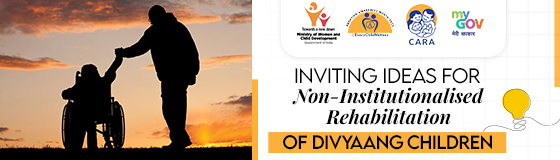
Inviting Ideas for Non-Institutionalised Rehabilitation of Divyaang Children

Inviting Ideas for Non-Institutionalised Rehabilitation of Divyaang Children
Start Date :
Oct 01, 2025
Last Date :
Nov 30, 2025
17:30 PM IST (GMT +5.30 Hrs)
Submission Closed

In 2025, the Central Adoption Resource Authority (CARA) is placing special focus on promoting family-based care for children with special needs (Divyaang children). In ...

In 2025, the Central Adoption Resource Authority (CARA) is placing special focus on promoting family-based care for children with special needs (Divyaang children). In collaboration with MyGov, CARA invites all Indian citizens to participate in an important national discussion on the theme:
“Non-institutionalized Rehabilitation of Children with Special Needs (Divyaang Children)”

This initiative seeks to create a collaborative platform where citizens can:
1. Share insights on the challenges and barriers in the identification and adoption of children with special needs
2. Suggest innovative ideas, strategies, or solutions to strengthen the adoption ecosystem
3. Contribute to policy-making by offering actionable recommendations to ensure a loving family environment for every child, especially those currently residing in Specialized Adoption Agencies (SAAs) and Child Care Institutions (CCIs)

Your thoughtful suggestions can play a key role in shaping a more inclusive, compassionate, and efficient adoption framework for Divyaang children.

Who can participate?
All Indian citizens are welcome to join the conversation and submit their ideas.

Why participate?
Selected entries may be featured in national-level publications, exhibitions, and even considered in policy discussions aimed at improving the lives of children with special needs.

Let’s work together to ensure every child finds a loving family and a brighter future. Join the discussion today and be a voice for change!

Reset
Showing 777 Submission(s)
Bhavish S
Bhavish S 3 months 3 days ago
Non-institutional rehabilitation for divyang can happen effectively through family, community, school, and local services instead of institutions or hostels. Below are practical ideas that can work at village, ward, and district levels in India. Home and family-based ideas: 1)Train parents and siblings as “primary rehabitars 2)Develop door-to-door home-based rehabilitation visits by local therapists 3Use tele-rehabilitation 4)Create parent support circles in each panchayat Inclusive education and school-based ideas: 1) Strengthen inclusive education in nearby government/private schools.Ensure every divyang child has an Individual Education Plan (IEP) 2)Deploy special educators at cluster or block level who travel to schools and homes, supporting teachers with strategies, teaching-learning materials, 3) strengthen sports activities among the divyang children, deploy special sport coaches like paralympic athlete sheetal devi
Gagandeep Kaur
Gagandeep Kaur 3 months 3 days ago
Divyang children is big concern for our country.it has been proper arrangement of their rehabilitation.some suggestion has been given for it. 1 A proper rehabilitation centre has been opened for their proper care. 2 Every hospital has to be compulsory for specially ward reserve for divyaang children. 3 Social organisation will take responsibility for their proper care and given better environment. 4 Religious and spiritual organisation has to be act as a supportive role for their mental fitness. 5 A national rehabilitation plan has been enacted for regulate all activity
Gagandeep Kaur
Gagandeep Kaur 3 months 3 days ago
Divyang children is big concern for our country.it has been proper arrangement of their rehabilitation.some suggestion has been given for it. 1 A proper rehabilitation centre has been opened for their proper care. 2 Every hospital has to be compulsory for specially ward reserve for divyaang children. 3 Social organisation will take responsibility for their proper care and given better environment. 4 Religious and spiritual organisation has to be act as a supportive role for their mental fitness. 5 A national rehabilitation plan has been enacted for regulate all activity
Gagandeep Kaur
Gagandeep Kaur 3 months 3 days ago
Divyang children is big concern for our country.it has been proper arrangement of their rehabilitation.some suggestion has been given for it. 1 A proper rehabilitation centre has been opened for their proper care. 2 Every hospital has to be compulsory for specially ward reserve for divyaang children. 3 Social organisation will take responsibility for their proper care and given better environment. 4 Religious and spiritual organisation has to be act as a supportive role for their mental fitness. 5 A national rehabilitation plan has been enacted for regulate all activity
Gagandeep Kaur
Gagandeep Kaur 3 months 3 days ago
A truly effective family-first support ecosystem for Divyaang children begins long before any policy document or welfare scheme—it begins at home. The family is the child’s first school, first safety net, and first emotional anchor. When families are informed, trained, and emotionally supported, they become powerful engines of transformation.Such an ecosystem must ensure that parents receive timely awareness on early diagnosis, access to medical and psychological support, and clear pathways to education and rehabilitation. Families should not be left to navigate disability on their own. They deserve simple processes, community-based assistance, and institutional backing that reduces stress rather than multiplying it.A family-first support ecosystem for Divyaang children is not just social welfare—it’s nation-building. When families are empowered with awareness, accessibility, and dignity-driven support, every child’s potential becomes a collective strength
Gagandeep Kaur
Gagandeep Kaur 3 months 3 days ago
A truly effective family-first support ecosystem for Divyaang children begins long before any policy document or welfare scheme—it begins at home. The family is the child’s first school, first safety net, and first emotional anchor. When families are informed, trained, and emotionally supported, they become powerful engines of transformation.Such an ecosystem must ensure that parents receive timely awareness on early diagnosis, access to medical and psychological support, and clear pathways to education and rehabilitation. Families should not be left to navigate disability on their own. They deserve simple processes, community-based assistance, and institutional backing that reduces stress rather than multiplying it.A family-first support ecosystem for Divyaang children is not just social welfare—it’s nation-building. When families are empowered with awareness, accessibility, and dignity-driven support, every child’s potential becomes a collective strength
AdityaKarbhariMohare
AdityaKarbhariMohare 3 months 3 days ago
hallo sir/Madam I am Aditya Mohare from Maharashtra Sambhaji nagar warzadi Gangapur taluka and I study in B . A third year student of Dr Babasaheb Ambedkar University Marathwada
FAYAZ
FAYAZ 3 months 3 days ago
rehabilitation of Divyaang children: - *Family-based care*: Encourage adoption and foster care by providing support and resources to families, promoting a loving and nurturing environment. - *Community-based rehabilitation*: Establish community centers offering therapy, education, and vocational training, helping children integrate into society. - *Special parenting.
Mohammed Nawaz Hussain
Mohammed Nawaz Hussain 3 months 3 days ago
A truly effective family-first support ecosystem for Divyaang children begins long before any policy document or welfare scheme—it begins at home. The family is the child’s first school, first safety net, and first emotional anchor. When families are informed, trained, and emotionally supported, they become powerful engines of transformation.Such an ecosystem must ensure that parents receive timely awareness on early diagnosis, access to medical and psychological support, and clear pathways to education and rehabilitation. Families should not be left to navigate disability on their own. They deserve simple processes, community-based assistance, and institutional backing that reduces stress rather than multiplying it.A family-first support ecosystem for Divyaang children is not just social welfare—it’s nation-building. When families are empowered with awareness, accessibility, and dignity-driven support, every child’s potential becomes a collective strength.