
- Chandigarh UT
- Creative Corner
- Dadra Nagar Haveli UT
- Daman and Diu U.T.
- Department of Administrative Reforms and Public Grievances
- Department of Biotechnology
- Department of Commerce
- Department of Consumer Affairs
- Department of Industrial Policy and Promotion (DIPP)
- Department of Posts
- Department of Science and Technology
- Department of Telecom
- Digital India
- Economic Affairs
- Ek Bharat Shreshtha Bharat
- Energy Conservation
- Expenditure Management Commission
- Food Security
- Gandhi@150
- Girl Child Education
- Government Advertisements
- Green India
- Incredible India!
- India Textiles
- Indian Railways
- Indian Space Research Organisation - ISRO
- Job Creation
- LiFE-21 Day Challenge
- Mann Ki Baat
- Manual Scavenging-Free India
- Ministry for Development of North Eastern Region
- Ministry of Agriculture and Farmers Welfare
- Ministry of Chemicals and Fertilizers
- Ministry of Civil Aviation
- Ministry of Coal
- Ministry of Corporate Affairs
- Ministry of Culture
- Ministry of Defence
- Ministry of Earth Sciences
- Ministry of Education
- Ministry of Electronics and Information Technology
- Ministry of Environment, Forest and Climate Change
- Ministry of External Affairs
- Ministry of Finance
- Ministry of Health and Family Welfare
- Ministry of Home Affairs
- Ministry of Housing and Urban Affairs
- Ministry of Information and Broadcasting
- Ministry of Jal Shakti
- Ministry of Law and Justice
- Ministry of Micro, Small and Medium Enterprises (MSME)
- Ministry of Petroleum and Natural Gas
- Ministry of Power
- Ministry of Social Justice and Empowerment
- Ministry of Statistics and Programme Implementation
- Ministry of Steel
- Ministry of Women and Child Development
- MyGov Move - Volunteer
- New Education Policy
- New India Championship
- NITI Aayog
- NRIs for India’s Growth
- Open Forum
- PM Live Events
- Revenue and GST
- Rural Development
- Saansad Adarsh Gram Yojana
- Sakriya Panchayat
- Skill Development
- Smart Cities
- Sporty India
- Swachh Bharat (Clean India)
- Tribal Development
- Watershed Management
- Youth for Nation-Building
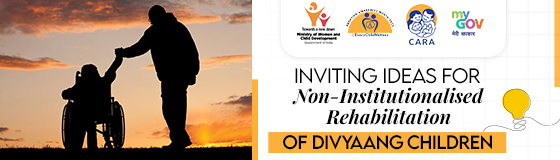
Inviting Ideas for Non-Institutionalised Rehabilitation of Divyaang Children

Start Date :
Oct 01, 2025
Last Date :
Nov 30, 2025
17:30 PM IST (GMT +5.30 Hrs)
In 2025, the Central Adoption Resource Authority (CARA) is placing special focus on promoting family-based care for children with special needs (Divyaang children). In ...
All Comments
Featured
New Comments
Comments (1)
Showing 777 Submission(s)
JethvaDevanshiJagdidhbhai
3 months 1 week ago
Title:
A Dignified, Family-Centered Approach for Divyaang Children
Comment:
I am Devanshi Jethva, a Horticulture student from Vadodara, and I believe that Divyaang children in India deserve rehabilitation that is rooted in family belonging rather than institutional care. While shelters provide safety, they cannot offer the emotional connection, identity formation, and personalized support that a family environment creates.
To strengthen outcomes, India should promote early identification, parent preparedness counselling, and disability-aware adoption support, so that families feel confident, informed, and empowered. Community-based therapy access and financial assistance can further ensure that care is not seen as a burden, but as an inclusive social responsibility.
With awareness, compassion, and supportive policies, we can build a future where every Divyaang child grows with dignity, love, and confidence.
🌸 “As a young student from Vadodara, I believe a child’s greatest rehabil
Like
(4)
Dislike
(0)
Reply
Report Spam
CHANDRASEKAR
3 months 1 week ago
🕉🙏🙏🙏🙏🙏🕉
Greetings to all organisations and institutions for their godly work they are doing to these children s. 👍🤝🙏
My suggestion for this
1. Govt. can give various advertisement to the public about the children's who are willing to adapt and take care of them very well and the government can support the parents by giving them free medical and various helps for the children and the family.
2. By joining the old age home with this organization so the old people will love and take care of them as grand parents.
3. Conduct weekend get together programs to the public so they can visit the organization and share their love and Affection with the children this will create a lovely atmosphere and make them to adopt the children in a few weeks.
4. Most of the rich and well settled couples don't have childrens will come forward to adapt these childrens.
🕉✋God bless you all 🤚🕉
🙏Bharat mata ki Jay🙏
Like
(3)
Dislike
(0)
Reply
Report Spam
Gagandeep Kaur
3 months 1 week ago
Absolutely , non- institutionalised rehabilitation of divyang children gives them wings of more love and can feel the family environment.
Why?
It helps them to recover rapidly.
This is must-
1) Monitoring the family
2) Councelling of family and child
3) Training to Family
How?
There is a need to aware people about this topic.So, more and more families will come up with their helping hands.
Like
(3)
Dislike
(0)
Reply
Report Spam
Isha Kharkate
3 months 1 week ago
Today, I am here to speak on a very meaningful and socially important topic — Non-Institutionalised Rehabilitation of Divyang Children.
Children with disabilities are not limited by their abilities, but often by the lack of accessible support and opportunities. Traditionally, rehabilitation meant sending children to institutions far away from their families. But this approach often distances children from emotional support, natural environments, and the warmth of home.
Non-institutionalised rehabilitation brings a new, progressive, and human-centered approach. It ensures that divyang children receive essential services such as therapy, early intervention, special education support, and assistive devices right within their own homes
Like
(3)
Dislike
(0)
Reply
Report Spam
Karamdeep Kaur
3 months 1 week ago
Absolutely , non- institutionalised rehabilitation of divyang children gives them wings of more love and can feel the family environment.
Why?
It helps them to recover rapidly.
This is must-
1) Monitoring the family
2) Councelling of family and child
3) Training to Family
How?
There is a need to aware people about this topic.So, more and more families will come up with their helping hands.
Like
(3)
Dislike
(0)
Reply
Report Spam
Stuti
3 months 1 week ago
💡 CIPs
Topic: Non-Institutionalized Rehabilitation of Divyang Children.
Idea: Community Inclusion Pods (CIPs)
* Structure: A localized network of 5-10 nearby families with Divyang children.
* Driver: A trained Community Facilitator (CF) acts as the local coordinator and coach.
| Strategy | Key Action | Benefit |
|---|---|---|
| Therapy | Mobile Therapy Units (MTU) visit CIPs; focus is on Parent Training for home-based, continuous therapy. | Maximizes impact; reduces institution dependency. |
| Inclusion | CF enables enrollment in local mainstream schools and coordinates shared teaching assistants. | Ensures social integration within the community. |
| Support | Regular peer meetings for parents for emotional and practical skill-sharing. | Reduces caregiver stress and isolation. |
Goal: To make the immediate community the primary environment for rehabilitation, replacing segregated institutions.
Like
(3)
Dislike
(0)
Reply
Report Spam
Anmol Jain
3 months 1 week ago
Definitely, non- institutionalised rehabilitation of divyang children gives them wings of more love and can feel the family environment.
Why?
It helps them to recover rapidly.
This is must-
1) Monitoring the family
2) Councelling of family and child
3) Training to Family
How?
There is a need to aware people about this topic.So, more and more families will come up with their helping hands.
Like
(4)
Dislike
(0)
Reply
Report Spam

Tejal Mali
3 months 1 week ago
kindly see the attachment
Like
(3)
Dislike
(0)
Reply
Report Spam
Ratnesh Mishra
3 months 1 week ago
Community-based rehabilitation through local centres. Home-based therapy and regular visits by trained workers. Inclusive education with special educators and resource rooms. Parent training for home-based support and skill development. Peer-support and buddy systems for social inclusion. Mobile therapy vans for remote areas. Involvement of Anganwadi, ASHA, SHGs and community volunteers. Village-level assistive device distribution camps. Tele-rehabilitation and mobile app guidance. Inclusive sports, art, music and recreational activities. Early intervention support through strengthened Anganwadi centres. Community-based vocational training for older children.
Like
(5)
Dislike
(0)
Reply
Report Spam
Yash Rawat
3 months 1 week ago
हमारे आस-पड़ोस के स्कूलों को भी इन बच्चों का स्वागत करने के लिए प्रोत्साहित किया जाना चाहिए, ताकि वे अपने साथियों के साथ बड़े हों और समाज का हिस्सा बनना सीखें। इस काम को सुचारू रूप से चलाने के लिए, CARA प्रगति पर नज़र रखने और परिवारों को मार्गदर्शन प्रदान करने के लिए एक सरल प्रणाली स्थापित कर सकता है। स्थानीय नेता और स्वयंसेवक भी जागरूकता फैलाकर और यह ज़िम्मेदारी लेने वाले परिवारों की मदद करके भूमिका निभा सकते हैं। जब कोई बच्चा किसी संस्थान के बजाय परिवार में बड़ा होता है, तो वह सिर्फ़ जीवित ही नहीं रहता वह फलता-फूलता है। जय हिंद-जय भारत।
Like
(5)
Dislike
(0)
Reply
Report Spam
- View More