Home | MyGov

Accessibility
Accessibility Tools
Color Adjustment
Text Size
Navigation Adjustment
Screen Reader iconScreen Reader

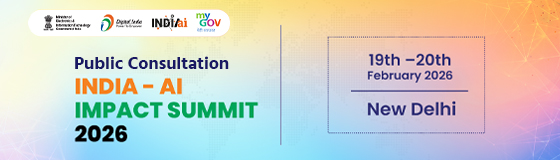
Public Consultation - Help Shape the AI Impact Summit 2026

Public Consultation - Help Shape the AI Impact Summit 2026
Start Date :
Jun 06, 2025
Last Date :
Jun 30, 2025
17:45 PM IST (GMT +5.30 Hrs)
Submission Closed

India is proud to host the AI Impact Summit 2026, a landmark global event announced by the Hon’ble Prime Minister at the France AI Action Summit. Building on the momentum of ...

India is proud to host the AI Impact Summit 2026, a landmark global event announced by the Hon’ble Prime Minister at the France AI Action Summit. Building on the momentum of Bletchley Park, Seoul, and Paris, the Summit will mark a strategic shift, from action to measurable impact, in global AI cooperation.

The Summit envisions a future where AI delivers real impact, advancing inclusive growth, social development, and a healthier planet. It aims to ensure that AI innovation and governance reflect the diverse realities, languages, and development priorities of both emerging and advanced economies.

Bringing together governments, industry leaders, researchers, startups, civil society, and international organizations, the Summit will chart a shared vision for harnessing AI responsibly, for good, and for all. The Summit will help bridge the AI divide and enable all communities, especially in the developing world, to shape and benefit from the future of AI.

To ensure the Summit is grounded in public priorities and stakeholder insight, the Government of India invites inputs from citizens, students, researchers, startups, civil society, and domain experts. Your feedback will help shape the themes, focus areas, and key deliverables of the Summit.

The Ministry of Electronics and Information Technology (MeitY), through IndiaAI (an independent Business Division under the Digital India Corporation), in collaboration with MyGov, is inviting inputs to help shape the discourse, themes, and outcomes of the AI Impact Summit 2026. Your views will ensure the Summit reflects national and international priorities and delivers meaningful, inclusive, and actionable outcomes.

Please provide your suggestions and inputs below regarding the AI Impact Summit and its themes, outcomes, priorities, and more

Reset
Showing 645 Submission(s)
Mitrabarun Mitra
Mitrabarun Mitra 10 months 2 weeks ago
India's AI Summit: "AI for All" to foster inclusive innovation and global trust. Outcomes: Global AI Equity Charter, multilingual AI, ethical AI framework, and AI for public good. Priorities: Democratizing AI access, ethical governance, AI for social impact (healthcare, agriculture), workforce transformation, and international cooperation. Emphasise India's DPI success and diverse stakeholder involvement for a Human-Centric AI future.
D VINAYAGAMOORTHY
D VINAYAGAMOORTHY 10 months 2 weeks ago
Good morning sir, We get threatening phonecalls from customers.For this we have Sanchaar Saathi app to report...Now My suggestion is whether we pay the money or not first option we have is we know their phone no ...with this we should have the option to block their upi A/c related to that phone no...or we should be able to share the a/c details and ifsc details in app where in we can put hold ir Blick the A/c immediately...We have to do this and popularize it largely...The effect would be their phone no would be blocked and a/c no would also be blocked.we should declare them money mule a/c and the id's connected with those should not be allowed to open any new a/c with any bank or financial instructions...To check this there should be a system..and they rob the public with these bank a/cs only...He should not be allowed to step in to any bank or financial institutions.Since they are robbing through online transactions ...it can be some what reduced.
SANJAY SARKAR
SANJAY SARKAR 10 months 2 weeks ago
Real-time intelligence is required for preventing and containing cyber attacks. Periodical ‘Backup of Data’ is a solution to ransomware. Using Artificial Intelligence (AI) for predicting and accurately identifying attacks. Using the knowledge gained from actual attacks that have already taken place in building effective and pragmatic defence. Increased awareness about cyber threats for which digital literacy is required first. India needs to secure its computing environment and IoT with current tools, patches, updates and best known methods in a timely manner. The need of the hour for Indian government is to develop core skills in cyber security, data integrity and data security fields while also setting stringent cyber security standards to protect banks and financial institutions.
SANJAY SARKAR
SANJAY SARKAR 10 months 2 weeks ago
Cyber Surakshit Bharat Initiative: It was launched in 2018 with an aim to spread awareness about cybercrime and building capacity for safety measures for Chief Information Security Officers (CISOs) and frontline IT staff across all government departments. National Cyber security Coordination Centre (NCCC): In 2017, the NCCC was developed. Its mandate is to scan internet traffic and communication metadata (which are little snippets of information hidden inside each communication) coming into the country to detect real-time cyber threats. Cyber Swachhta Kendra: In 2017, this platform was introduced for internet users to clean their computers and devices by wiping out viruses and malware. Training of 1.14 Lakh persons through 52 institutions under the Information Security Education and Awareness Project (ISEA) – a project to raise awareness and to provide research, education and training in the field of Information Security. International cooperation: Looking forward to becoming a sec
SANJAY SARKAR
SANJAY SARKAR 10 months 2 weeks ago
Cybersecurity refers to technologies, processes, and rules created to protect computer systems, servers, networks, programs, devices, and data from cyber-attacks. It aims to protect against the unauthorised access to data and misuse of technologies. India’s growing reliance on digital technologies, increasing use of the internet, lack of awareness, and vulnerability of the Critical Information Infrastructure have made it a target of a wide range of cyber threats. According to a CERT-In report, over 3.94 lakh cyber security incidents were reported in 2020 in India, an increase of 63% from the previous year. These incidents included phishing attacks, website intrusions, malware attacks, and ransomware attacks...
SANJAY SARKAR
SANJAY SARKAR 10 months 2 weeks ago
National Cyber Security Policy: Familiarize yourself with the National Cyber Security Policy, which outlines India's approach to cybersecurity.  Cybersecurity Threats: Understand the specific cyber threats that India faces, including cyberattacks on critical infrastructure, data breaches, and cyberterrorism.  Government Initiatives: Be aware of government initiatives aimed at strengthening cybersecurity, such as the establishment of the Defence Cyber Agency (DCyA).  Legislation: Study relevant legislation, including the Digital Personal Data Protection Act 2023, which aims to protect personal data.  Global Trends: Emerging Threats: Stay updated on emerging cyber threats, such as the use of AI in cyberattacks and the increasing number of IoT devices, which can become entry points for cyberattacks.  Cybersecurity Skills Gap: Be aware of the global cybersecurity skills gap and the shortage of skilled professionals in the field. 
SANJAY SARKAR
SANJAY SARKAR 10 months 2 weeks ago
National Cyber Security Policy: Familiarize yourself with the National Cyber Security Policy, which outlines India's approach to cybersecurity.  Cybersecurity Threats: Understand the specific cyber threats that India faces, including cyberattacks on critical infrastructure, data breaches, and cyberterrorism.  Government Initiatives: Be aware of government initiatives aimed at strengthening cybersecurity, such as the establishment of the Defence Cyber Agency (DCyA).  Legislation: Study relevant legislation, including the Digital Personal Data Protection Act 2023, which aims to protect personal data.  Global Trends: Emerging Threats: Stay updated on emerging cyber threats, such as the use of AI in cyberattacks and the increasing number of IoT devices, which can become entry points for cyberattacks.  Cybersecurity Skills Gap: Be aware of the global cybersecurity skills gap and the shortage of skilled professionals in the field. 
SANJAY SARKAR
SANJAY SARKAR 10 months 2 weeks ago
National Cyber Security Policy: Familiarize yourself with the National Cyber Security Policy, which outlines India's approach to cybersecurity.  Cybersecurity Threats: Understand the specific cyber threats that India faces, including cyberattacks on critical infrastructure, data breaches, and cyberterrorism.  Government Initiatives: Be aware of government initiatives aimed at strengthening cybersecurity, such as the establishment of the Defence Cyber Agency (DCyA).  Legislation: Study relevant legislation, including the Digital Personal Data Protection Act 2023, which aims to protect personal data.  Global Trends: Emerging Threats: Stay updated on emerging cyber threats, such as the use of AI in cyberattacks and the increasing number of IoT devices, which can become entry points for cyberattacks.  Cybersecurity Skills Gap: Be aware of the global cybersecurity skills gap and the shortage of skilled professionals in the field. 
SANJAY SARKAR
SANJAY SARKAR 10 months 2 weeks ago
National Cyber Security Policy: Familiarize yourself with the National Cyber Security Policy, which outlines India's approach to cybersecurity.  Cybersecurity Threats: Understand the specific cyber threats that India faces, including cyberattacks on critical infrastructure, data breaches, and cyberterrorism.  Government Initiatives: Be aware of government initiatives aimed at strengthening cybersecurity, such as the establishment of the Defence Cyber Agency (DCyA).  Legislation: Study relevant legislation, including the Digital Personal Data Protection Act 2023, which aims to protect personal data.