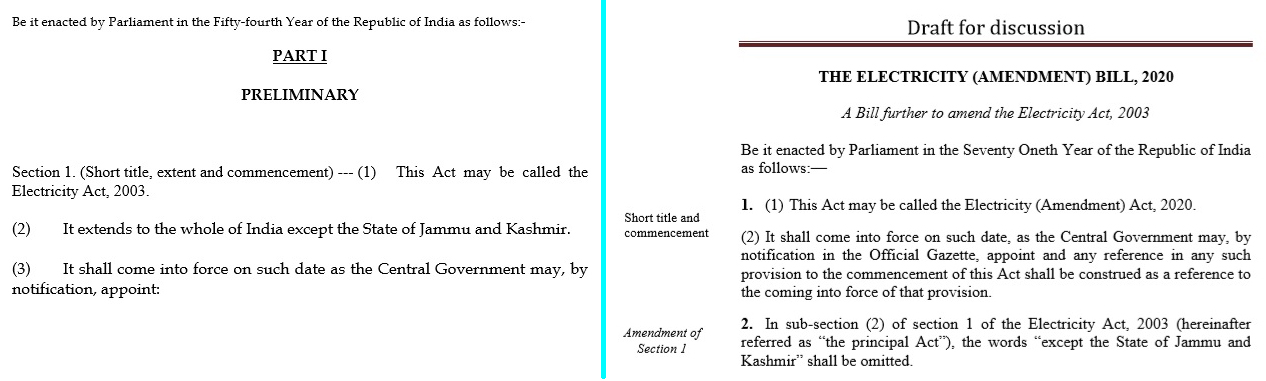
Ministry of Power has identified few key amendments in the Electricity Act 2003 to address immediate requirements of the electricity sector. Accordingly, draft proposal has been circulated on 17.04.2020 in the form of draft Electricity Act (Amendment) Bill 2020 and stakeholders comments sought till 5th June 2020.
1. Establishment of Electricity Contract Enforcement Authority under retired Judge of the High Court for ensuring performance of the contract. The Authority shall have all the powers of a civil court including but limited to powers of attachment and sale of property, arrest and detention in prison and appointment of a receiver. This will ensure faster disposal of adjudicating matters regarding performance of obligations under a contract related to sale, purchase or transmission of electricity.
2. Determination of Cost reflective Tariff for ensuring viability of Electricity Distribution companies (Discoms). the Appropriate Commission to fix tariff for retail sale of electricity without accounting for subsidy; The subsidy, as declared and provided by the State Governments, will be given directly by the government to the consumers clearly reflecting in their bill;
3. Distribution sub licensees: Distribution Licensee may authorise another person, as a sub-license to supply electricity in any particular part of its area of supply, with the permission of the State Electricity Regulatory Commission. This will enable the sub licensee to serve the consumers with full responsibility and due diligence. The distribution licensee will now have the choice to opt for either sub-licensee model or franchisee model. This proposal will bring investment in the distribution sector, ensure regulatory oversight and protect the interests of consumers.
4. Establishment of adequate Payment Security Mechanism : Proposed to empower Load Dispatch Centres to oversee the establishment of adequate payment security mechanism before scheduling dispatch of electricity, as per contracts.
5. Strengthening of the Appellate Tribunal (APTEL): It is proposed to increase its strength of Members, apart from the Chairperson, to at least seven to facilitate quick disposal of cases; also to enhance the powers by assigning power equivalent to High Court under the provisions of the Contempt of Courts Act. With increased strength of members, now APTEL benches can also sit in a place other than Delhi as per the requirement of the case and for easy access to the state.
6. Proposal for Single Selection Committee for giving recommendations for appointments of chairperson and members in central as well as state regulatory commissions for uniformity in selection. The Selection Committee shall be headed by the Judge of Supreme Court .Appointments shall continue to be done by respective Governments.
7. National Renewable Energy Policy: It is proposed to have a separate policy for the development and promotion of generation of electricity from renewable sources of energy.
8. Hydro Power Purchase Obligations (HPO): a minimum percentage of purchase of electricity from hydro sources of energy is to be specified by the State Commissions. Hydro Power purchase Obligations shall be separate part of non solar based Renewable Purchase Obligations.
9. Enforcement of Renewable purchase obligations by levy penalties for non-fulfilment of obligation to buy electricity from renewable and/or hydro sources of energy.
10. Provisions related to Cross border trade in Electricity have been added to facilitate and develop trade in electricity with other countries.
Click here to read the draft bill.
Last date of submission is 5th June,2020.