Home | MyGov

Accessibility
Accessibility Tools
Color Adjustment
Text Size
Navigation Adjustment
Screen Reader iconScreen Reader

Share innovative ideas on circular economy in E-waste

Innovative ideas on circular economy in E-waste
Start Date :
Feb 01, 2022
Last Date :
Feb 15, 2022
23:45 PM IST (GMT +5.30 Hrs)
Submission Closed

Innovative ideas on circular economy in E-waste ...

Innovative ideas on circular economy in E-waste

Today, electronic waste poses a significant challenge for society. With the introduction of innovative features and up-gradation, people are changing their devices by discarding the old ones, thereby contributing to the generation of electronic waste significantly.

Replacing the linear systems with circular in electrical and electronic equipment intends to maximize value at each life-cycle stage by reusing, repairing, recovering remanufacturing, regenerating products and material.

Ministry of Electronics & Information Technology (MeitY) observes Swachhata Pakhwada 2022 from 1st February 2022 to 15th February 2022 promoting ‘E-waste se Raksha- Swachhata hi Suraksha’. Citizens are invited to share their innovative ideas on how circular economy practices can help in sustainable and efficient E-waste Management.

The best entries from the citizens will be identified by the Ministry and will be featured on the MyGov page.

The last date to receive suggestions is 15th February 2022.

Reset
Showing 862 Submission(s)
SUTHAHAR P
SUTHAHAR P 4 years 2 months ago
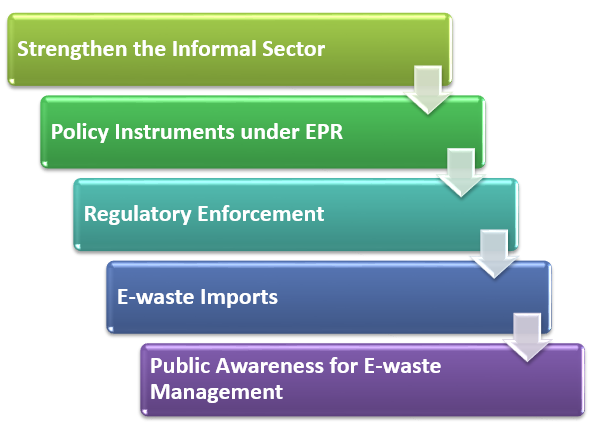
Strengthen the Informal Sector : The first step can be to more explicitly recognize the informal sector as the stakeholder in any future e-waste regime. Addressing the problem of informal sector e-waste practices requires a greater understanding of the sector itself in terms of its incentives and challenges. Engagement with informal sector workers and the groups, in a manner that recognizes the right of their livelihoods, builds trust, and develops an understanding of the problems along with potential solutions, can be an initial step. The government must institute a platform that facilitates consultations among various stakeholders like informal sector workers, NGOs working with the informal sector, third parties, private entities, and registered recyclers, and manufacturers. The forums can be constituted under the Ministry of Environment, Forest and Climate Change at a certain level under the State Department.
SUTHAHAR P
SUTHAHAR P 4 years 2 months ago
We are constantly evaluating the effectiveness of e-waste regulation and bringing in necessary changes. The government plays an important role in bringing together various stakeholders in a system. We have a few measures that can be considered to move forward.
mygov_164420855350710931
SUTHAHAR P
SUTHAHAR P 4 years 2 months ago
The composition of e-waste is changing rapidly due to the new electronic devices to enter the market. It requires significant investment in research & development for innovative recycling methods and technologies for future-proofing India’s e-waste policies and management. For example, smartphones usage has expanded dramatically in India over the past five years, but any e-waste recycling rules do not yet cover the lithium-ion batteries that power the devices.
SUTHAHAR P
SUTHAHAR P 4 years 2 months ago
The Indian government can also expand formal e-waste recycling capacity by co-funding infrastructure upgrades and processing systems at existing government-approved recycling centers. It can provide co-funding incentives to governments for setting up new recycling units through public-private partnerships with large e-waste companies. State governments could also develop grant schemes for incentivizing small-scale, informal e-waste recycling centers to upgrade the facilities so that they comply with them both environmental and occupational health and safety regulations. States can apply for national urban development funding schemes, which can be used to link the well-established informal sector network of decentralized collection and small recycling units with large-scale industrial recycling centers.
SUTHAHAR P
SUTHAHAR P 4 years 2 months ago
The Indian Government has introduced a point-based reward system of E-waste Recycling Credits (ERCs) for formal organizations to incentivize them to channel their e-waste through government-approved recycling centers. The E-Waste Rules already classify and code e-waste like laptops, computers, and mobile phones. These categories have to be correlated at different ERC reward levels. Depending on the type of e-waste supplied, organizations must earn the requisite ERCs that can be used to offset energy utility bills. Such an initiative will also provide a strong incentive for informal sector e-waste businesses to formalize the operations and establish supply chain links with approved recycling centers.
SUTHAHAR P
SUTHAHAR P 4 years 2 months ago
The ERCs can be piloted over a 3 to 5 years period to assess the efficacy and to fine-tune for further implementation. The government and industrial sectors in metropolitan cities generate more than 70 % of e-waste. The ERCs can be trialed with a few large industries and government organizations in Mumbai, Delhi, or Bangalore.
SUTHAHAR P
SUTHAHAR P 4 years 2 months ago
The regulations must also specify, elaborate standards and processes for other entities for dismantlers, collectors, recyclers, and bulk consumers and required the agencies to enforce compliance with specific standards. The regulatory authorities must capture benefit from poor enforcement, lack of transparency, unwillingness to publicly share information on compliance and regulatory actions. It has long afflicted environmental regulatory enforcement in India, and e-waste regulations are no exception. It poses the significant public policy challenge to the future of e-waste management in India.
SUTHAHAR P
SUTHAHAR P 4 years 2 months ago
The inability to reliably source e-waste quantities create economies of scale restricts the entry of private players to set up e-waste management systems in a formal sector. For instance, employing effective recycling technologies for e-waste management in India may require significant upfront capital expenditures, which cannot be justified for private entities in the absence of certainty about sourcing enough quantities of e-waste. Also, these markets suffer from information barriers.
SUTHAHAR P
SUTHAHAR P 4 years 2 months ago
Several cities have very few dedicated collection depots or formal recycling centres where consumers can voluntarily drop-off the e-waste. The majority of people and urban household consumers used to sell e-waste or get some discount in exchange when they purchase any new electrical or electronic products from small-scale retail shops. Since consumers lack market information about prices for e-waste and various e-waste components, they have few financial incentives for responsibly disposing of their e-waste.
SUTHAHAR P
SUTHAHAR P 4 years 2 months ago
India has very limited infrastructure capacity for large-scale management of e-waste. There are very few governments approved e-waste recycling centers in the country, which only constitutes about 1/5th of the total amount of e-waste generated each year. The Indian Government offers the co-funded grant scheme that covers between 25% to 50% of the project costs for the e-waste management facilities and building capacity for e-waste businesses. However, the uptake of this scheme has been very limited. In addition, there is also a shortage of formally approved e-waste recycling centers as presently existing centers operate far below their capacity due to poorly organized supply chains between them and the majority of informal sector collectors of e-waste in India.