Government of IndiaGOVERNMENT OF INDIA
Skip to main content
हिन्दी language
  • English
  • हिन्दी
Accessibility
Accessibility Tools
Color Adjustment
Text Size
Navigation Adjustment
Screen Reader iconScreen Reader
MyGov Twitter
MyGov Facebook
MyGov Youtube
MyGov Instagram
MyGov Linkedin
MyGov Whatsapp
Meri Sarkar Logo

Recent Searches

      Close

      शामिल हों

      • समूह
      • कार्य
      • चर्चा करें
      • जनमत/सर्वेक्षण
      • ब्लॉग
      • वार्ता
      • क्विज़
      • MG प्राइम
      • अभियान
      • शपथ
      • पॉडकास्ट
      • मीडिया
      • पत्रिकाएँ

      माईगव राज्य

      • अंडमान-निकोबार द्वीप समूह
      • अरूणाचल प्रदेश
      • असम
      • चंडीगढ़
      • छत्तीसगढ़
      • दादरा और नगर हवेली और दमन और दीव
      • गोवा
      • गुजरात
      • हरियाणा
      • हिमाचल प्रदेश
      • जम्मू और कश्मीर
      • झारखण्‍ड
      • कर्नाटक
      • लद्दाख
      • मध्‍य प्रदेश
      • महाराष्ट्र
      • मणिपुर
      • मिजोरम
      • नागालैण्‍ड
      • राजस्थान
      • तमिलनाडु
      • त्रिपुरा
      • उत्तर प्रदेश
      • उत्तराखंड
      • लक्षद्वीप
      • ओडिशा
      • पुडुचेरी
      • सिक्किम

      माइक्रोसाइट्स

      • ब्लॉग
      • कैंपस
      • इनोवेट इंडिया
      • शपथ
      • क्विज़
      • साथी
      • सेल्फ4सोसायटी
      • ट्रांसफॉर्मिंग इंडिया
      • PM इवेंट्स

      जानें

      • माईगव: अवलोकन
      • माईगव से संबद्ध करें
      • माईगव के साथ काम करें
      • सर्कुलर
      • पल्स न्यूजलेटर
      • टेंडर्स
      • साप्ताहिक समाचार पत्र
      • Meity डैशबोर्ड
      • सेक्टर्स
      • कौशल
      • रूचि के क्षेत्र
      • आयु वर्ग
      • राष्ट्रीय कार्यक्रम
      • आर्काइव साइट्स

      मदद/प्रतिक्रिया

      • संपर्क करें
      • FAQ
      • प्रतिक्रिया
      • मदद
      • हमसे जुड़ें
      • सार्वजनिक शिकायत
      • साइट मैप
      • नियम एवं शर्तें
      • आधार का इस्तेमाल
      • वेब सूचना प्रबंधक
      • ICC
      • MyGov सोशल
      • पॉइंट्स और बैज्स
      • वेबसाइट की पॉलिसी
      user-profile
      Together, Let's Engage In Good Governance 
      Login/Register
      1. Home
      2. Discuss
      3. Inviting Ideas for Next Phase of Rural Sanitation
      Facebook X
      Inviting Ideas for Next Phase of Rural Sanitation
      प्रारंभ तिथि 01/08/2026 - 11:49
      अंतिम तिथि 02/10/2026 - 23:45
      Time zone: IST (GMT +5.30 Hrs)
      Login to Participate
      क्षेत्र:
      Water & Sanitation
      Created : 1/08/2026
      608
      Total Comments
      442
      Users Participated

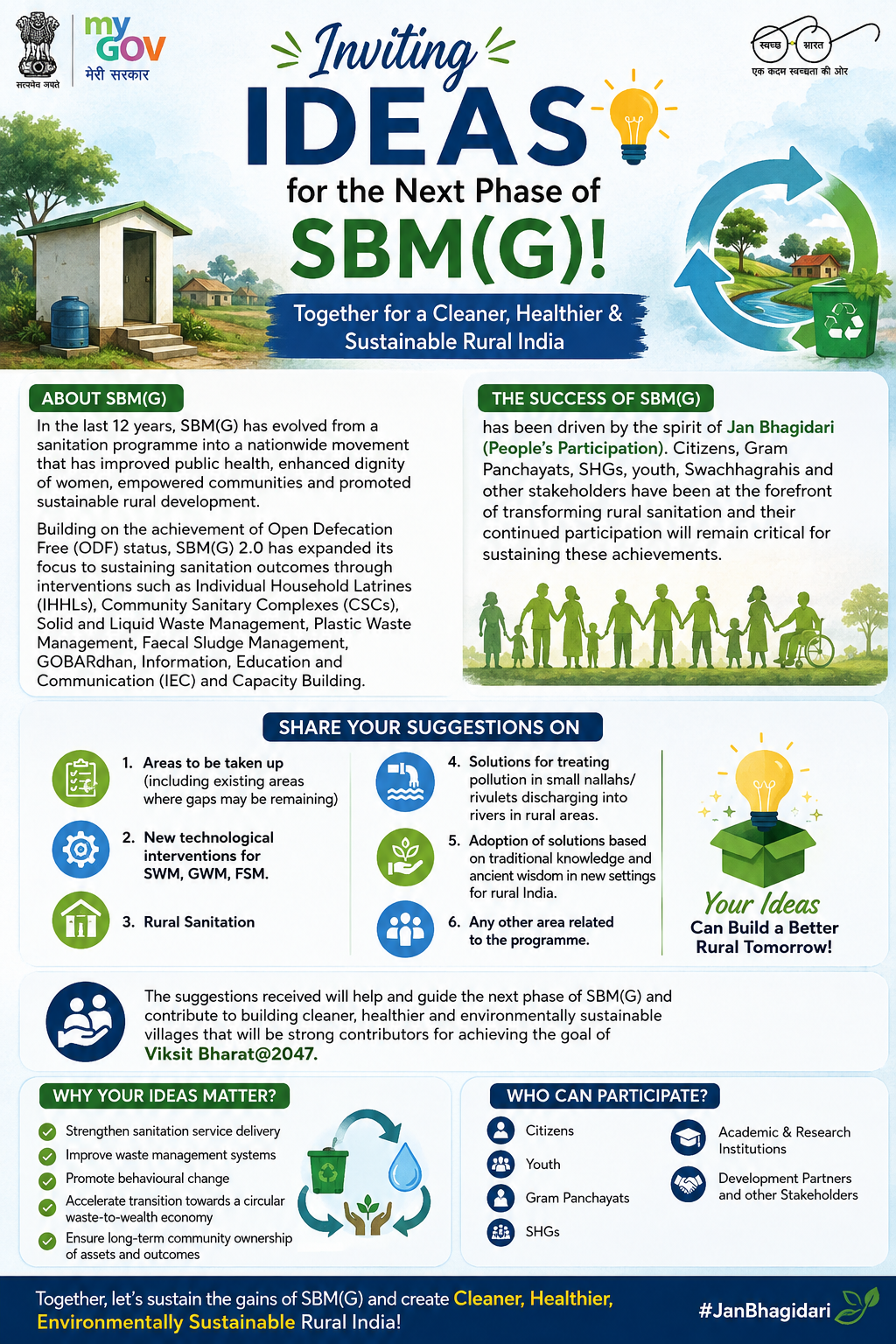
      In the last 12 years, SBM(G) has evolved from a sanitation programme into a nationwide movement that has improved public health, enhanced dignity of women, empowered communities and promoted sustainable rural development. Building on the achievement of Open Defecation Free (ODF) status, SBM(G) 2.0 has expanded its focus to sustaining sanitation outcomes through interventions such as Individual Household Latrines (IHHLs), Community Sanitary Complexes (CSCs), Solid and Liquid Waste Management, Plastic Waste Management, Faecal Sludge Management, GOBARdhan, Information, Education and Communication (IEC) and Capacity Building. The current phase of the Mission is scheduled to conclude in March 2027.

      As the Department prepares the roadmap for the next phase of rural sanitation, it seeks ideas from citizens to sustain and strengthen the gains achieved under SBM(G) while addressing emerging challenges related to waste management, resource recovery, environmental sustainability, Operation & Maintenance (O&M) and long-term community ownership of assets and outcomes. Innovative, practical and scalable solutions are required to enhance sanitation service delivery, strengthen waste management systems, promote behavioural change and accelerate the transition towards a circular waste-to-wealth economy. Given that the diversities of rural areas from urban cities, suggestions and ideas, specific to rural scenarios will be highly appreciated. Along with these, with peri-urban areas / villages also growing fast and having characteristics of urban centers, solutions specific for such areas are also being sought.

      The success of SBM(G) has been driven by the spirit of Jan Bhagidari (People's Participation). Citizens, Gram Panchayats, SHGs, youth, Swachhagrahis and other stakeholders have been at the forefront of transforming rural sanitation and their continued participation will remain critical for sustaining these achievements. 

      Accordingly, the Department of Drinking Water and Sanitation (DDWS), Ministry of Jal Shakti in collaboration with MyGov, invites citizens, youth, Gram Panchayats, SHGs, academic and research institutions, development partners and other stakeholders to share their suggestions and ideas for the next phase of rural sanitation programme on the following:

      1. Areas to be taken up (including existing areas where gaps may be remaining)
      2. New technological interventions for SWM, GWM, FSM.
      3. Rural Sanitation 
      4. Solutions for treating pollution in small nallahs/rivulets discharging into rivers in rural areas.
      5. Adoption of solutions based on traditional knowledge and ancient wisdom in new settings for rural India. 
      6. Any other area related to the programme.

      The suggestions received will help and guide the next phase of SBM(G) and contribute to building cleaner, healthier and environmentally sustainable villages that will be strong contributors for achieving the goal of Viksit Bharat@2047.

      Participation Guidelines 

      1. All Citizens, youth (including students), Gram Panchayats & SHGs, academic and research institutions, development partners, NGOs and other stakeholders are invited to contribute ideas for shaping the next phase of rural sanitation and solid-liquid waste management under Swachh Bharat Mission (Grameen).
      2. For detailed information about SBM(G) Phase II, applicants may visit the SBM(G) Phase II operational guidelines available on website of the Department (https://swachhbharatmission.ddws.gov.in). The guidelines can also be assessed through: https://swachhbharatmission.ddws.gov.in/sites/default/files/Guidelines/SBMG%20Phase-II%20Operational%20Guidelines.pdf 
      3. Suggestions may be submitted on any of the major components of SBM(G), including Individual Household Latrines (IHHLs), Community Sanitary Complexes (CSCs), Solid Waste Management, Liquid Waste Management, Plastic Waste Management, GOBARdhan, Faecal Sludge Management, Information, Education and Communication (IEC) and Capacity Building. Global best practices forming the bases of solution, may also duly mentioned and referred.
      4. Participants are encouraged to propose innovative, technology-driven, scientific, managerial, practical, feasible and scalable solutions to address rural sanitation challenges and strengthen long-term sustainability.
      5. Suggestions should focus on supporting the Department of Drinking Water and Sanitation (DDWS), Ministry of Jal Shakti, in developing the roadmap for the next phase of rural sanitation for India.
      6. Participants are required to register on the MyGov platform and submit their suggestions through the prescribed online form.

      Rishita Chaudhary_1
      Rishita Chaudhary_1
      3 weeks 2 days ago

      “Clean water is not a luxury, it is a basic human right.” Safe and affordable water is essential for health and dignity. Health ka direct connection: Contaminated water aur poor sanitation se diarrhoea, cholera, typhoid, hepatitis A jaise diseases spread hote hain. Sanitation = disease prevention: Sirf hospital banane se health improve nahi hogi; disease ko prevent karne ke liye clean water, toilets aur hygiene equally important hain. Women ki dignity aur safety: Ghar ke paas water supply aur toilets hone se women ko long distances travel karke water collect karne ya open defecation ka risk kam hota hai. Jal Jeevan Mission specifically women ko water-fetching ki daily burden se free karne ka objective rakhta hai. Government initiatives ka strong example: Jal Jeevan Mission rural households ko functional tap-water connections provide karne par focus karta hai, while Swachh Bharat Mission-Grameen sanitation aur ODF Plus villages par focus karta hai.

      Like 3
      Dislike 0
      • Reply
      Facebook X
      Ravikesh kumar_7
      Ravikesh kumar
      3 weeks 2 days ago

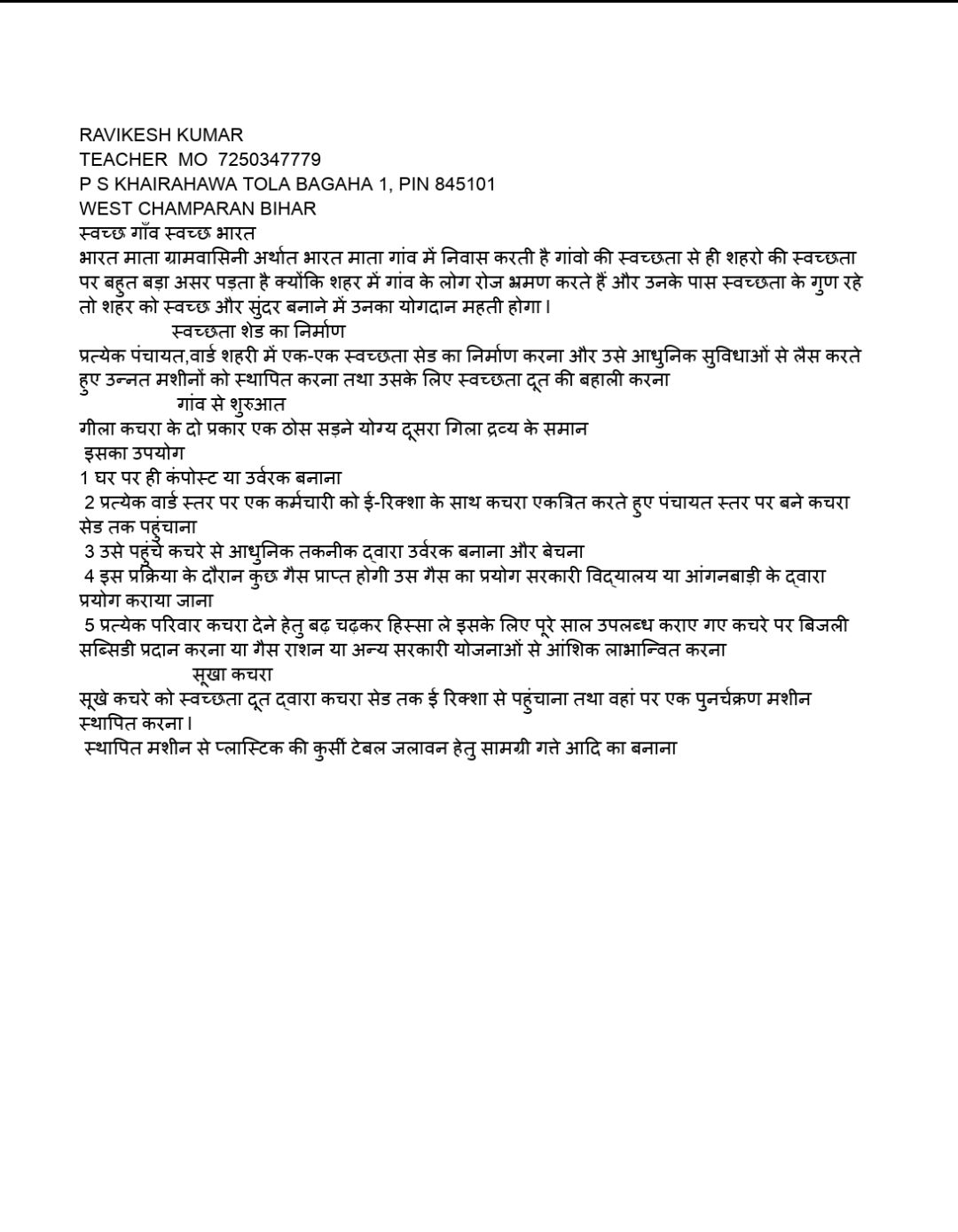
      RAVIKESH KUMAR TEACHER P S KHAIRAHAWA TOLA BAGAHA 1, PIN 845101 WEST CHAMPARAN BIHAR स्वच्छ गाँव स्वच्छ भारत भारत माता ग्रामवासिनी अर्थात भारत माता गांव में निवास करती है गांवो की स्वच्छता से ही शहरो की स्वच्छता पर बहुत बड़ा असर पड़ता है क्योंकि शहर में गांव के लोग रोज भ्रमण करते हैं और उनके पास स्वच्छता के गुण रहे तो शहर को स्वच्छ और सुंदर बनाने में उनका योगदान महती होगा l स्वच्छता शेड का निर्माण प्रत्येक पंचायत,वार्ड शहरी में एक-एक स्वच्छता सेड का निर्माण करना और उसे आधुनिक सुविधाओं से लैस करते हुए उन्नत मशीनों को स्थापित करना तथा उसके लिए स्वच्छता दूत की बहाली करना गांव से शुरुआत गीला कचरा के दो प्रकार एक ठोस सड़ने योग्य दूसरा गिला द्रव्य के समान इसका उपयोग 1 घर पर ही कंपोस्ट या उर्वरक बनाना 2 प्रत्येक वार्ड स्तर पर एक कर्मचारी को ई-रिक्शा के साथ कचरा एकत्रित करते हुए पंचायत स्तर पर बने कचरा सेड तक पहुंचाना 3 उसे पहुंचे कचरे से आधुनिक तकनीक द्वारा उर्वरक बनाना और बेचना 4 इस प्रक्रिया के दौरान कुछ गैस प्राप्त होगी उस गैस का प्रयोग

      comments image 184583
      Like 4
      Dislike 0
      • Reply
      Facebook X
      NilamaniPradhan_13
      NilamaniPradhan_13
      3 weeks 2 days ago

      Nivitingi ideas for next phese

      Like 4
      Dislike 0
      • Reply
      Facebook X
      DrMdAksarAli
      DR MD AKSAR ALI
      3 weeks 2 days ago

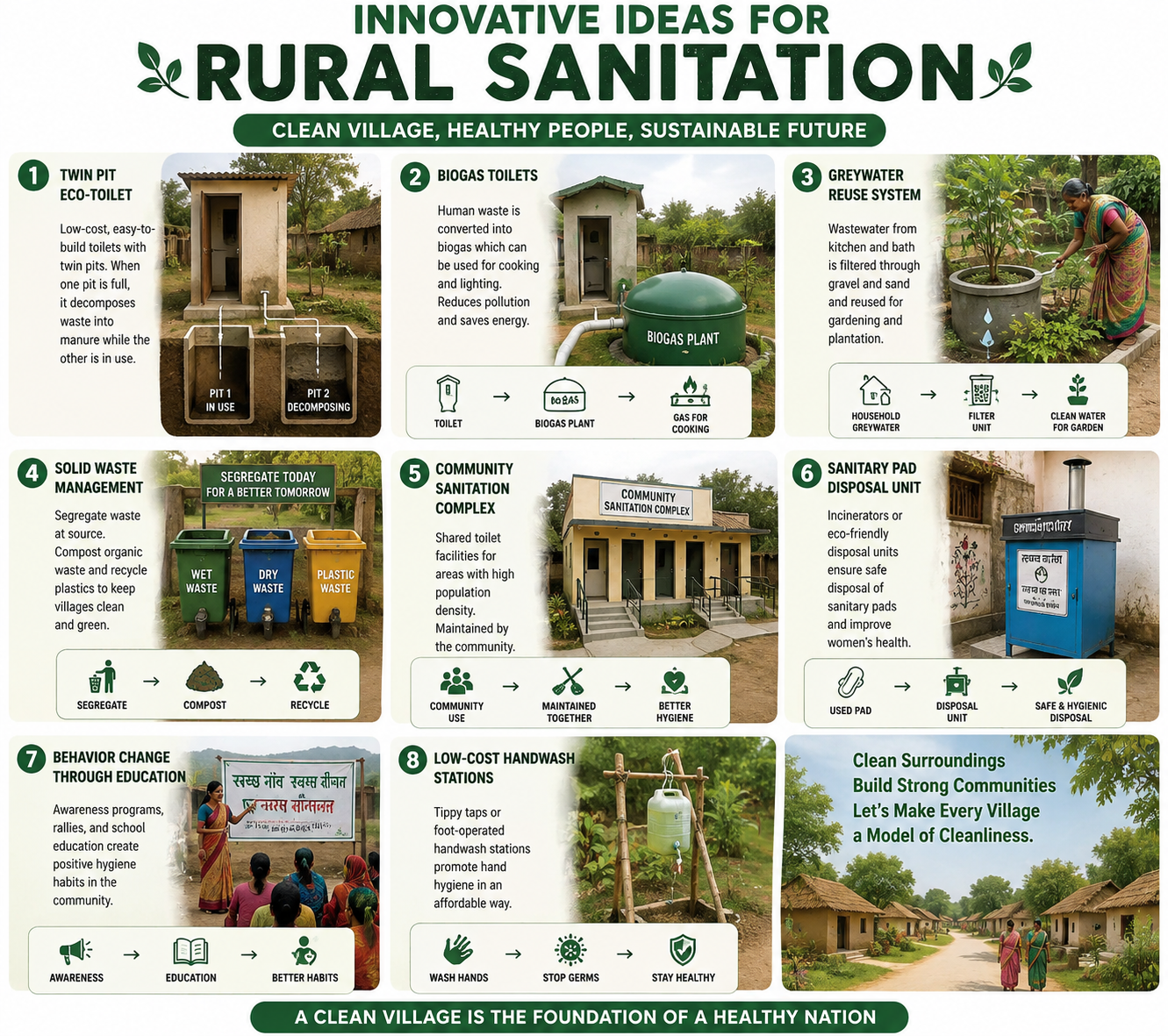
      Certainly. These ideas can be developed into a practical rural sanitation model where sanitation is linked with health, waste management, water conservation, energy. 1. Twin-Pit-Toilet A twin-pit toilet has two alternating pits. One pit is used while the other remains closed and decomposes the waste. How it works: Toilet waste enters Pit 1. When Pit 1 becomes full, the flow is diverted to Pit 2. Pit 1 is left undisturbed for sufficient time so the contents decompose. The decomposed material can be safely handled according to local health and sanitation guidance. Advantages: Low cost, requires relatively little water, reduces the need for frequent pit emptying, and is suitable for many rural households. 2. Biogas Toilet A biogas toilet connects human waste with a small anaerobic digester. works: Human waste enters the digester, where microorganisms break it down in the absence of oxygen and produce biogas. Uses: Biogas can pote

      comments image 184514
      Like 3
      Dislike 0
      • Reply
      Facebook X
      Mirreyyan
      Mirreyyan
      3 weeks 2 days ago

      💡 Smart & Sustainable Village Sanitation System My suggestion is to develop rural sanitation beyond the construction of toilets and make it a Smart, Sustainable and Community-Based Sanitation System. The next phase of SBM(G) should focus not only on maintaining Open Defecation Free (ODF) status but also on proper waste management, environmental protection, resource recovery, behavioural change and long-term community ownership. First, every household should be encouraged to separate wet and dry waste at source. Gram Panchayats should establish regular door-to-door waste collection systems. Wet waste can be converted into compost or biogas, while plastic, paper, metal and other recyclable materials can be separated and sent to recycling facilities. This will reduce the amount of waste going to open dumping areas and can also create useful resources and income opportunities. Every village can have a Waste Collection and Resource Recovery Centre where collected waste is sorted.

      comments image 184461
      Like 2
      Dislike 0
      • Reply
      Facebook X
      Rachna_2423
      Rachna_2423
      3 weeks 2 days ago

      Hi Team, Here are a few simple and effective ideas to make our villages cleaner and keep sanitation assets working for the long run: Cleaner Rivers & Nallahs: Use natural plant filtering system (like Vetiver grass beds) where village drains meet small rivers. This cleans the greywater naturally without needing expensive equipment or electricity. Better Toilet Maintenance: Put basic water-level sensors in public community toilets. When water runs low or something breaks, an automated message goes straight to the local Panchayat team for quick fixes. Turning Waste into Money: Mix treated toilet waste with daily kitchen/farm waste to make rich organic compost. Local Women Self-Help Groups (SHGs) can run these small composting units and sell the organic manure to nearby farmers. Fixing Traditional Water Bodies: Clean up and revive old village ponds with modern gravel and sand filters so wastewater doesn't overflow onto roads and can recharge ground water safely. Village Rewards etc

      (3.11 MB)
      Like 3
      Dislike 0
      • Reply
      Facebook X
      umakant.fulzele@gmail.com
      umakant.fulzele
      3 weeks 2 days ago

      I am writing as a concerned citizen with a humble suggestion regarding urban flood management in India. Recent extreme rainfall and flooding incidents in the region have once again highlighted how vulnerable our cities and infrastructure can be. These events made me think about whether we should look beyond conventional drainage expansion and consider more advanced, long-term flood-management infrastructure. I recently came across Japan's underground flood-control systems and was extremely impressed by the scale and engineering behind them. For example, Tokyo's Metropolitan Area Outer Underground Discharge Channel is a large underground system designed to collect and temporarily store excess stormwater during extreme rainfall and then safely discharge it into a major river. Let us move from repeatedly responding to urban floods to building cities that are prepared for them.

      comments image 184414 (3.74 MB)
      Like 2
      Dislike 1
      • Reply
      Facebook X
      Tinu_173
      Tinu_173
      3 weeks 2 days ago

      Rural sanitation is a big concern for our country. It should be shorted out very smartly .we can improve rural water sanitation by - providing clean drinking water through clean supply of water. building and maintaining toilets. treating wastewater before it enters into rivers. properly managing garbage by hiring workers who collect daily garbage . separating awareness about handwashing and keeping hygiene .The farmers will help India in becoming Atmanirbhar by becoming Atmanirbhar themselves. They could use the biogas to run electricity generators to power their villages, reducing their load on the national grid, or they can contribute to the national grid, increasing our Atmanirbharta.

      Like 4
      Dislike 0
      • Reply
      Facebook X
      atifhamad
      atifhamad
      3 weeks 2 days ago

      we can improve rural water sanitation by - providing clean drinking water through clean supply of water. building and maintaining toilets. treating wastewater before it enters into rivers. properly managing garbage by hiring workers who collect daily garbage . separating awareness about handwashing and keeping hygiene . government should fine people who put garbage in road and polluting the river water road etc. government have to take severe action to make our country clean .

      Like 3
      Dislike 0
      • Reply
      Facebook X
      kunal kishore_11
      kunal kishore
      3 weeks 2 days ago

      Rural sanitation is a big concern for our country. It should be shorted out very smartly. I want to give some suggestion for it. 1 social awareness should be started for aware rural people at mass level. 2 sanitation volunteer should be appointed in rural areas. 3 All panchayat representative should be given responsibility to achieve goal of sanitation. 4 A committee will be form at panchayat level to include local people as well as panchayat representative.

      Like 4
      Dislike 0
      • Reply
      Facebook X
      • First page « पहला
      • Previous page ‹ पिछला
      • …
      • पृष्ठ 10
      • पृष्ठ 11
      • पृष्ठ 12
      • पृष्ठ 13
      • Current page 14
      • पृष्ठ 15
      • पृष्ठ 16
      • पृष्ठ 17
      • पृष्ठ 18
      • …
      • Next page अगला ›
      • Last page आखरी »
      Please Log In to submit a comment.
      शामिल हों
      • समूह
      • कार्य
      • चर्चा करें
      • ब्लॉग
      • जनमत/सर्वेक्षण
      • वार्ता
      • क्विज़
      • MG प्राइम
      • अभियान
      • शपथ
      • पॉडकास्ट
      • मीडिया
      • पत्रिकाएँ
      जानें
      • माईगव: अवलोकन
      • माईगव से संबद्ध करें
      • माईगव के साथ काम करें
      • सर्कुलर
      • पल्स न्यूजलेटर
      • टेंडर्स
      • साप्ताहिक समाचार पत्र
      • MeitY Dashboard
      • सेक्टर्स
      • कौशल
      • रूचि के क्षेत्र
      • आयु वर्ग
      • राष्ट्रीय कार्यक्रम
      • आर्काइव साइट्स
      सहायता और समर्थन
      • संपर्क करें
      • FAQ
      • प्रतिक्रिया
      • मदद
      • हमसे जुड़ें
      • सार्वजनिक शिकायत
      • साइट मैप
      • नियम एवं शर्तें
      • आधार का इस्तेमाल
      • वेब सूचना प्रबंधक
      • ICC
      • MyGov सोशल
      • पॉइंट्स और बैज्स
      • वेबसाइट की पॉलिसी
      उपयोगी लिंक्स
      • MyGov Quiz MyGov Quiz
      • Transforming India ट्रांसफॉर्मिंग इंडिया
      • MyGov Innovation माईगव इनोवेशन
      • MyGov Pledge माईगव संकल्प
      • MyGov Blog माईगव ब्लॉग
      • Self4Society सेल्फ4सोसायटी
      • Campus Program कैंपस कार्यक्रम
      • MyGov Saathi साथी
      Follow us
      Twitter Twitter 33.11 + Lakh Followers Facebook Facebook 15.14 + Lakh Followers Instagram Instagram 30.73 + Lakh Followers YouTube YouTube 7.43 + Lakh Subscribers LinkedIn LinkedIn 1.63 + Lakh Followers Messenger Messenger 1.60 + Lakh Followers WhatsApp WhatsApp 910.05 + Lakh Followers DailyHunt DailyHunt 7.2 + K Followers Public Public 85.5 + K Followers ShareChat ShareChat 82.22K Followers Snapchat Snapchat View All
      QR Code

      Download the MyGov Mobile App Join us in building a New India on the move.

      App Store Play Store
      NIC logo

      © Content owned, updated and maintained by the MyGov Cell. This website belongs to MyGov, Ministry of Electronics & Information Technology, Government of India.
      Platform is designed, developed and hosted by National Informatics Centre.

      CQW - MyGov certificateCertified Quality Website
      • Meity
      • Digital India
      • National Portal of India
      • Data Portal

      Copyright © MyGov 2014

      secure-1 - Last Updated: September 22, 2026
      Top
      This website uses cookies to provide a better user experience.
      By clicking accept, you agree to the policies outlined in the Cookie Settings.