Government of IndiaGOVERNMENT OF INDIA
मुख्य सामग्री छोड़ें
हिन्दी language
  • English
  • हिन्दी
Accessibility
Accessibility Tools
Color Adjustment
Text Size
Navigation Adjustment
Screen Reader iconScreen Reader
MyGov Twitter
MyGov Facebook
MyGov Youtube
MyGov Instagram
MyGov Linkedin
MyGov Whatsapp
Meri Sarkar Logo

Recent Searches

      Close

      शामिल हों

      • समूह
      • कार्य
      • चर्चा करें
      • जनमत/सर्वेक्षण
      • ब्लॉग
      • वार्ता
      • क्विज़
      • MG प्राइम
      • अभियान
      • शपथ
      • पॉडकास्ट
      • मीडिया
      • पत्रिकाएँ

      माईगव राज्य

      • अंडमान-निकोबार द्वीप समूह
      • अरूणाचल प्रदेश
      • असम
      • चंडीगढ़
      • छत्तीसगढ़
      • दादरा और नगर हवेली और दमन और दीव
      • गोवा
      • गुजरात
      • हरियाणा
      • हिमाचल प्रदेश
      • जम्मू और कश्मीर
      • झारखण्‍ड
      • कर्नाटक
      • लद्दाख
      • मध्‍य प्रदेश
      • महाराष्ट्र
      • मणिपुर
      • मिजोरम
      • नागालैण्‍ड
      • राजस्थान
      • तमिलनाडु
      • त्रिपुरा
      • उत्तर प्रदेश
      • उत्तराखंड
      • लक्षद्वीप
      • ओडिशा
      • पुडुचेरी
      • सिक्किम

      माइक्रोसाइट्स

      • ब्लॉग
      • कैंपस
      • इनोवेट इंडिया
      • शपथ
      • क्विज़
      • साथी
      • सेल्फ4सोसायटी
      • ट्रांसफॉर्मिंग इंडिया
      • PM इवेंट्स

      जानें

      • माईगव: अवलोकन
      • माईगव से संबद्ध करें
      • माईगव के साथ काम करें
      • सर्कुलर
      • पल्स न्यूजलेटर
      • टेंडर्स
      • साप्ताहिक समाचार पत्र
      • Meity डैशबोर्ड
      • सेक्टर्स
      • कौशल
      • रूचि के क्षेत्र
      • आयु वर्ग
      • राष्ट्रीय कार्यक्रम
      • आर्काइव साइट्स

      मदद/प्रतिक्रिया

      • संपर्क करें
      • FAQ
      • प्रतिक्रिया
      • मदद
      • हमसे जुड़ें
      • सार्वजनिक शिकायत
      • साइट मैप
      • नियम एवं शर्तें
      • आधार का इस्तेमाल
      • वेब सूचना प्रबंधक
      • ICC
      • MyGov सोशल
      • पॉइंट्स और बैज्स
      • वेबसाइट की पॉलिसी
      user-profile
      Together, Let's Engage In Good Governance 
      Login/Register
      1. Home
      2. Discuss
      3. Inviting Ideas for Next Phase of Rural Sanitation

      Inviting Ideas for Next Phase of Rural Sanitation

      Facebook X
      Inviting Ideas for Next Phase of Rural Sanitation
      प्रारंभ तिथि 01/08/2026 - 11:49
      अंतिम तिथि 02/10/2026 - 23:45
      Time zone: IST (GMT +5.30 Hrs)
      Login to Participate
      क्षेत्र:
      Water & Sanitation
      Created : 1/08/2026
      515
      Total Comments
      364
      Users Participated

      In the last 12 years, SBM(G) has evolved from a sanitation programme into a nationwide movement that has improved public health, enhanced dignity of women, empowered communities and promoted sustainable rural development. Building on the achievement of Open Defecation Free (ODF) status, SBM(G) 2.0 has expanded its focus to sustaining sanitation outcomes through interventions such as Individual Household Latrines (IHHLs), Community Sanitary Complexes (CSCs), Solid and Liquid Waste Management, Plastic Waste Management, Faecal Sludge Management, GOBARdhan, Information, Education and Communication (IEC) and Capacity Building. The current phase of the Mission is scheduled to conclude in March 2027.

      As the Department prepares the roadmap for the next phase of rural sanitation, it seeks ideas from citizens to sustain and strengthen the gains achieved under SBM(G) while addressing emerging challenges related to waste management, resource recovery, environmental sustainability, Operation & Maintenance (O&M) and long-term community ownership of assets and outcomes. Innovative, practical and scalable solutions are required to enhance sanitation service delivery, strengthen waste management systems, promote behavioural change and accelerate the transition towards a circular waste-to-wealth economy. Given that the diversities of rural areas from urban cities, suggestions and ideas, specific to rural scenarios will be highly appreciated. Along with these, with peri-urban areas / villages also growing fast and having characteristics of urban centers, solutions specific for such areas are also being sought.

      The success of SBM(G) has been driven by the spirit of Jan Bhagidari (People's Participation). Citizens, Gram Panchayats, SHGs, youth, Swachhagrahis and other stakeholders have been at the forefront of transforming rural sanitation and their continued participation will remain critical for sustaining these achievements. 

      Accordingly, the Department of Drinking Water and Sanitation (DDWS), Ministry of Jal Shakti in collaboration with MyGov, invites citizens, youth, Gram Panchayats, SHGs, academic and research institutions, development partners and other stakeholders to share their suggestions and ideas for the next phase of rural sanitation programme on the following:

      1. Areas to be taken up (including existing areas where gaps may be remaining)
      2. New technological interventions for SWM, GWM, FSM.
      3. Rural Sanitation 
      4. Solutions for treating pollution in small nallahs/rivulets discharging into rivers in rural areas.
      5. Adoption of solutions based on traditional knowledge and ancient wisdom in new settings for rural India. 
      6. Any other area related to the programme.

      The suggestions received will help and guide the next phase of SBM(G) and contribute to building cleaner, healthier and environmentally sustainable villages that will be strong contributors for achieving the goal of Viksit Bharat@2047.

      Participation Guidelines 

      1. All Citizens, youth (including students), Gram Panchayats & SHGs, academic and research institutions, development partners, NGOs and other stakeholders are invited to contribute ideas for shaping the next phase of rural sanitation and solid-liquid waste management under Swachh Bharat Mission (Grameen).
      2. For detailed information about SBM(G) Phase II, applicants may visit the SBM(G) Phase II operational guidelines available on website of the Department (https://swachhbharatmission.ddws.gov.in). The guidelines can also be assessed through: https://swachhbharatmission.ddws.gov.in/sites/default/files/Guidelines/SBMG%20Phase-II%20Operational%20Guidelines.pdf 
      3. Suggestions may be submitted on any of the major components of SBM(G), including Individual Household Latrines (IHHLs), Community Sanitary Complexes (CSCs), Solid Waste Management, Liquid Waste Management, Plastic Waste Management, GOBARdhan, Faecal Sludge Management, Information, Education and Communication (IEC) and Capacity Building. Global best practices forming the bases of solution, may also duly mentioned and referred.
      4. Participants are encouraged to propose innovative, technology-driven, scientific, managerial, practical, feasible and scalable solutions to address rural sanitation challenges and strengthen long-term sustainability.
      5. Suggestions should focus on supporting the Department of Drinking Water and Sanitation (DDWS), Ministry of Jal Shakti, in developing the roadmap for the next phase of rural sanitation for India.
      6. Participants are required to register on the MyGov platform and submit their suggestions through the prescribed online form.
      BrahmDevYadav_2
      BrahmDevYadav
      3 weeks 5 days ago

      How to solve sanitation problems? These efforts can include the construction of clean and safe bathrooms. Often the solution is a latrine that can function without the existence of any municipal sewage treatment infrastructure. Outreach employs a process that enables the people living with unsafe water to solve the issue themselves.

      Like 1
      Dislike 0
      • Reply
      Facebook X
      BrahmDevYadav_2
      BrahmDevYadav
      3 weeks 5 days ago

      What are the challenges and solutions for sustainable urban waste management? 1. Significant Waste Generation. 2. Space Constraints and Lack of Infrastructure. 3. Excessive Non-Biodegradable Waste Generation. 4. Waste Reduction and Prevention at Source. 5. Landfill Reduction and Diversion. 6. Leveraging Technology and Innovative Waste Collection Systems.

      Like 1
      Dislike 0
      • Reply
      Facebook X
      BrahmDevYadav_2
      BrahmDevYadav
      3 weeks 5 days ago

      What is the most sustainable way to improve sanitation in our community? Promotion of practices that can prevent transmission of the pathogens that cause diarrheal diseases is therefore hugely important. These practices include handwashing with soap, proper handling of food and water purification.

      Like 1
      Dislike 0
      • Reply
      Facebook X
      BrahmDevYadav_2
      BrahmDevYadav
      3 weeks 5 days ago

      How to improve sanitation in rural areas? primary health care and improvement in rural sanitation requires building proper facilities, shifting community habits, and ensuring long-term maintenance.

      Like 1
      Dislike 0
      • Reply
      Facebook X
      BrahmDevYadav_2
      BrahmDevYadav
      3 weeks 5 days ago

      सामुदायिक सहभागिता और व्यवहार परिवर्तन:- 1. सतत सामाजिक लामबंदी:- स्थानीय अग्रिम पंक्ति के कार्यकर्ताओं और स्वयंसेवकों (जैसे स्वच्छग्राही) को निरंतर पारस्परिक संचार के लिए तैनात करके एक बार के जागरूकता अभियानों से आगे बढ़ें। 2. विद्यालय और युवा कार्यक्रम: स्वच्छता क्लबों और स्वच्छता-केंद्रित गतिविधियों के माध्यम से ग्रामीण विद्यालयों और युवा समूहों को शामिल करें ताकि बच्चों में जीवन भर के लिए स्वच्छता की आदतें बचपन से ही विकसित हो सकें। 3. प्रोत्साहन मॉडल: उच्च प्रदर्शन करने वाले गांवों को सार्वजनिक और वित्तीय रूप से पुरस्कृत करें ताकि सामूहिक गौरव की भावना और समुदाय के स्थायी स्वामित्व को बढ़ावा मिल सके।

      Like 1
      Dislike 0
      • Reply
      Facebook X
      Pallavi_6957
      Pallavi_6957
      3 weeks 5 days ago

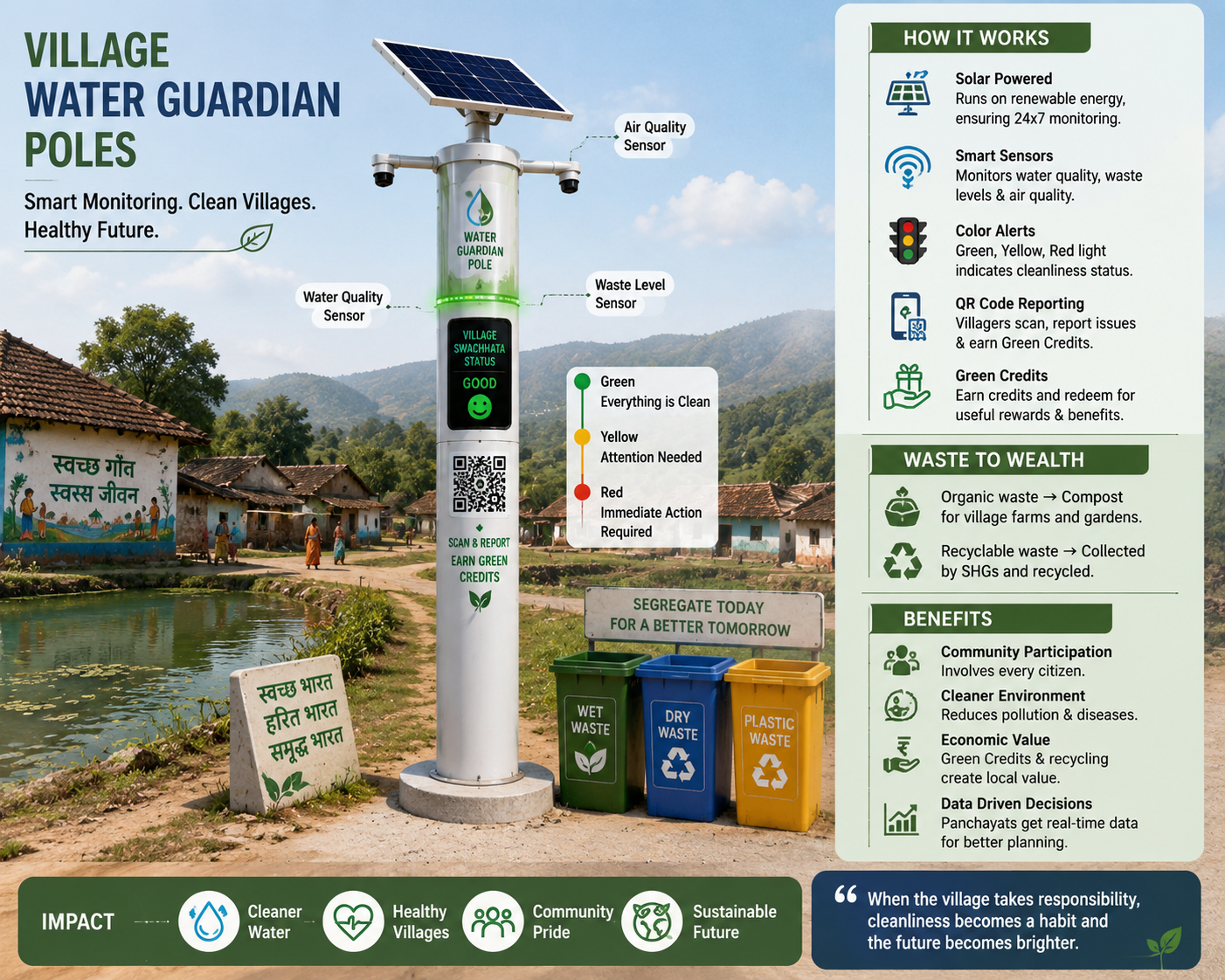
      I propose a Village Resource Passport system that gives every household a QR code linked to waste segregation, composting, water conservation, and cleanliness activities. Smart collection points scan the QR code when properly sorted waste is deposited. Families earn Green Credits that can be exchanged for public services, school supplies, tree saplings, or local market discounts. The Panchayat dashboard tracks participation, identifies gaps, and plans collections efficiently. Organic waste becomes compost for community farms, while recyclable materials support village enterprises. Monthly neighborhood challenges, school eco clubs, and self help groups encourage continuous participation. Offline functionality ensures access without reliable internet. This low cost, scalable model combines technology, transparency, behavioral change, and community ownership to strengthen sanitation, reduce pollution, improve livelihoods, and build cleaner, healthier, self reliant villages. For all. Toget

      comments image 160007
      Like 1
      Dislike 0
      • Reply
      Facebook X
      BrahmDevYadav_2
      BrahmDevYadav
      3 weeks 5 days ago

      2. संचालन एवं रखरखाव (ओ एंड एम) निधि:- निरंतर मरम्मत कार्यों को कवर करने के लिए मामूली, समुदाय द्वारा सहमत उपयोगकर्ता शुल्क और प्रदर्शन-आधारित सरकारी अनुदानों द्वारा समर्थित स्थानीय रखरखाव निधि स्थापित करें। 3. डिजिटल ट्रैकिंग डैशबोर्ड:- कार्यात्मक बुनियादी ढांचे की निगरानी करने, मशीनीकृत गाद निकालने की प्रक्रिया को शेड्यूल करने और वास्तविक समय में स्वच्छता संबंधी मेट्रिक्स को ट्रैक करने के लिए मोबाइल ऐप और जीपीएस-टैग वाली संपत्तियों का उपयोग करें।

      Like 1
      Dislike 0
      • Reply
      Facebook X
      BrahmDevYadav_2
      BrahmDevYadav
      3 weeks 5 days ago

      3. अपशिष्ट से धन सृजन की पहल:- सामुदायिक स्तर के संयंत्रों (जैसे कि गोबर्धन पद्धति) के माध्यम से घरेलू और पशु अपशिष्ट को बायोगैस और जैविक खाद में परिवर्तित करना, और प्लास्टिक कचरे को पुन: प्रयोज्य सामग्रियों में संसाधित करना। स्थानीय शासन और वित्त को सुदृढ़ बनाना:- 1. स्थानीय निकायों को सशक्त बनाना:- समर्पित ग्राम स्वच्छता सततता योजनाओं के माध्यम से स्थानीय स्वच्छता संसाधनों की योजना बनाने, संचालन करने और निगरानी करने के लिए ग्राम परिषदों (ग्राम पंचायतों) को प्रशिक्षित और संसाधन उपलब्ध कराना।

      Like 1
      Dislike 0
      • Reply
      Facebook X
      BrahmDevYadav_2
      BrahmDevYadav
      3 weeks 5 days ago

      विकेंद्रीकृत अपशिष्ट और मल प्रबंधन:- 1. मल कीचड़ प्रबंधन:- एकल-गड्ढे और सेप्टिक-टैंक प्रणालियों से अपशिष्ट को सुरक्षित रूप से एकत्र करने, परिवहन करने और उपचारित करने के लिए क्लस्टर-स्तर या कम लागत वाले मल कीचड़ उपचार संयंत्रों का निर्माण करें। 2. असंतृप्त जल और अपशिष्ट जल का पुन: उपयोग:- घरेलू असंतृप्त जल को अलग करें और स्थिर जल संचयन और पर्यावरणीय प्रदूषण को रोकने के लिए स्थिरीकरण तालाब, निर्मित आर्द्रभूमि और सोख गड्ढे जैसे कम लागत वाले प्रकृति-आधारित समाधानों का उपयोग करें।

      Like 1
      Dislike 0
      • Reply
      Facebook X
      BrahmDevYadav_2
      BrahmDevYadav
      3 weeks 5 days ago

      ग्रामीण स्वच्छता संबंधी चुनौतियों का समाधान करने और दीर्घकालिक स्थिरता सुनिश्चित करने के लिए केवल बुनियादी शौचालय बनाने पर ध्यान केंद्रित करने के बजाय व्यापक अपशिष्ट प्रबंधन, निरंतर व्यवहार सुदृढ़ीकरण, विकेंद्रीकृत तकनीकी मॉडल और मजबूत स्थानीय शासन को लागू करने परध्यान केंद्रित करना आवश्यक है ।

      Like 1
      Dislike 0
      • Reply
      Facebook X
      • First page « पहला
      • Previous page ‹ पिछला
      • …
      • पृष्ठ 33
      • पृष्ठ 34
      • पृष्ठ 35
      • पृष्ठ 36
      • Current page 37
      • पृष्ठ 38
      • पृष्ठ 39
      • पृष्ठ 40
      • पृष्ठ 41
      • …
      • Next page अगला ›
      • Last page आखरी »
      Please Log In to submit a comment.
      शामिल हों
      • समूह
      • कार्य
      • चर्चा करें
      • ब्लॉग
      • जनमत/सर्वेक्षण
      • वार्ता
      • क्विज़
      • MG प्राइम
      • अभियान
      • शपथ
      • पॉडकास्ट
      • मीडिया
      • पत्रिकाएँ
      जानें
      • माईगव: अवलोकन
      • माईगव से संबद्ध करें
      • माईगव के साथ काम करें
      • सर्कुलर
      • पल्स न्यूजलेटर
      • टेंडर्स
      • साप्ताहिक समाचार पत्र
      • Meity डैशबोर्ड
      • सेक्टर्स
      • कौशल
      • रूचि के क्षेत्र
      • आयु वर्ग
      • राष्ट्रीय कार्यक्रम
      • आर्काइव साइट्स
      सहायता और समर्थन
      • संपर्क करें
      • FAQ
      • प्रतिक्रिया
      • मदद
      • हमसे जुड़ें
      • सार्वजनिक शिकायत
      • साइट मैप
      • नियम एवं शर्तें
      • आधार का इस्तेमाल
      • वेब सूचना प्रबंधक
      • ICC
      • MyGov सोशल
      • पॉइंट्स और बैज्स
      • वेबसाइट की पॉलिसी
      उपयोगी लिंक्स
      • MyGov Quiz MyGov Quiz
      • Transforming India ट्रांसफॉर्मिंग इंडिया
      • MyGov Innovation माईगव इनोवेशन
      • MyGov Pledge माईगव संकल्प
      • MyGov Blog माईगव ब्लॉग
      • Self4Society सेल्फ4सोसायटी
      • Campus Program कैंपस कार्यक्रम
      • MyGov Saathi साथी
      Follow us
      Twitter Twitter 33.11 + Lakh Followers Facebook Facebook 15.14 + Lakh Followers Instagram Instagram 30.73 + Lakh Followers YouTube YouTube 7.43 + Lakh Subscribers LinkedIn LinkedIn 1.63 + Lakh Followers Messenger Messenger 1.60 + Lakh Followers WhatsApp WhatsApp 910.05 + Lakh Followers DailyHunt DailyHunt 7.2 + K Followers Public Public 85.5 + K Followers ShareChat ShareChat 82.22K Followers Snapchat Snapchat View All
      QR Code

      Download the MyGov Mobile App Join us in building a New India on the move.

      App Store Play Store
      NIC logo

      © Content owned, updated and maintained by the MyGov Cell. This website belongs to MyGov, Ministry of Electronics & Information Technology, Government of India.
      Platform is designed, developed and hosted by National Informatics Centre.

      CQW - MyGov certificateCertified Quality Website
      • Meity
      • Digital India
      • National Portal of India
      • Data Portal

      Copyright © MyGov 2014

      secure-1 - Last Updated: August 31, 2026
      Top
      This website uses cookies to provide a better user experience.
      By clicking accept, you agree to the policies outlined in the Cookie Settings.