Government of IndiaGOVERNMENT OF INDIA
Skip to main content
English language
  • English
  • हिन्दी
Accessibility
Accessibility Tools
Color Adjustment
Text Size
Navigation Adjustment
Screen Reader iconScreen Reader
MyGov Twitter
MyGov Facebook
MyGov Youtube
MyGov Instagram
MyGov Linkedin
MyGov Whatsapp
Meri Sarkar Logo

Recent Searches

      Close

      Get Involved

      • Groups
      • Do/Tasks
      • Discuss
      • Poll/Survey
      • Blog
      • Talk
      • Quiz
      • MG Prime
      • Campaigns
      • Pledge
      • Podcast
      • Media
      • Periodicals

      MyGov States

      • Andaman & Nicobar Islands
      • Arunachal Pradesh
      • Assam
      • Chandigarh
      • Chhattisgarh
      • Dadra and Nagar Haveli and Daman and Diu
      • Goa
      • Gujarat
      • Haryana
      • Himachal Pradesh
      • Jammu And Kashmir
      • Jharkhand
      • Karnataka
      • Ladakh
      • Madhya Pradesh
      • Maharashtra
      • Manipur
      • Mizoram
      • Nagaland
      • Rajasthan
      • Tamil Nadu
      • Tripura
      • Uttar Pradesh
      • Uttarakhand
      • Lakshadweep
      • Odisha
      • Puducherry
      • Sikkim

      Microsites

      • Blog
      • Campus
      • Innovate India
      • Pledge
      • Quiz
      • Saathi
      • Self4Society
      • Transforming India
      • PM Events

      Get to Know

      • MyGov: An Overview
      • Associate with MyGov
      • Work at MyGov
      • Circulars
      • Pulse Newsletter
      • Tenders
      • Weekly Newsletter
      • Meity Dashboard
      • Sectors
      • Skills
      • Area of Interest
      • Age Group
      • National Events
      • Archive Sites

      Help/Feedback

      • Contact Us
      • FAQ
      • Feedback
      • Help
      • Link To Us
      • Public Grievance
      • Site Map
      • Terms & Conditions
      • Usage of Aadhaar
      • Web Information Manager
      • ICC
      • MyGov Social
      • Points and Badges
      • Website Policies
      user-profile
      Together, Let's Engage In Good Governance 
      Login/Register
      1. Home
      2. Discuss
      3. Inviting Ideas for Next Phase of Rural Sanitation
      Facebook X
      Inviting Ideas for Next Phase of Rural Sanitation
      Start Date 01/08/2026 - 11:49
      End Date 02/10/2026 - 23:45
      Time zone: IST (GMT +5.30 Hrs)
      Login to Participate
      Sector:
      Water & Sanitation
      Created : 1/08/2026
      636
      Total Comments
      461
      Users Participated

      In the last 12 years, SBM(G) has evolved from a sanitation programme into a nationwide movement that has improved public health, enhanced dignity of women, empowered communities and promoted sustainable rural development. Building on the achievement of Open Defecation Free (ODF) status, SBM(G) 2.0 has expanded its focus to sustaining sanitation outcomes through interventions such as Individual Household Latrines (IHHLs), Community Sanitary Complexes (CSCs), Solid and Liquid Waste Management, Plastic Waste Management, Faecal Sludge Management, GOBARdhan, Information, Education and Communication (IEC) and Capacity Building. The current phase of the Mission is scheduled to conclude in March 2027.

      As the Department prepares the roadmap for the next phase of rural sanitation, it seeks ideas from citizens to sustain and strengthen the gains achieved under SBM(G) while addressing emerging challenges related to waste management, resource recovery, environmental sustainability, Operation & Maintenance (O&M) and long-term community ownership of assets and outcomes. Innovative, practical and scalable solutions are required to enhance sanitation service delivery, strengthen waste management systems, promote behavioural change and accelerate the transition towards a circular waste-to-wealth economy. Given that the diversities of rural areas from urban cities, suggestions and ideas, specific to rural scenarios will be highly appreciated. Along with these, with peri-urban areas / villages also growing fast and having characteristics of urban centers, solutions specific for such areas are also being sought.

      The success of SBM(G) has been driven by the spirit of Jan Bhagidari (People's Participation). Citizens, Gram Panchayats, SHGs, youth, Swachhagrahis and other stakeholders have been at the forefront of transforming rural sanitation and their continued participation will remain critical for sustaining these achievements. 

      Accordingly, the Department of Drinking Water and Sanitation (DDWS), Ministry of Jal Shakti in collaboration with MyGov, invites citizens, youth, Gram Panchayats, SHGs, academic and research institutions, development partners and other stakeholders to share their suggestions and ideas for the next phase of rural sanitation programme on the following:

      1. Areas to be taken up (including existing areas where gaps may be remaining)
      2. New technological interventions for SWM, GWM, FSM.
      3. Rural Sanitation 
      4. Solutions for treating pollution in small nallahs/rivulets discharging into rivers in rural areas.
      5. Adoption of solutions based on traditional knowledge and ancient wisdom in new settings for rural India. 
      6. Any other area related to the programme.

      The suggestions received will help and guide the next phase of SBM(G) and contribute to building cleaner, healthier and environmentally sustainable villages that will be strong contributors for achieving the goal of Viksit Bharat@2047.

      Participation Guidelines 

      1. All Citizens, youth (including students), Gram Panchayats & SHGs, academic and research institutions, development partners, NGOs and other stakeholders are invited to contribute ideas for shaping the next phase of rural sanitation and solid-liquid waste management under Swachh Bharat Mission (Grameen).
      2. For detailed information about SBM(G) Phase II, applicants may visit the SBM(G) Phase II operational guidelines available on website of the Department (https://swachhbharatmission.ddws.gov.in). The guidelines can also be assessed through: https://swachhbharatmission.ddws.gov.in/sites/default/files/Guidelines/SBMG%20Phase-II%20Operational%20Guidelines.pdf 
      3. Suggestions may be submitted on any of the major components of SBM(G), including Individual Household Latrines (IHHLs), Community Sanitary Complexes (CSCs), Solid Waste Management, Liquid Waste Management, Plastic Waste Management, GOBARdhan, Faecal Sludge Management, Information, Education and Communication (IEC) and Capacity Building. Global best practices forming the bases of solution, may also duly mentioned and referred.
      4. Participants are encouraged to propose innovative, technology-driven, scientific, managerial, practical, feasible and scalable solutions to address rural sanitation challenges and strengthen long-term sustainability.
      5. Suggestions should focus on supporting the Department of Drinking Water and Sanitation (DDWS), Ministry of Jal Shakti, in developing the roadmap for the next phase of rural sanitation for India.
      6. Participants are required to register on the MyGov platform and submit their suggestions through the prescribed online form.
      rhushikesh dattatraya shilwant
      rhushikesh dattatraya shilwant
      4 weeks ago

      The next phase of SBM(G) should strengthen its human resources and ensure financial and service security for contractual personnel. A separate Accounting/Budget Head should be created for their salaries/honorarium with adequate and timely funds. The cases of eligible contractual personnel having 10 years or more of continuous service should be reviewed for regularisation/service stabilisation, subject to applicable Government rules, sanctioned posts, recruitment norms and Hon’ble Supreme Court directions. Eligible personnel may be provided applicable pay scale/pay structure, service benefits and continuity up to the prescribed age of superannuation, as per rules. A long-term Human Resource Policy should be introduced to retain experienced personnel, provide social security, training and performance-based incentives. This will ensure continuity, strengthen institutional capacity and improve sustainable rural sanitation.

      (0.24 MB)
      Like 8
      Dislike 0
      • Reply
      Facebook X
      Rohit Sharma 1614
      Rohit Sharma 1614
      4 weeks ago

      Respected Prime Minister Shri Narendra Modiji. I have tried to complaint against rampant domestic water wastage and public nuisance in Rajkot City, Gujarat. I have written so many times to local Municipal Corporation, Deputy CM. I also tried to uplod my complaint to CMO Gujarat Portal but it is not working and not allowing us to upload any grievances. There are millions of gallons of water is wasted everyday, and there is urgent need to stop it. I humbly request you to solve this serious issue. The letter of complaint is attached herewith. Thanking you. Jay Hind.

      (0.13 MB)
      Like 3
      Dislike 0
      • Reply
      Facebook X
      ArshdeepSingh_6002
      ArshdeepSingh_6002
      4 weeks ago

      Smart Waste Management & Monitoring (Tech-Enabled)​IoT-Enabled Community Dustbins: Panchayat level par secondary garbage collection points par ultrasonic sensor-based bins lagana, jo 80% bharte hi Gram Panchayat ke safai karmi ya block coordinator ko alert SMS bhej sakein.​Gramin Safai App & QR-Code Audits: Har gaon ke community toilets (CSCs) aur waste collection sheds par QR code lagaya jaye, jise scan karke gaon wale safai status report kar sakein ya star rating de sakein.​Drone Mapping for Open Dumpsites: Har mahine panchayat ke outskirts aur nadi-talabo ke kinare illegal plastic dumping identify karne ke liye brief drone survey.​2. Plastic & Solid Waste Monetization​Panchayat Plastic Buy-Back Centers: Gaon ke kisan aur families jo single-use plastic, fertilizer bags, ya plastic bottles jama karein, unhein weight ke hisab se cash coupons ya organic compost discount mile.​Mini Shredder Units at Block Level: Har block level par ek plastic shredder unit ho, ja

      Like 3
      Dislike 0
      • Reply
      Facebook X
      smitaupadhyay_13
      smitaupadhyay_13
      4 weeks ago

      The future of rural sanitation focuses on shifting from basic toilet construction to long-term sustainability, advanced waste management, and community-led operations. Key Focus Areas for Future Rural Sanitation aim to maintain open defecation-free statuses while expanding into solid and liquid waste management ,plastic waste management, and faecal sludge management. Future frameworks emphasize long-term funding, clear local responsibilities, and routine functionality monitoring to prevent infrastructure from falling into disuse. Emerging concepts integrate low-cost IoT sensors to monitor toilet usage and water levels, digital dashboards for Gram Panchayats, and mobile apps for reporting maintenance issues. Emphasizing household-level waste segregation, composting, greywater reuse, and converting organic waste into biogas or compost at the local level rather than relying on costly central plants. Addressing cultural barriers and psychological habits through continuous engagement.

      Like 3
      Dislike 0
      • Reply
      Facebook X
      smitaupadhyay_13
      smitaupadhyay_13
      4 weeks ago

      Involve Local Groups Empower women, self-help groups , and youth leaders to drive hygiene education in schools and homes.Build Long-Term Habits: Use regular public campaigns, local assemblies , and street plays to make cleanliness a continuous cultural habit rather than a one-time event.Sustainable Infrastructure & Maintenance Secure Funding for Operations Mandate a small, collected user fee at the village level and lock in dedicated portions of local grants strictly for the upkeep of sanitation assets.Climate-Resilient Designs: Build flood-resistant twin-pit or elevated leach-pit toilets in disaster-prone or high-water-table zones.Low-Cost Natural Inputs: Standardize vernacular methods like using wood ash and slaked lime to naturally neutralize odors and eliminate pathogens in pits and animal sheds. Route treated household wastewater into community kitchen gardens and micro-irrigation systems instead of open ponds or rivers. Convert wet waste and cattle dung

      Like 3
      Dislike 0
      • Reply
      Facebook X
      neena sunil goenka
      neena sunil goenka
      4 weeks ago

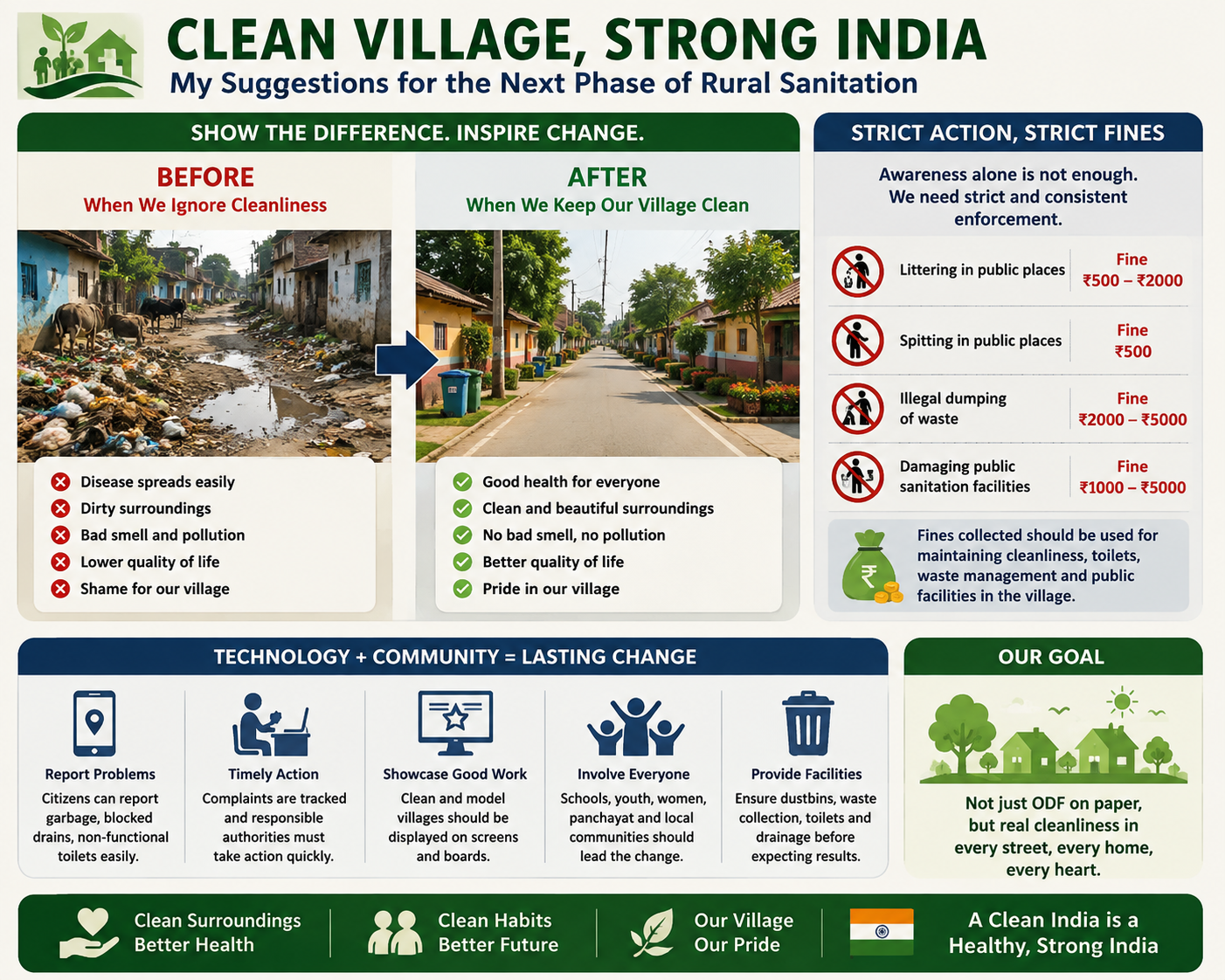
      People are strongly influenced by what they see. Digital screens or visual boards in villages, markets and public places could show clear “before and after” comparisons of the same place—dirty versus clean—and explain how cleanliness improves health, dignity and quality of life. Clean villages could also be showcased to create healthy competition and community pride. At the same time, awareness alone may not be enough in a country with such a large population. After providing proper waste bins, collection systems and sanitation facilities, there should be strict and consistent action against littering, spitting and illegal dumping, including meaningful fines for repeated violations. Technology could also allow citizens to report overflowing garbage, blocked drains and non-functional toilets, with accountability for timely action. My suggestion is simple: show people the difference, educate them, involve the community, provide proper facilities and enforce the rules.

      comments image 186519
      Like 3
      Dislike 0
      • Reply
      Facebook X
      vikeevishal
      Vikee Vishal
      4 weeks ago

      Smart Waste Management & Monitoring (Tech-Enabled) ​IoT-Enabled Community Dustbins: Panchayat level par secondary garbage collection points par ultrasonic sensor-based bins lagana, jo 80% bharte hi Gram Panchayat ke safai karmi ya block coordinator ko alert SMS bhej sakein. ​Gramin Safai App & QR-Code Audits: Har gaon ke community toilets (CSCs) aur waste collection sheds par QR code lagaya jaye, jise scan karke gaon wale safai status report kar sakein ya star rating de sakein. ​Drone Mapping for Open Dumpsites: Har mahine panchayat ke outskirts aur nadi-talabo ke kinare illegal plastic dumping identify karne ke liye brief drone survey. ​2. Plastic & Solid Waste Monetization ​Panchayat Plastic Buy-Back Centers: Gaon ke kisan aur families jo single-use plastic, fertilizer bags, ya plastic bottles jama karein, unhein weight ke hisab se cash coupons ya organic compost discount mile. ​Mini Shredder Units at Block Level: Har block level par ek plastic shredder unit ho, ja

      Like 3
      Dislike 0
      • Reply
      Facebook X
      DeepanshiSharma_290
      DeepanshiSharma_290
      4 weeks ago

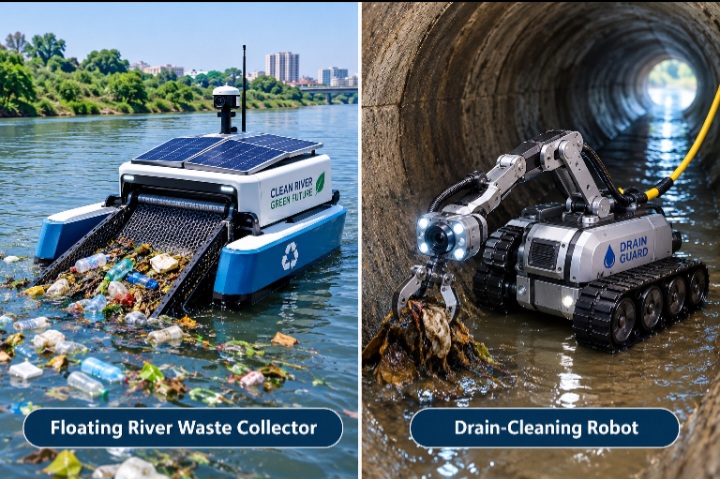
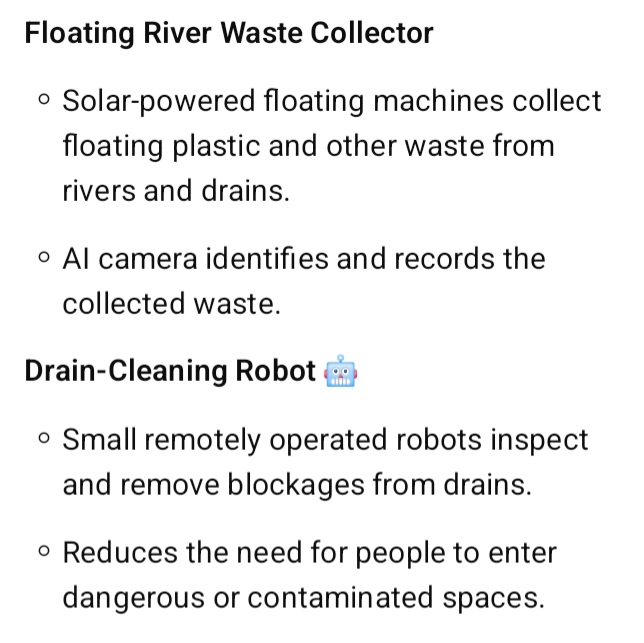
      Mahoday/Mahodya, Here is my idea for cleaning blockages from pipes and the plastic waste instantly from rivers And robots that work by solar panel charging which can clean huge garbage/dung dumps instantly.

      comments image 186378 comments image 186379
      Like 3
      Dislike 0
      • Reply
      Facebook X
      GarvSingh_108
      GarvSingh_108
      4 weeks ago

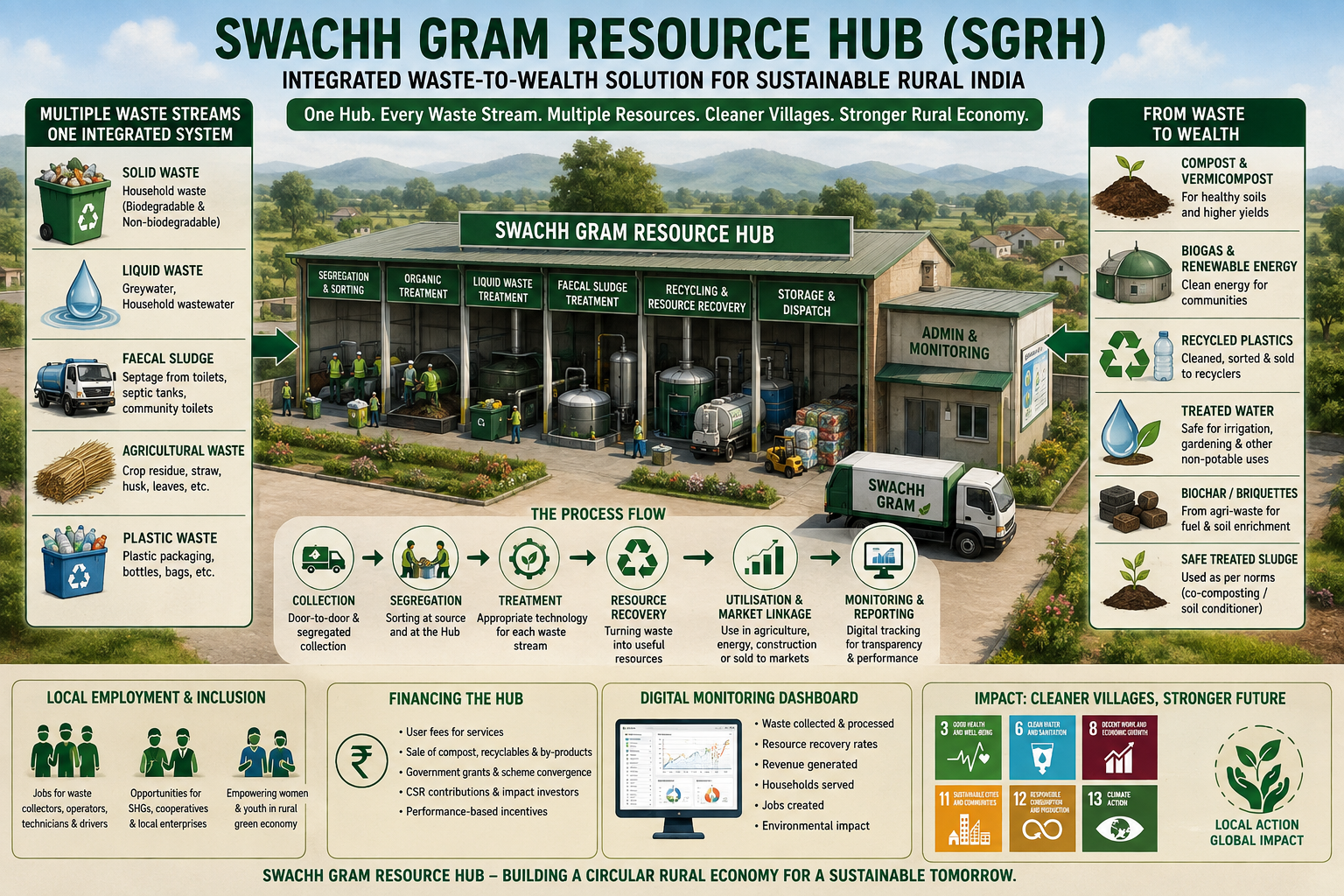
      Proposed Idea: “Swachh Gram Resource Hub” — Waste-to-Wealth at Every Cluster Create a Swachh Gram Resource Hub (SGRH) at the Gram Panchayat or cluster level that integrates solid waste, liquid waste, faecal sludge, agricultural waste and plastic waste into one locally managed circular-economy system. Instead of treating each waste stream separately, the Hub would become a rural sanitation service centre responsible for collection, treatment, resource recovery, O&M and monitoring. The new element: “Sanitation Service Guarantee” The next phase could introduce a Village Sanitation Service Guarantee, similar in concept to a basic public utility. A practical pilot I would recommend proposing a 100-village “Rural Circular Sanitation Mission” pilot covering different geographies—water-stressed villages, flood-prone villages, tribal areas, agricultural villages and peri-urban villages.

      comments image 186166
      Like 4
      Dislike 0
      • Reply
      Facebook X
      Tahsin Nazar
      Tahsin Nazar
      4 weeks ago

      Phase III ana chahiye kyunki abhi awareness ki jaroorat hai or is adhuk yantr se bhi jodne ki awashyakta hai

      Like 3
      Dislike 0
      • Reply
      Facebook X
      • First page « First
      • Previous page ‹ Previous
      • …
      • Page 8
      • Page 9
      • Page 10
      • Page 11
      • Current page 12
      • Page 13
      • Page 14
      • Page 15
      • Page 16
      • …
      • Next page Next ›
      • Last page Last »
      Please Log In to submit a comment.
      Get Involved
      • Groups
      • Do/Tasks
      • Discuss
      • Blog
      • Poll/Survey
      • Talk
      • Quiz
      • MG Prime
      • Campaigns
      • Pledge
      • Podcast
      • Media
      • Periodicals
      Get to Know
      • MyGov: An Overview
      • Associate with MyGov
      • Work at MyGov
      • Circulars
      • Pulse Newsletter
      • Tenders
      • Weekly Newsletter
      • MeitY Dashboard
      • Sectors
      • Skills
      • Area of Interest
      • Age Group
      • National Events
      • Archive Sites
      Help & Support
      • Contact Us
      • FAQ
      • Feedback
      • Help
      • Link To Us
      • Public Grievance
      • Site Map
      • Terms & Conditions
      • Usage of Aadhaar
      • Web Information Manager
      • ICC
      • MyGov Social
      • Points and Badges
      • Website Policies
      Useful Links
      • MyGov Quiz MyGov Quiz
      • Transforming India Transforming India
      • MyGov Innovation MyGov Innovation
      • MyGov Pledge MyGov Pledge
      • MyGov Blog MyGov Blog
      • Self4Society Self4Society
      • Campus Program Campus Program
      • MyGov Saathi Saathi
      Follow us
      Twitter Twitter 33.11 + Lakh Followers Facebook Facebook 15.14 + Lakh Followers Instagram Instagram 30.73 + Lakh Followers YouTube YouTube 7.43 + Lakh Subscribers LinkedIn LinkedIn 1.63 + Lakh Followers Messenger Messenger 1.60 + Lakh Followers WhatsApp WhatsApp 910.05 + Lakh Followers DailyHunt DailyHunt 7.2 + K Followers Public Public 85.5 + K Followers ShareChat ShareChat 82.22K Followers Snapchat Snapchat View All
      QR Code

      Download the MyGov Mobile App Join us in building a New India on the move.

      App Store Play Store
      NIC logo

      © Content owned, updated and maintained by the MyGov Cell. This website belongs to MyGov, Ministry of Electronics & Information Technology, Government of India.
      Platform is designed, developed and hosted by National Informatics Centre.

      CQW - MyGov certificateCertified Quality Website
      • Meity
      • Digital India
      • National Portal of India
      • Data Portal

      Copyright © MyGov 2014

      secure-1 - Last Updated: September 29, 2026
      Top
      This website uses cookies to provide a better user experience.
      By clicking accept, you agree to the policies outlined in the Cookie Settings.