Government of IndiaGOVERNMENT OF INDIA
Skip main content
English language
  • English
  • हिन्दी
Accessibility
Accessibility Tools
Color Adjustment
Text Size
Navigation Adjustment
Screen Reader iconScreen Reader
MyGov Twitter
MyGov Facebook
MyGov Youtube
MyGov Instagram
MyGov Linkedin
MyGov Whatsapp
Meri Sarkar Logo

Recent Searches

      Close

      Get Involved

      • Groups
      • Do/Tasks
      • Discuss
      • Poll/Survey
      • Blog
      • Talk
      • Quiz
      • MG Prime
      • Campaigns
      • Pledge
      • Podcast
      • Media
      • Periodicals

      MyGov States

      • Andaman & Nicobar Islands
      • Arunachal Pradesh
      • Assam
      • Chandigarh
      • Chhattisgarh
      • Dadra and Nagar Haveli and Daman and Diu
      • Goa
      • Gujarat
      • Haryana
      • Himachal Pradesh
      • Jammu And Kashmir
      • Jharkhand
      • Karnataka
      • Ladakh
      • Madhya Pradesh
      • Maharashtra
      • Manipur
      • Mizoram
      • Nagaland
      • Rajasthan
      • Tamil Nadu
      • Tripura
      • Uttar Pradesh
      • Uttarakhand
      • Lakshadweep
      • Odisha
      • Puducherry
      • Sikkim

      Microsites

      • Blog
      • Campus
      • Innovate India
      • Pledge
      • Quiz
      • Saathi
      • Self4Society
      • Transforming India
      • PM Events

      Get to Know

      • MyGov: An Overview
      • Associate with MyGov
      • Work at MyGov
      • Circulars
      • Pulse Newsletter
      • Tenders
      • Weekly Newsletter
      • Meity Dashboard
      • Sectors
      • Skills
      • Area of Interest
      • Age Group
      • National Events
      • ICC

      Help/Feedback

      • Contact Us
      • FAQ
      • Feedback
      • Help
      • Link To Us
      • Public Grievance
      • Site Map
      • Terms & Conditions
      • Usage of Aadhaar
      • Web Information Manager
      • Archive Sites
      • MyGov Social
      • Points and Badges
      • Website Policies
      user-profile
      Together, Let's Engage In Good Governance 
      Login/Register
      1. Home
      2. Discuss
      3. Inviting Ideas for Next Phase of Rural Sanitation

      Inviting Ideas for Next Phase of Rural Sanitation

      Facebook X
      Inviting Ideas for Next Phase of Rural Sanitation
      Start Date 01/08/2026 - 11:49
      End Date 02/10/2026 - 23:45
      Time zone: IST (GMT +5.30 Hrs)
      Login to Participate
      Sector:
      Water & Sanitation
      Created : 1/08/2026
      136
      Total Comments
      75
      Users Participated

      In the last 12 years, SBM(G) has evolved from a sanitation programme into a nationwide movement that has improved public health, enhanced dignity of women, empowered communities and promoted sustainable rural development. Building on the achievement of Open Defecation Free (ODF) status, SBM(G) 2.0 has expanded its focus to sustaining sanitation outcomes through interventions such as Individual Household Latrines (IHHLs), Community Sanitary Complexes (CSCs), Solid and Liquid Waste Management, Plastic Waste Management, Faecal Sludge Management, GOBARdhan, Information, Education and Communication (IEC) and Capacity Building. The current phase of the Mission is scheduled to conclude in March 2027.

      As the Department prepares the roadmap for the next phase of rural sanitation, it seeks ideas from citizens to sustain and strengthen the gains achieved under SBM(G) while addressing emerging challenges related to waste management, resource recovery, environmental sustainability, Operation & Maintenance (O&M) and long-term community ownership of assets and outcomes. Innovative, practical and scalable solutions are required to enhance sanitation service delivery, strengthen waste management systems, promote behavioural change and accelerate the transition towards a circular waste-to-wealth economy. Given that the diversities of rural areas from urban cities, suggestions and ideas, specific to rural scenarios will be highly appreciated. Along with these, with peri-urban areas / villages also growing fast and having characteristics of urban centers, solutions specific for such areas are also being sought.

      The success of SBM(G) has been driven by the spirit of Jan Bhagidari (People's Participation). Citizens, Gram Panchayats, SHGs, youth, Swachhagrahis and other stakeholders have been at the forefront of transforming rural sanitation and their continued participation will remain critical for sustaining these achievements. 

      Accordingly, the Department of Drinking Water and Sanitation (DDWS), Ministry of Jal Shakti in collaboration with MyGov, invites citizens, youth, Gram Panchayats, SHGs, academic and research institutions, development partners and other stakeholders to share their suggestions and ideas for the next phase of rural sanitation programme on the following:

      1. Areas to be taken up (including existing areas where gaps may be remaining)
      2. New technological interventions for SWM, GWM, FSM.
      3. Rural Sanitation 
      4. Solutions for treating pollution in small nallahs/rivulets discharging into rivers in rural areas.
      5. Adoption of solutions based on traditional knowledge and ancient wisdom in new settings for rural India. 
      6. Any other area related to the programme.

      The suggestions received will help and guide the next phase of SBM(G) and contribute to building cleaner, healthier and environmentally sustainable villages that will be strong contributors for achieving the goal of Viksit Bharat@2047.

      Participation Guidelines 

      1. All Citizens, youth (including students), Gram Panchayats & SHGs, academic and research institutions, development partners, NGOs and other stakeholders are invited to contribute ideas for shaping the next phase of rural sanitation and solid-liquid waste management under Swachh Bharat Mission (Grameen).
      2. For detailed information about SBM(G) Phase II, applicants may visit the SBM(G) Phase II operational guidelines available on website of the Department (https://swachhbharatmission.ddws.gov.in). The guidelines can also be assessed through: https://swachhbharatmission.ddws.gov.in/sites/default/files/Guidelines/SBMG%20Phase-II%20Operational%20Guidelines.pdf 
      3. Suggestions may be submitted on any of the major components of SBM(G), including Individual Household Latrines (IHHLs), Community Sanitary Complexes (CSCs), Solid Waste Management, Liquid Waste Management, Plastic Waste Management, GOBARdhan, Faecal Sludge Management, Information, Education and Communication (IEC) and Capacity Building. Global best practices forming the bases of solution, may also duly mentioned and referred.
      4. Participants are encouraged to propose innovative, technology-driven, scientific, managerial, practical, feasible and scalable solutions to address rural sanitation challenges and strengthen long-term sustainability.
      5. Suggestions should focus on supporting the Department of Drinking Water and Sanitation (DDWS), Ministry of Jal Shakti, in developing the roadmap for the next phase of rural sanitation for India.
      6. Participants are required to register on the MyGov platform and submit their suggestions through the prescribed online form.

      Balachitra 1987
      Balachitra 1987
      2 days 11 hours ago

      Mandatory Village Channels: Enact a digital transparency mandate requiring every Gram Panchayat to establish official, verified Instagram and YouTube channels to broadcast all local government sanitation initiatives, project updates, and public fund utilization data.Bi-Weekly Video Audits: Require the video recording and live-streaming of bi-weekly Gram Sabha sanitation reviews and asset inspections to ensure absolute transparency in public work execution.Youth Content Creators: Recruit local rural youth as digital content creators under the "Swachhata Digital Ambassador" scheme to shoot real-time project progress, geo-tagging activities, and waste management updates.Before-and-After Campaigns: Launch visual "Before-and-After" video campaigns tracking the transformation of open garbage dumps into functional sorting hubs or micro-parks, holding contractors publicly accountable.QR-Coded Video Feedback: Print unique QR codes on all community sanitary facilities linking

      Like 2
      Dislike 0
      • Reply
      Facebook X
      Balachitra 1987
      Balachitra 1987
      2 days 11 hours ago

      Floating Eco-Islands: Deploy floating treatment wetlands constructed with native hyper-accumulating aquatic plants inside small nallahs discharging into main river systems.Charcoal Gabion Dams: Construct low-cost wire gabion check dams filled with activated charcoal, river sand, and gravel to filter macro-pollutants within rural rivulets.Mechanized Mesh Screens: Install multi-tier stainless steel mechanical mesh screens at nallah mouth junctions to intercept floating plastic debris before river entry.Vetiver Bank Binding: Mass-plant deep-rooted Vetiver grass along the edges of open drains to bio-filter heavy runoff while structurally stabilizing soil banks.Moringa-Based Clarification: Promote community-scale primary sedimentation tanks utilizing crushed, traditional Moringa oleifera seed powder as a natural organic coagulant.Terracotta Sediment Traps: Install interconnected, local clay-baked terracotta baffle walls at drainage nodes to decelerate water speed and trap heavy silt natural

      Like 2
      Dislike 0
      • Reply
      Facebook X
      Balachitra 1987
      Balachitra 1987
      2 days 11 hours ago

      Solar Powered CSCs: Equip all community sanitary blocks with solar-powered overhead pumps and automated LED lighting to ensure safe night usage.Menstrual Hygiene Hubs: Integrate private sanitary pad vending machines and smoke-free terracotta incinerators inside every women’s public toilet complex.Mobile Transit CSCs: Deploy seasonal, containerized mobile toilet blocks at rotating village weekly markets (haats) and major religious pilgrimage routes.SHG Plastic Hubs: Establish cluster-level plastic shredding units operated by trained SHGs to process flexible and single-use commercial packing plastics.Plastic-to-Fuel Aggregation: Feed shredded rural plastic waste into regional pelletisation plants to manufacture alternative refuse-derived fuel (RDF) for cement kilns.Gram Plastic Roads: Mandate the mixing of shredded village plastic waste into local bitumen mixtures for rural PMGSY road construction projects.

      Like 2
      Dislike 0
      • Reply
      Facebook X
      Balachitra 1987
      Balachitra 1987
      2 days 11 hours ago

      Satellitic Monitoring: Deploy high-resolution GIS and satellite imaging to map open drainage paths and monitor water log points across villages seasonally.Sanitation Impact Audits: Require yearly third-party environmental and public health audits for every village block to measure groundwater contamination changes.Single-Window Clearances: Create a fast-track administrative window at the Block level for SHGs to secure statutory clearances for waste facilities.Corporate Swachh Bonds: Float rural-sanitation-focused municipal bonds to crowd-in private corporate social responsibility (CSR) capital for macro-level district treatment infrastructure.Elevated Plinths: Raise the foundation plinths of individual household latrines (IHHL) above historical high-flood levels in low-lying rural regions.Twin-Pit Customisation: Standardize twin-pit pour-flush toilets with specialized honeycomb brick linings to optimize structural safety and safe decomposition

      Like 2
      Dislike 0
      • Reply
      Facebook X
      Balachitra 1987
      Balachitra 1987
      2 days 11 hours ago

      RWH Mandate: Enact gram-panchayat bylaws making rooftop rainwater harvesting structures legally compulsory for every new and existing rural household.Mandatory Geo-Tagging: Integrate mandatory geo-tagging of all household rainwater harvesting systems via a centralized mobile app to track national water recharge assets.JLG Infrastructure Contracts: Award structural construction contracts for household toilets and rainwater units exclusively to village Joint Liability Groups (JLGs).SHG Maintenance Contracts: Institutionalise long-term operation and maintenance (O&M) service contracts to women Self-Help Groups (SHGs) for managing community utilities.Swachhata Green Credits: Establish a village-level financial incentive scheme rewarding Gram Panchayats with development grants based on geo-tagged sanitation milestones.Institutional Convergence: Mandate 100% running water, liquid waste systems, and gender-segregated toilets in all rural schools, Anganwadis, and healthcare centers

      Like 2
      Dislike 0
      • Reply
      Facebook X
      Balachitra 1987
      Balachitra 1987
      2 days 11 hours ago

      Climate-Resilient Infrastructure: Mandate rooftop rainwater harvesting structures with digital geo-tagging for every rural household, awarding construction and validation contracts directly to village-level Joint Liability Groups (JLGs).IoT-Enabled Waste Management: Deploy automated segregation units at block hubs and install IoT-monitored greywater pumps in constructed wetlands, with maintenance contracts managed by trained women Self-Help Groups (SHGs).Traditional Phyto-Purification: Revive ecological wisdom by mass-planting deep-rooted Vetiver grass and Moringa along drainage channels, executing these green bio-filtering projects via dedicated contracts handed to local SHGs.Entrepreneurial O&M Frameworks: Institutionalise "Swachhata Green Credits" by formally appointing village SHGs and JLGs as registered contractors to manage user-fee-based plastic collection and geo-tagged water conservation monitoring.

      Like 2
      Dislike 0
      • Reply
      Facebook X
      RanaManasveeVanvirsinh
      RanaManasveeVanvirsinh
      2 days 13 hours ago

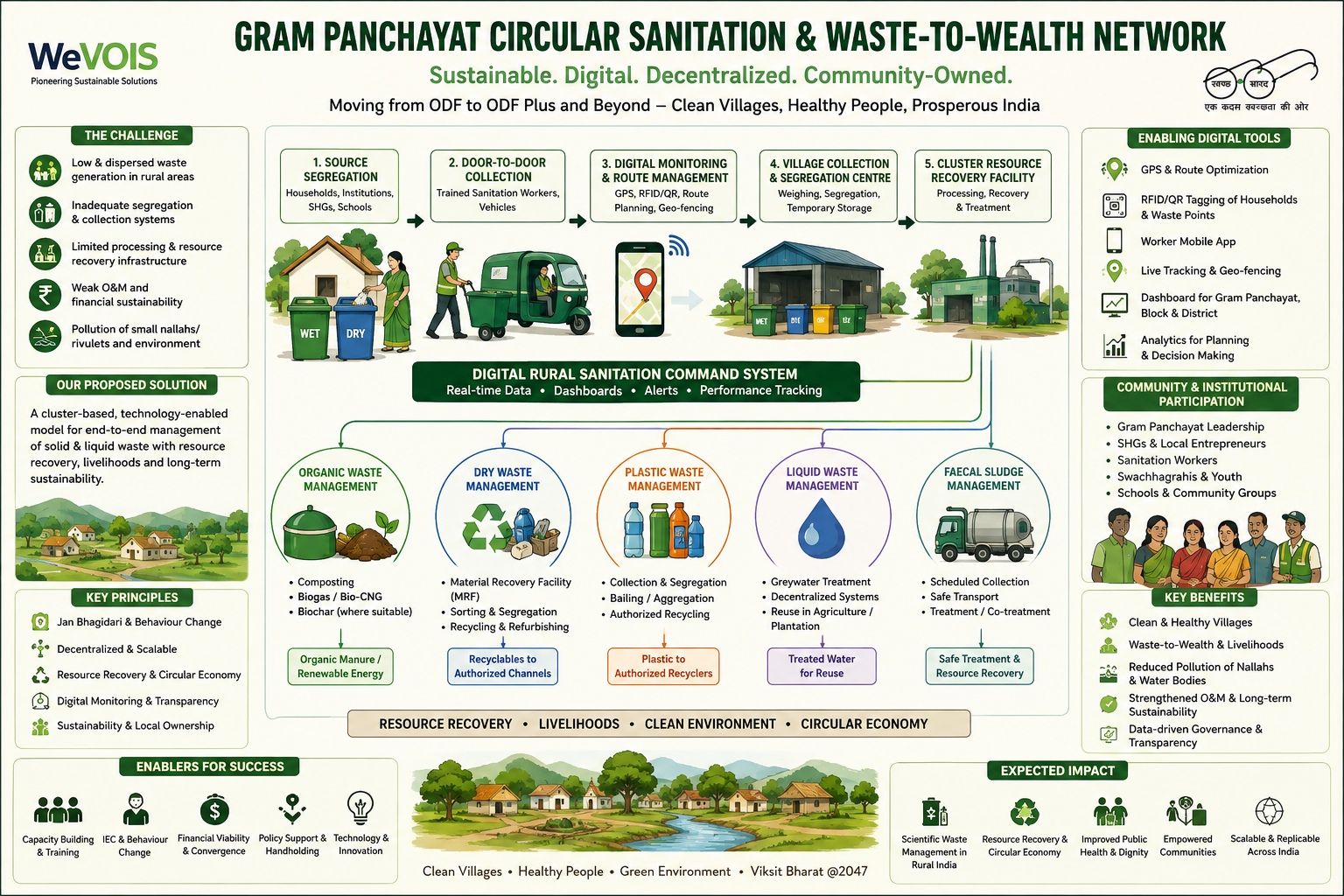
      🌿 Next Phase of Rural Sanitation – From Clean Villages to Smart & Sustainable Villages 🇮🇳 India has made remarkable progress in rural sanitation. 🌱 The next phase should focus on sustainability, waste management, and community participation. Every village should convert wet waste into compost or biogas ♻️, while greywater should be treated and reused for kitchen gardens and irrigation. 💧 Plastic waste collection centers with reward-based recycling can motivate citizens to keep villages clean. 📦 Schools should conduct monthly sanitation drives, and every Gram Panchayat should adopt a digital cleanliness dashboard to monitor progress. 📱 Women's Self Help Groups can lead awareness campaigns and sanitation enterprises, creating both employment and cleaner villages. 👩‍🌾 Together, through innovation, technology, and public participation, India can build healthier, greener, and self-reliant villages for future generations. 🌍✨ Clean Village, Healthy India! 🇮🇳

      comments image 155623
      Like 3
      Dislike 0
      • Reply
      Facebook X
      Heaven Nayak
      Heaven Nayak
      2 days 14 hours ago

      Excellent initiative! Clean villages are the foundation of a healthy and developed India. 🇮🇳🌱" "Great step towards a cleaner, healthier, and sustainable rural India. Keep it up! 👏" "Every idea matters. Together we can build a Swachh and Samriddh Bharat. 💚" "A wonderful initiative to encourage innovation for rural sanitation. Best wishes! 🌍✨" "Clean villages, healthy lives, brighter future. Proud to support this mission! 🇮🇳"

      (3.31 MB)
      Like 2
      Dislike 0
      • Reply
      Facebook X
      Heaven Nayak
      Heaven Nayak
      2 days 14 hours ago

      Excellent initiative! Clean villages are the foundation of a healthy and developed India. 🇮🇳🌱" "Great step towards a cleaner, healthier, and sustainable rural India. Keep it up! 👏" "Every idea matters. Together we can build a Swachh and Samriddh Bharat. 💚" "A wonderful initiative to encourage innovation for rural sanitation. Best wishes! 🌍✨" "Clean villages, healthy lives, brighter future. Proud to support this mission! 🇮🇳"

      Like 2
      Dislike 0
      • Reply
      Facebook X
      Anudeep_275
      Anudeep_275
      2 days 15 hours ago

      BODDUGARI RENUKA madam– A Visionary Leader, Legal Professional, Philanthropist & Social Reformer. Boddugari Renuka madam is an accomplished Gold Medalist,Advocate, Philanthropist, Social Activist, Environmentalist and successful entrepreneur whose life reflects an unwavering commitment to justice, leadership and humanitarian service. Beyond her professional achievements, Boddugari Renuka madam has become widely respected for her extraordinary contributions to society.For more than five years, she has devoted herself to serving underprivileged communities throughout the Patancheru constituency, transforming countless lives through meaningful and sustainable social initiatives. Renuka amma flagship humanitarian initiative is the monthly Annadanam (free meal service) conducted on the first Saturday of every month in Patancheru Temples and Government hospitals, through which more than 1,500 people receive nutritious meals at temples, government hospitals and public places every month.

      Like 2
      Dislike 0
      • Reply
      Facebook X
      • First page « First
      • Previous page ‹ Previous
      • …
      • Page 4
      • Page 5
      • Page 6
      • Page 7
      • Current page 8
      • Page 9
      • Page 10
      • Page 11
      • Page 12
      • …
      • Next page Next ›
      • Last page Last »
      Please Log In to submit a comment.
      Get Involved
      • Groups
      • Do/Task
      • Discuss
      • Blog
      • Poll/Survey
      • Talk
      • Quiz
      • MG Prime
      • Campaigns
      • Pledge
      • Podcast
      • Media
      • Periodicals
      Get to Know
      • MyGov: An Overview
      • Associate with MyGov
      • Work at MyGov
      • Circulars
      • Pulse Newsletter
      • Tenders
      • Weekly Newsletter
      • Meity Dashboard
      • Sectors
      • Skills
      • Area of Interest
      • Age Group
      • National Events
      • ICC
      Help & Support
      • Contact Us
      • FAQ
      • Feedback
      • Help
      • Link To Us
      • Public Grievance
      • Site Map
      • Terms & Conditions
      • Usage of Aadhaar
      • Web Information Manager
      • Archive Sites
      • MyGov Social
      • Points and Badges
      • Website Policies
      Useful Links
      • MyGov Quiz MyGov Quiz
      • Transforming India Transforming India
      • MyGov Innovation MyGov Innovation
      • MyGov Pledge MyGov Pledge
      • MyGov Blog MyGov Blog
      • Self4Society Self4Society
      • Campus Program Campus Program
      • MyGov Saathi Saathi
      Follow us
      WhatsApp WhatsApp 910.05 + Lakh Followers Messenger Messenger 1.60 + Lakh Followers Facebook Facebook 15.14 + Lakh Followers Telegram Telegram 6.19 + Lakh Followers Instagram Instagram 30.73 + Lakh Followers Twitter Twitter 33.11 + Lakh Followers LinkedIn LinkedIn 1.63 + Lakh Followers YouTube YouTube 7.43 + Lakh Subscribers Pinterest Pinterest 19.80K Followers ShareChat ShareChat 82.22K Followers Chingari Chingari 4.90 + Lakh Followers View All
      QR Code

      Download the MyGov Mobile App Join us in building a New India on the move.

      App Store Play Store
      NIC logo

      © Content owned, updated and maintained by the MyGov Cell. This website belongs to MyGov, Ministry of Electronics & Information Technology, Government of India.
      Platform is designed, developed and hosted by National Informatics Centre.

      CQW - MyGov certificateCertified Quality Website
      • Meity
      • Digital India
      • National Portal of India
      • Data Portal

      Copyright © MyGov 2014

      secure-1 - Last Updated: August 4, 2026
      Top
      This website uses cookies to provide a better user experience.
      By clicking accept, you agree to the policies outlined in the Cookie Settings.