Government of IndiaGOVERNMENT OF INDIA
मुख्य सामग्री छोड़ें
हिन्दी language
  • English
  • हिन्दी
Accessibility
Accessibility Tools
Color Adjustment
Text Size
Navigation Adjustment
Screen Reader iconScreen Reader
MyGov Twitter
MyGov Facebook
MyGov Youtube
MyGov Instagram
MyGov Linkedin
MyGov Whatsapp
Meri Sarkar Logo

Recent Searches

      Close

      शामिल हों

      • समूह
      • कार्य
      • चर्चा करें
      • जनमत/सर्वेक्षण
      • ब्लॉग
      • वार्ता
      • क्विज़
      • MG प्राइम
      • अभियान
      • शपथ
      • पॉडकास्ट
      • मीडिया
      • पत्रिकाएँ

      माईगव राज्य

      • अंडमान-निकोबार द्वीप समूह
      • अरूणाचल प्रदेश
      • असम
      • चंडीगढ़
      • छत्तीसगढ़
      • दादरा और नगर हवेली और दमन और दीव
      • गोवा
      • गुजरात
      • हरियाणा
      • हिमाचल प्रदेश
      • जम्मू और कश्मीर
      • झारखण्‍ड
      • कर्नाटक
      • लद्दाख
      • मध्‍य प्रदेश
      • महाराष्ट्र
      • मणिपुर
      • मिजोरम
      • नागालैण्‍ड
      • राजस्थान
      • तमिलनाडु
      • त्रिपुरा
      • उत्तर प्रदेश
      • उत्तराखंड
      • लक्षद्वीप
      • ओडिशा
      • पुडुचेरी
      • सिक्किम

      माइक्रोसाइट्स

      • ब्लॉग
      • कैंपस
      • इनोवेट इंडिया
      • शपथ
      • क्विज़
      • साथी
      • सेल्फ4सोसायटी
      • ट्रांसफॉर्मिंग इंडिया
      • PM इवेंट्स

      जानें

      • माईगव: अवलोकन
      • माईगव से संबद्ध करें
      • माईगव के साथ काम करें
      • सर्कुलर
      • पल्स न्यूजलेटर
      • टेंडर्स
      • साप्ताहिक समाचार पत्र
      • Meity डैशबोर्ड
      • सेक्टर्स
      • कौशल
      • रूचि के क्षेत्र
      • आयु वर्ग
      • राष्ट्रीय कार्यक्रम
      • ICC

      मदद/प्रतिक्रिया

      • संपर्क करें
      • FAQ
      • प्रतिक्रिया
      • मदद
      • हमसे जुड़ें
      • सार्वजनिक शिकायत
      • साइट मैप
      • नियम एवं शर्तें
      • आधार का इस्तेमाल
      • वेब सूचना प्रबंधक
      • आर्काइव साइट्स
      • MyGov सोशल
      • पॉइंट्स और बैज्स
      • वेबसाइट की पॉलिसी
      user-profile
      Together, Let's Engage In Good Governance 
      Login/Register
      1. Home
      2. Discuss
      3. Inviting Ideas for Next Phase of Rural Sanitation

      Inviting Ideas for Next Phase of Rural Sanitation

      Facebook X
      Inviting Ideas for Next Phase of Rural Sanitation
      Start Date 01/08/2026 - 11:49
      End Date 02/10/2026 - 23:45
      Time zone: IST (GMT +5.30 Hrs)
      Login to Participate
      Sector:
      Water & Sanitation
      Created : 1/08/2026
      160
      Total Comments
      89
      Users Participated

      In the last 12 years, SBM(G) has evolved from a sanitation programme into a nationwide movement that has improved public health, enhanced dignity of women, empowered communities and promoted sustainable rural development. Building on the achievement of Open Defecation Free (ODF) status, SBM(G) 2.0 has expanded its focus to sustaining sanitation outcomes through interventions such as Individual Household Latrines (IHHLs), Community Sanitary Complexes (CSCs), Solid and Liquid Waste Management, Plastic Waste Management, Faecal Sludge Management, GOBARdhan, Information, Education and Communication (IEC) and Capacity Building. The current phase of the Mission is scheduled to conclude in March 2027.

      As the Department prepares the roadmap for the next phase of rural sanitation, it seeks ideas from citizens to sustain and strengthen the gains achieved under SBM(G) while addressing emerging challenges related to waste management, resource recovery, environmental sustainability, Operation & Maintenance (O&M) and long-term community ownership of assets and outcomes. Innovative, practical and scalable solutions are required to enhance sanitation service delivery, strengthen waste management systems, promote behavioural change and accelerate the transition towards a circular waste-to-wealth economy. Given that the diversities of rural areas from urban cities, suggestions and ideas, specific to rural scenarios will be highly appreciated. Along with these, with peri-urban areas / villages also growing fast and having characteristics of urban centers, solutions specific for such areas are also being sought.

      The success of SBM(G) has been driven by the spirit of Jan Bhagidari (People's Participation). Citizens, Gram Panchayats, SHGs, youth, Swachhagrahis and other stakeholders have been at the forefront of transforming rural sanitation and their continued participation will remain critical for sustaining these achievements. 

      Accordingly, the Department of Drinking Water and Sanitation (DDWS), Ministry of Jal Shakti in collaboration with MyGov, invites citizens, youth, Gram Panchayats, SHGs, academic and research institutions, development partners and other stakeholders to share their suggestions and ideas for the next phase of rural sanitation programme on the following:

      1. Areas to be taken up (including existing areas where gaps may be remaining)
      2. New technological interventions for SWM, GWM, FSM.
      3. Rural Sanitation 
      4. Solutions for treating pollution in small nallahs/rivulets discharging into rivers in rural areas.
      5. Adoption of solutions based on traditional knowledge and ancient wisdom in new settings for rural India. 
      6. Any other area related to the programme.

      The suggestions received will help and guide the next phase of SBM(G) and contribute to building cleaner, healthier and environmentally sustainable villages that will be strong contributors for achieving the goal of Viksit Bharat@2047.

      Participation Guidelines 

      1. All Citizens, youth (including students), Gram Panchayats & SHGs, academic and research institutions, development partners, NGOs and other stakeholders are invited to contribute ideas for shaping the next phase of rural sanitation and solid-liquid waste management under Swachh Bharat Mission (Grameen).
      2. For detailed information about SBM(G) Phase II, applicants may visit the SBM(G) Phase II operational guidelines available on website of the Department (https://swachhbharatmission.ddws.gov.in). The guidelines can also be assessed through: https://swachhbharatmission.ddws.gov.in/sites/default/files/Guidelines/SBMG%20Phase-II%20Operational%20Guidelines.pdf 
      3. Suggestions may be submitted on any of the major components of SBM(G), including Individual Household Latrines (IHHLs), Community Sanitary Complexes (CSCs), Solid Waste Management, Liquid Waste Management, Plastic Waste Management, GOBARdhan, Faecal Sludge Management, Information, Education and Communication (IEC) and Capacity Building. Global best practices forming the bases of solution, may also duly mentioned and referred.
      4. Participants are encouraged to propose innovative, technology-driven, scientific, managerial, practical, feasible and scalable solutions to address rural sanitation challenges and strengthen long-term sustainability.
      5. Suggestions should focus on supporting the Department of Drinking Water and Sanitation (DDWS), Ministry of Jal Shakti, in developing the roadmap for the next phase of rural sanitation for India.
      6. Participants are required to register on the MyGov platform and submit their suggestions through the prescribed online form.

      bhupendra kumar_364
      bhupendra kumar_364
      2 days 12 hours ago

      🌿 Taglines / Headlines "Har Vichar, Ek Naya Swachh Kal" "Soch Badlo, Gaon Badlo" "Aapka Idea, Bharat Ka Agla Kadam" "Swachhata Ki Agli Kahani, Aapke Vichar Se" "Ek Soch, Ek Swachh Bharat" "Naye Vichar, Nayi Disha, Naya Gaon" "Gaon Ki Awaaz, Swachh Bharat Ki Buniyad" "Idea Do, Badlaav Lao" "Swachhata Ka Agla Adhyay, Aap Likhenge" "Chhoti Soch, Bada Badlaav" ✨ English Options "Your Idea. India's Next Clean Chapter." "Think Clean. Build Rural India." "From Villages, For Villages — Share Your Vision." "Innovation Starts at the Grassroots." "Every Idea Counts Towards a Cleaner Tomorrow." "Shape the Future of Rural Sanitation." "Small Ideas, Big Impact — Rural India Needs You." 🎯 Call-to-Action Lines "Apna Vichar Share Karo, Badlaav Ki Shuruaat Karo" "Join the Movement — Submit Your Idea Today" "Your Voice Can Build a Healthier Village" "Contribute Now — Let's Design Rural India's Future" 🖋️ One-Liner for Poster Highlight "Gaon Saaf, Soch Saaf — Agla Kadam Aapka!"

      comments image 156722
      Like 2
      Dislike 0
      • Reply
      Facebook X
      PrashantSahu_251
      PrashantSahu_251
      2 days 12 hours ago

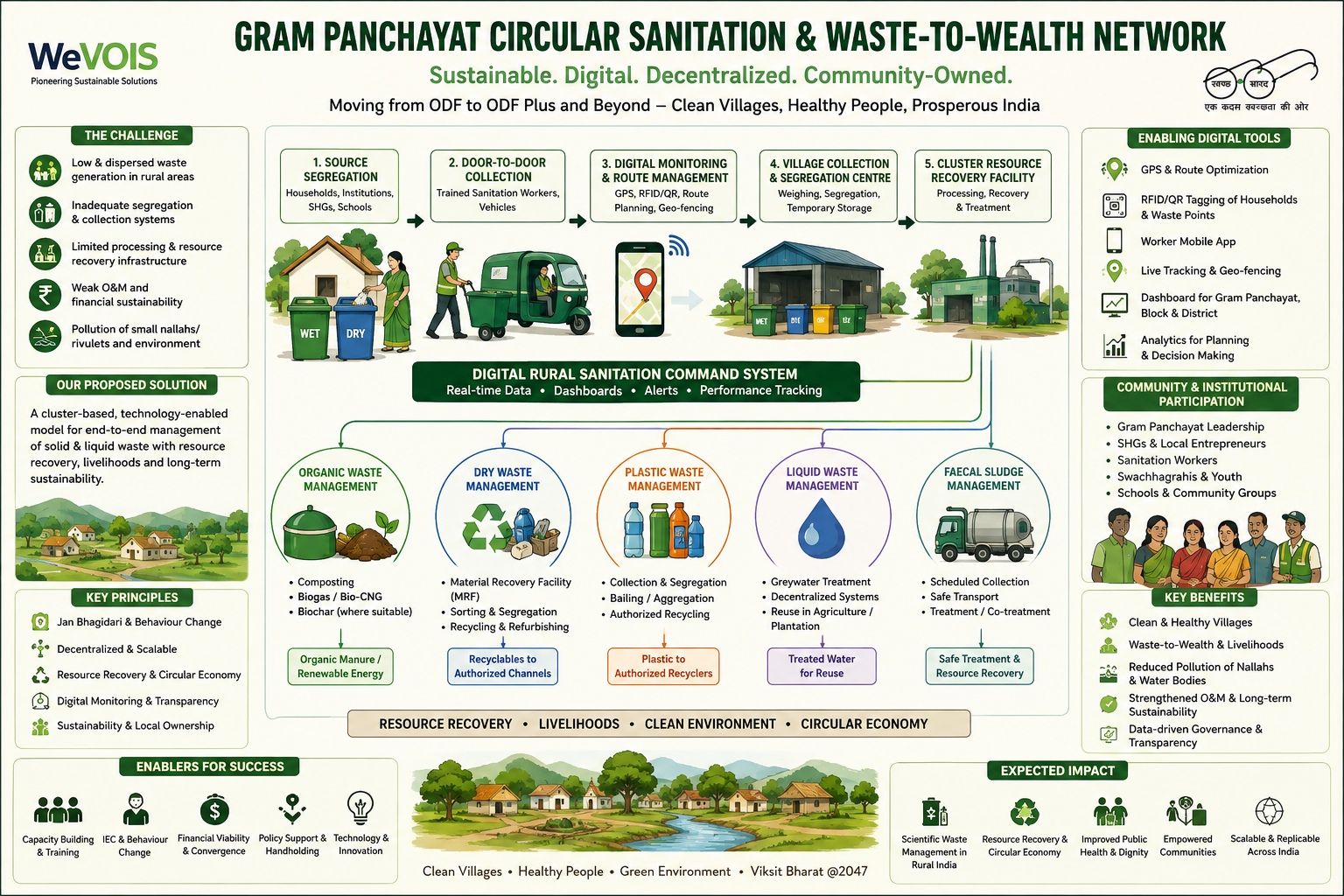
      Suggestions for Plastic Waste Management in Rural Areas 1. Set up a small plastic collection center in every Gram Panchayat so people have a proper place to dispose of plastic waste. 2. Women Self-Help Groups (SHGs) can manage these centers and earn income by collecting and recycling plastic. 3. Use simple and low-cost machines to recycle plastic waste within the village instead of sending it to cities. 4. Convert recycled plastic into useful products like dustbins, benches, flower pots, paving blocks, fencing poles, and school furniture. 5. Organize a "Plastic-Free Village Day" every month where villagers, students, and youth collect plastic waste from roads, fields, and public places. 6. Give small rewards or certificates to families who regularly deposit plastic waste at the collection center to encourage participation. 7. Conduct awareness programs in schools and villages to teach people about reducing plastic use and keeping the environment clean.

      Like 2
      Dislike 0
      • Reply
      Facebook X
      PrashantSahu_251
      PrashantSahu_251
      2 days 12 hours ago

      Plastic waste is becoming a big problem in villages, especially single-use plastic and multi-layered plastic, because it is difficult and expensive to transport it to recycling plants in cities. A good solution is to set up small plastic recycling centers at the block or Gram Panchayat level and let Women Self-Help Groups (SHGs) manage them. These centers can use simple and low-cost machines to shred and recycle plastic waste collected from nearby villages. The recycled plastic can be used to make useful products like paving tiles, flower pots, fencing poles, benches, or dustbins. These products can be used within the village itself or sold to nearby areas. This will help keep villages clean, reduce plastic pollution, create jobs for rural women, and provide an additional source of income for SHGs. Instead of treating plastic as waste, it can become a valuable resource that supports a cleaner environment and a self-sustaining rural economy.

      Like 2
      Dislike 0
      • Reply
      Facebook X
      bhupendra kumar_364
      bhupendra kumar_364
      2 days 12 hours ago

      Swachh Bharat Mission ne gaon-gaon mein swachhata ki ek nayi soch di hai. Ab samay hai agle charan ki disha tay karne ka — behtar waste management, sustainable sanitation, aur har gaon ki active bhagidari ke saath. Swachh Bharat, Swasth Bharat

      Like 2
      Dislike 0
      • Reply
      Facebook X
      krishnakumar_9702
      krishnakumar_9702
      2 days 12 hours ago

      To make rural sanitation sustainable, every village should have regular awareness campaigns on cleanliness, proper waste management, and safe drinking water. Schools and local communities should actively participate. Digital monitoring, timely maintenance of toilets, and incentives for clean villages can improve long-term sanitation and public health.

      Like 3
      Dislike 0
      • Reply
      Facebook X
      Darshan P B_1
      Darshan P B
      2 days 13 hours ago

      As rural landscapes evolve, the boundary between villages and towns is blurring. Peri-urban centers and large rural villages now host bustling commercial hubs, including dhabas, hardware stores, and local manufacturing units. These entities generate significantly more waste than a standard household, straining local waste infrastructure. Implementing a tiered "Pay-As-You-Throw" (PAYT) municipal model tailored for these rural commercial zones will ensure financial sustainability. Unlike a flat tax, PAYT charges businesses based specifically on the volume and type of waste they generate. This system financially penalizes high-waste generation and strictly incentivizes commercial source segregation and recycling. The revenue generated from these commercial waste fees directly funds the Gram Panchayat’s sanitation workers, transport vehicles, and processing facilities, creating a self-sustaining financial loop for robust solid waste management in rapidly urbanizing areas.

      Like 2
      Dislike 0
      • Reply
      Facebook X
      Darshan P B_1
      Darshan P B
      2 days 13 hours ago

      Modern sanitation often relies heavily on synthetic chemical cleaners, which are not only expensive and dependent on complex supply chains but can also disrupt the natural biological processes required for effective pit latrine and compost degradation. To counter this, SBM(G) can officially standardize and promote the ancient, vernacular wisdom of using wood ash and slaked lime (chuna) for sanitization. For centuries, these highly accessible, low-cost materials have been used in rural India. When applied to pit latrines, animal sheds, and compost trenches, ash and lime naturally raise the pH level of the environment. This effectively neutralizes odors, accelerates the breakdown of organic matter, and acts as a powerful natural biocide to eliminate harmful pathogens and fly larvae. By re-integrating this traditional knowledge, we empower households to maintain supreme hygiene standards sustainably, utilizing zero-cost materials readily available in their own backyards.

      Like 2
      Dislike 0
      • Reply
      Facebook X
      Darshan P B_1
      Darshan P B
      2 days 13 hours ago

      The greatest threat to the longevity of SBM(G) infrastructure is the lack of structured operation and maintenance. Relying perpetually on Gram Panchayat funds for upkeep is unsustainable. Instead, we must foster a new class of rural micro-entrepreneurs called "Sanitation-Preneurs." Through subsidized government loans and targeted capacity building, local youth can establish small businesses dedicated to sanitation services. These micro-franchises would offer paid services to households and commercial setups, such as mechanized pit-emptying, septic tank cleaning, drain desilting, and the distribution of processed compost back to farmers. By transitioning sanitation from a free government welfare service to a competitive, localized business model, we guarantee the professional, timely maintenance of rural infrastructure while simultaneously generating employment and retaining wealth within the village economy.

      Like 2
      Dislike 0
      • Reply
      Facebook X
      Darshan P B_1
      Darshan P B
      2 days 13 hours ago

      Rural India possesses a wealth of ancient wisdom regarding water conservation, particularly through traditional structures like 'Johads', 'Baolis', and stepwells. However, as villages modernize, these vital catchments are increasingly being ruined by the ingress of synthetic greywater and plastic pollution. SBM(G) 2.0 can revive this traditional knowledge by integrating it with modern ecological engineering. By constructing engineered bio-swales and physical silt-traps at the natural catchment inlets of these traditional ponds, we can protect the water quality. These bio-swales, lined with specific filtering reeds and gravel, naturally intercept and purify soapy household runoff and trap solid waste before it reaches the main reservoir. This fusion of ancient rainwater harvesting architecture with modern bio-filtration ensures these historical water bodies remain pristine, providing a sustainable, clean water table for the community while preventing vector-borne diseases.

      Like 2
      Dislike 0
      • Reply
      Facebook X
      Darshan P B_1
      Darshan P B
      2 days 13 hours ago

      While SBM(G) has successfully built infrastructure, sustaining long-term behavioral change requires transitioning from awareness campaigns to tangible economic incentives. Introducing a "Swachhata Credits" gamification system creates a digital ledger for positive sanitation behaviors. Using the existing network of Swachhagrahis, households receive digital points on a dedicated app for measurable actions: consistently segregating dry/wet waste, maintaining their soak pits, or contributing cow dung to the community GOBARdhan plant. Once accumulated, these credits can be redeemed for direct economic benefits, such as subsidized agricultural seeds, discounted fertilizers from local cooperatives, or even rebates on Gram Panchayat water and property taxes. By directly monetizing civic responsibility, this system ensures absolute community participation, transforms waste into a valuable household currency, and guarantees the sustained maintenance of village sanitation assets.

      Like 2
      Dislike 0
      • Reply
      Facebook X
      • First page « पहला
      • Previous page ‹ पिछला
      • …
      • पृष्ठ 4
      • पृष्ठ 5
      • पृष्ठ 6
      • पृष्ठ 7
      • Current page 8
      • पृष्ठ 9
      • पृष्ठ 10
      • पृष्ठ 11
      • पृष्ठ 12
      • …
      • Next page अगला ›
      • Last page आखरी »
      Please Log In to submit a comment.
      शामिल हों
      • समूह
      • कार्य
      • चर्चा करें
      • ब्लॉग
      • जनमत/सर्वेक्षण
      • वार्ता
      • क्विज़
      • MG प्राइम
      • अभियान
      • शपथ
      • पॉडकास्ट
      • मीडिया
      • पत्रिकाएँ
      जानें
      • माईगव: अवलोकन
      • माईगव से संबद्ध करें
      • माईगव के साथ काम करें
      • सर्कुलर
      • पल्स न्यूजलेटर
      • टेंडर्स
      • साप्ताहिक समाचार पत्र
      • Meity डैशबोर्ड
      • सेक्टर्स
      • कौशल
      • रूचि के क्षेत्र
      • आयु वर्ग
      • राष्ट्रीय कार्यक्रम
      • ICC
      सहायता और समर्थन
      • संपर्क करें
      • FAQ
      • प्रतिक्रिया
      • मदद
      • हमसे जुड़ें
      • सार्वजनिक शिकायत
      • साइट मैप
      • नियम एवं शर्तें
      • आधार का इस्तेमाल
      • वेब सूचना प्रबंधक
      • आर्काइव साइट्स
      • MyGov सोशल
      • पॉइंट्स और बैज्स
      • वेबसाइट की पॉलिसी
      उपयोगी लिंक्स
      • MyGov Quiz MyGov Quiz
      • Transforming India ट्रांसफॉर्मिंग इंडिया
      • MyGov Innovation माईगव इनोवेशन
      • MyGov Pledge माईगव संकल्प
      • MyGov Blog माईगव ब्लॉग
      • Self4Society सेल्फ4सोसायटी
      • Campus Program कैंपस कार्यक्रम
      • MyGov Saathi साथी
      Follow us
      WhatsApp WhatsApp 910.05 + Lakh Followers Messenger Messenger 1.60 + Lakh Followers Facebook Facebook 15.14 + Lakh Followers Telegram Telegram 6.19 + Lakh Followers Instagram Instagram 30.73 + Lakh Followers Twitter Twitter 33.11 + Lakh Followers LinkedIn LinkedIn 1.63 + Lakh Followers YouTube YouTube 7.43 + Lakh Subscribers Pinterest Pinterest 19.80K Followers ShareChat ShareChat 82.22K Followers Chingari Chingari 4.90 + Lakh Followers View All
      QR Code

      Download the MyGov Mobile App Join us in building a New India on the move.

      App Store Play Store
      NIC logo

      © Content owned, updated and maintained by the MyGov Cell. This website belongs to MyGov, Ministry of Electronics & Information Technology, Government of India.
      Platform is designed, developed and hosted by National Informatics Centre.

      CQW - MyGov certificateCertified Quality Website
      • Meity
      • Digital India
      • National Portal of India
      • Data Portal

      Copyright © MyGov 2014

      secure-1 - Last Updated: August 6, 2026
      Top
      This website uses cookies to provide a better user experience.
      By clicking accept, you agree to the policies outlined in the Cookie Settings.