Government of IndiaGOVERNMENT OF INDIA
Skip to main content
हिन्दी language
  • English
  • हिन्दी
Accessibility
Accessibility Tools
Color Adjustment
Text Size
Navigation Adjustment
Screen Reader iconScreen Reader
MyGov Twitter
MyGov Facebook
MyGov Youtube
MyGov Instagram
MyGov Linkedin
MyGov Whatsapp
Meri Sarkar Logo

Recent Searches

      Close

      शामिल हों

      • समूह
      • कार्य
      • चर्चा करें
      • जनमत/सर्वेक्षण
      • ब्लॉग
      • वार्ता
      • क्विज़
      • MG प्राइम
      • अभियान
      • शपथ
      • पॉडकास्ट
      • मीडिया
      • पत्रिकाएँ

      माईगव राज्य

      • अंडमान-निकोबार द्वीप समूह
      • अरूणाचल प्रदेश
      • असम
      • चंडीगढ़
      • छत्तीसगढ़
      • दादरा और नगर हवेली और दमन और दीव
      • गोवा
      • गुजरात
      • हरियाणा
      • हिमाचल प्रदेश
      • जम्मू और कश्मीर
      • झारखण्‍ड
      • कर्नाटक
      • लद्दाख
      • मध्‍य प्रदेश
      • महाराष्ट्र
      • मणिपुर
      • मिजोरम
      • नागालैण्‍ड
      • राजस्थान
      • तमिलनाडु
      • त्रिपुरा
      • उत्तर प्रदेश
      • उत्तराखंड
      • लक्षद्वीप
      • ओडिशा
      • पुडुचेरी
      • सिक्किम

      माइक्रोसाइट्स

      • ब्लॉग
      • कैंपस
      • इनोवेट इंडिया
      • शपथ
      • क्विज़
      • साथी
      • सेल्फ4सोसायटी
      • ट्रांसफॉर्मिंग इंडिया
      • PM इवेंट्स

      जानें

      • माईगव: अवलोकन
      • माईगव से संबद्ध करें
      • माईगव के साथ काम करें
      • सर्कुलर
      • पल्स न्यूजलेटर
      • टेंडर्स
      • साप्ताहिक समाचार पत्र
      • Meity डैशबोर्ड
      • सेक्टर्स
      • कौशल
      • रूचि के क्षेत्र
      • आयु वर्ग
      • राष्ट्रीय कार्यक्रम
      • आर्काइव साइट्स

      मदद/प्रतिक्रिया

      • संपर्क करें
      • FAQ
      • प्रतिक्रिया
      • मदद
      • हमसे जुड़ें
      • सार्वजनिक शिकायत
      • साइट मैप
      • नियम एवं शर्तें
      • आधार का इस्तेमाल
      • वेब सूचना प्रबंधक
      • ICC
      • MyGov सोशल
      • पॉइंट्स और बैज्स
      • वेबसाइट की पॉलिसी
      user-profile
      Together, Let's Engage In Good Governance 
      Login/Register
      1. Home
      2. Discuss
      3. Inviting Ideas for Next Phase of Rural Sanitation
      Facebook X
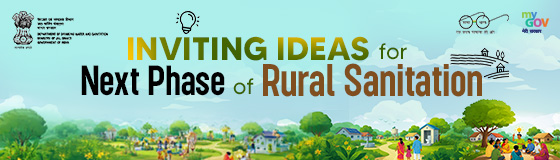
      Inviting Ideas for Next Phase of Rural Sanitation
      प्रारंभ तिथि 01/08/2026 - 11:49
      अंतिम तिथि 02/10/2026 - 23:45
      Time zone: IST (GMT +5.30 Hrs)
      Login to Participate
      क्षेत्र:
      Water & Sanitation
      Created : 1/08/2026
      606
      Total Comments
      441
      Users Participated

      In the last 12 years, SBM(G) has evolved from a sanitation programme into a nationwide movement that has improved public health, enhanced dignity of women, empowered communities and promoted sustainable rural development. Building on the achievement of Open Defecation Free (ODF) status, SBM(G) 2.0 has expanded its focus to sustaining sanitation outcomes through interventions such as Individual Household Latrines (IHHLs), Community Sanitary Complexes (CSCs), Solid and Liquid Waste Management, Plastic Waste Management, Faecal Sludge Management, GOBARdhan, Information, Education and Communication (IEC) and Capacity Building. The current phase of the Mission is scheduled to conclude in March 2027.

      As the Department prepares the roadmap for the next phase of rural sanitation, it seeks ideas from citizens to sustain and strengthen the gains achieved under SBM(G) while addressing emerging challenges related to waste management, resource recovery, environmental sustainability, Operation & Maintenance (O&M) and long-term community ownership of assets and outcomes. Innovative, practical and scalable solutions are required to enhance sanitation service delivery, strengthen waste management systems, promote behavioural change and accelerate the transition towards a circular waste-to-wealth economy. Given that the diversities of rural areas from urban cities, suggestions and ideas, specific to rural scenarios will be highly appreciated. Along with these, with peri-urban areas / villages also growing fast and having characteristics of urban centers, solutions specific for such areas are also being sought.

      The success of SBM(G) has been driven by the spirit of Jan Bhagidari (People's Participation). Citizens, Gram Panchayats, SHGs, youth, Swachhagrahis and other stakeholders have been at the forefront of transforming rural sanitation and their continued participation will remain critical for sustaining these achievements. 

      Accordingly, the Department of Drinking Water and Sanitation (DDWS), Ministry of Jal Shakti in collaboration with MyGov, invites citizens, youth, Gram Panchayats, SHGs, academic and research institutions, development partners and other stakeholders to share their suggestions and ideas for the next phase of rural sanitation programme on the following:

      1. Areas to be taken up (including existing areas where gaps may be remaining)
      2. New technological interventions for SWM, GWM, FSM.
      3. Rural Sanitation 
      4. Solutions for treating pollution in small nallahs/rivulets discharging into rivers in rural areas.
      5. Adoption of solutions based on traditional knowledge and ancient wisdom in new settings for rural India. 
      6. Any other area related to the programme.

      The suggestions received will help and guide the next phase of SBM(G) and contribute to building cleaner, healthier and environmentally sustainable villages that will be strong contributors for achieving the goal of Viksit Bharat@2047.

      Participation Guidelines 

      1. All Citizens, youth (including students), Gram Panchayats & SHGs, academic and research institutions, development partners, NGOs and other stakeholders are invited to contribute ideas for shaping the next phase of rural sanitation and solid-liquid waste management under Swachh Bharat Mission (Grameen).
      2. For detailed information about SBM(G) Phase II, applicants may visit the SBM(G) Phase II operational guidelines available on website of the Department (https://swachhbharatmission.ddws.gov.in). The guidelines can also be assessed through: https://swachhbharatmission.ddws.gov.in/sites/default/files/Guidelines/SBMG%20Phase-II%20Operational%20Guidelines.pdf 
      3. Suggestions may be submitted on any of the major components of SBM(G), including Individual Household Latrines (IHHLs), Community Sanitary Complexes (CSCs), Solid Waste Management, Liquid Waste Management, Plastic Waste Management, GOBARdhan, Faecal Sludge Management, Information, Education and Communication (IEC) and Capacity Building. Global best practices forming the bases of solution, may also duly mentioned and referred.
      4. Participants are encouraged to propose innovative, technology-driven, scientific, managerial, practical, feasible and scalable solutions to address rural sanitation challenges and strengthen long-term sustainability.
      5. Suggestions should focus on supporting the Department of Drinking Water and Sanitation (DDWS), Ministry of Jal Shakti, in developing the roadmap for the next phase of rural sanitation for India.
      6. Participants are required to register on the MyGov platform and submit their suggestions through the prescribed online form.

      Ishan Jaswal 4
      Ishan Jaswal 4
      1 week 1 day ago

      **JalRakshak – Smart Water-Point Monitoring System** I propose “JalRakshak”, a low-cost AI and IoT-based system for monitoring public taps and water tanks in rural villages. Flow sensors can detect excessive water usage or continuously running taps, while water-level sensors can prevent tank overflow. Basic water-quality sensors can identify sudden changes in parameters such as pH, turbidity and conductivity. The system will send data to a simple Gram Panchayat dashboard. AI will learn normal water-use patterns and identify unusual behaviour, helping detect possible leakage, wastage or other problems at an early stage. Each water point can receive a Water-Waste Score to help Panchayats prioritize maintenance. The system can be piloted in one village and later scaled to other villages and peri-urban areas. JalRakshak will promote water conservation, faster maintenance, better monitoring and sustainable rural sanitation through technology and community participation.

      Like 2
      Dislike 0
      • Reply
      Facebook X
      nehasharma_2891
      nehasharma_2891
      1 week 2 days ago

      Honorable Prime minister Shri Narendra Modi ji, I am discussing the main issue of villages that is household waste management. It is the main issue arises in every village as there is no particular space for waste management and people use to throw their household garbage near the pond and near the government locality like stadium, vyamshala etc. Every kind of waste is thrown which is most unhygienic thing . I suggest you to buildup some waste management plants near 2-3 villages and create facilities to carry household waste from door to door just like urban , so that villages will also remain clean and green. Buildup waste management plants helps to create employment for villagers and from that we can manage the garbage as in making electricity or gas and rest of the waste from that will be used in infrastructure of roads and railway tracks etc. If this waste management problem will solved then villages will also become clean and Swachh Bharat Mission Gramin will hopefully succeeded.

      Like 2
      Dislike 0
      • Reply
      Facebook X
      varma khushi santoshkumar
      varma khushi santoshkumar
      1 week 2 days ago

      The Swachh Bharat Mission (Gramin) has achieved remarkable toilet coverage, but the next phase must focus on sustainability, waste management, and community ownership. First, shift from construction to Operation & Maintenance by forming village Sanitation Committees under Gram Panchayats to monitor usage and repairs. In Mewat, Haryana, women SHGs running “Swachhata Samooh” reduced toilet abandonment significantly. Second, integrate water supply with sanitation by linking SBM-G with Jal Jeevan Mission; Ralegan Siddhi, Maharashtra shows how water conservation ensures year-round toilet functionality. Third, adopt decentralised waste-to-resource models like biogas plants and composting units; Kachchh, Gujarat villages convert waste into cooking gas and manure. Fourth, train local champions—Swachhata Doots from NCC, NSS, and schools—to drive behaviour change through street plays and peer monitoring, as seen in Satara, Maharashtra. Fifth, introduce micro-contribution (₹50–100/household) for

      Like 2
      Dislike 0
      • Reply
      Facebook X
      Latkaribhanuchandar
      Latkaribhanuchandar
      1 week 2 days ago

      Hon’ble Prime Minister Shri Narendra Modi Ji, For the next phase of Swachh Bharat Mission (Grameen), I suggest establishing “Gram Swachhata Resource Centres” at Gram Panchayat or cluster level. These centres can integrate waste collection, segregation, recycling, composting, greywater treatment and Faecal Sludge Management. Wet waste, cattle dung and agricultural waste can be converted into compost or biogas, while recyclable materials can support local livelihoods. Greywater should be treated through suitable solutions such as soak pits, constructed wetlands or DEWATS and reused wherever feasible. For peri-urban and densely populated villages, cluster-based Faecal Sludge Management and co-treatment with nearby STPs should be promoted where feasible. SHGs, youth, Swachhagrahis and Gram Panchayats should become active owners and managers, supported by sustainable O&M and revenue models. Clean Village → Waste-to-Wealth → Sustainable Village

      (0.28 MB)
      Like 1
      Dislike 0
      • Reply
      Facebook X
      KumtsuLims
      KumtsuLims
      1 week 3 days ago

      A few directions worth considering, depending on where the current program stands: Beyond toilet construction (if coverage is already high) Shift focus from "access" to actual, sustained use and behavior change Fecal sludge management — safe emptying, transport, and treatment (many areas build toilets but have nowhere for waste to go) Solid + liquid waste management at village level, not just latrines Sustainability and quality Retrofitting poorly built or single-pit toilets into twin-pit/septic systems Water availability tied to toilet use — no water source nearby kills usage Maintenance and repair support so toilets don't fall into disuse Institutional and community School and anganwadi (childcare center) sanitation and menstrual hygiene facilities Community-led total sanitation (CLTS) refreshers to sustain "open defecation free" status, since backsliding is common Local ownership — panchayat-level accountability and financing, not just top-down targets.

      Like 1
      Dislike 0
      • Reply
      Facebook X
      Devineni Manoj Kumar
      Devineni Manoj Kumar
      1 week 3 days ago

      The program of Magic Drain Technical disposal of waste material is already happening in selected regions of the state of india Andhra Pradesh. May be this is suitable for India because of its less budget feasibility and easily materialised in less time period. Like Solar energy i think this Magic Drainage technical program is suitable for India as a whole particularly villages.

      Like 1
      Dislike 0
      • Reply
      Facebook X
      rajeshmahato@yahoo.com
      RAJESH MAHATO
      1 week 3 days ago

      Lack of access to household toilets. Continued practice of open defecation. Poor maintenance of sanitation facilities. Inadequate fecal sludge and waste management. Shortage of water for sanitation purposes. Low awareness of hygiene and health practices. Financial constraints for construction and upkeep. Limited technical support and skilled manpower. Poor sanitation facilities in schools and public places. Safety and privacy concerns, especially for women and girls. Lack of inclusive facilities for elderly and differently-abled persons. Weak monitoring and evaluation mechanisms. Seasonal challenges such as floods and droughts affecting facilities. Difficulty in changing long-standing social and cultural behaviors. Ensuring long-term sustainability and regular usage of toilets. Focus Areas for New Ideas Water-saving sanitation solutions Affordable and durable toilets Smart monitoring systems Community behavior change initiatives

      Like 1
      Dislike 0
      • Reply
      Facebook X
      Akshay Jain_16
      Akshay Jain
      1 week 4 days ago

      अगर हम ऐसे इको एटीएम शुरू कर सकें जिनमें पुराने या खराब फोन िमा जकए िा सकें और बदले में ग्राहक नकद या यूपीआई के माध्यम से ऑनलाइन भुगतान प्राप्त कर सकें, तो यह भारत में एक क्ाांजतकारी कदम होगा। अगर हम ग्रामीण बैंकोां और भारतीय स्टेट बैंक की शाखाओां में ऐसे इको एटीएम स्थाजपत कर दें जिनमें पुराने या खराब फोन िमा जकए िा सकें, तो मोबाइल सुरजित रहेंगे और डेटा चोरी से सुरजित रहेगा। अगर ग्राहक को फोन का मूल्य जमल सके, तो हम कैजशफाई और बैंकोां की मदद से इस इको एटीएम पररयोिना को शुरू कर सकते हैं। यह एक शानदार पररयोिना होगी और हम पुराने फोन उनकी कांपजनयोां के अनुसार बेच सकेंगे और अगर कांपनी बांद हो गई है, तब भी हम मोबाइल फोन स्वीकार कर सकते हैं।

      Like 1
      Dislike 0
      • Reply
      Facebook X
      dvis505@gmail.com
      Deepak Kumar Vishwakarma
      1 week 4 days ago

      Respected Sir Sabhi Villages Mai Har Ghar Water-Harvesting System Ho and Road Par Street Light Ho and Road Par Awara Maveshiyo Ki Faltu Aawa Jahi Par Rok Lage and Villages Ki Sabhi Roads ki Continue Saaf Safai Hoti Rahe. Thanks 🙏 Yours Deepak Kumar Vishwakarma

      Like 1
      Dislike 0
      • Reply
      Facebook X
      Saurabh_278
      Saurabh_278
      1 week 4 days ago

      A nominal local tax could be introduced at the village level for development purposes. By tax, I mean a small contribution of around ₹100–₹200 per household, depending on the type/size of the house. BPL households could be exempted. The purpose would not only be fund generation but also greater awareness and participation. When villagers contribute from their own pockets, they are more likely to take interest in development projects and monitor how the funds are being utilized. This can improve transparency, accountability and citizen participation. Additionally, a VDO or Patwari should have fixed office hours of 2–3 hours in the village to receive complaints, applications and queries from villagers. After office hours, they can undertake field visits and other duties. This would strengthen the connection between citizens and local administration.

      Like 1
      Dislike 0
      • Reply
      Facebook X
      • First page « पहला
      • Previous page ‹ पिछला
      • पृष्ठ 1
      • पृष्ठ 2
      • Current page 3
      • पृष्ठ 4
      • पृष्ठ 5
      • पृष्ठ 6
      • पृष्ठ 7
      • पृष्ठ 8
      • पृष्ठ 9
      • …
      • Next page अगला ›
      • Last page आखरी »
      Please Log In to submit a comment.
      शामिल हों
      • समूह
      • कार्य
      • चर्चा करें
      • ब्लॉग
      • जनमत/सर्वेक्षण
      • वार्ता
      • क्विज़
      • MG प्राइम
      • अभियान
      • शपथ
      • पॉडकास्ट
      • मीडिया
      • पत्रिकाएँ
      जानें
      • माईगव: अवलोकन
      • माईगव से संबद्ध करें
      • माईगव के साथ काम करें
      • सर्कुलर
      • पल्स न्यूजलेटर
      • टेंडर्स
      • साप्ताहिक समाचार पत्र
      • Meity डैशबोर्ड
      • सेक्टर्स
      • कौशल
      • रूचि के क्षेत्र
      • आयु वर्ग
      • राष्ट्रीय कार्यक्रम
      • आर्काइव साइट्स
      सहायता और समर्थन
      • संपर्क करें
      • FAQ
      • प्रतिक्रिया
      • मदद
      • हमसे जुड़ें
      • सार्वजनिक शिकायत
      • साइट मैप
      • नियम एवं शर्तें
      • आधार का इस्तेमाल
      • वेब सूचना प्रबंधक
      • ICC
      • MyGov सोशल
      • पॉइंट्स और बैज्स
      • वेबसाइट की पॉलिसी
      उपयोगी लिंक्स
      • MyGov Quiz MyGov Quiz
      • Transforming India ट्रांसफॉर्मिंग इंडिया
      • MyGov Innovation माईगव इनोवेशन
      • MyGov Pledge माईगव संकल्प
      • MyGov Blog माईगव ब्लॉग
      • Self4Society सेल्फ4सोसायटी
      • Campus Program कैंपस कार्यक्रम
      • MyGov Saathi साथी
      Follow us
      Twitter Twitter 33.11 + Lakh Followers Facebook Facebook 15.14 + Lakh Followers Instagram Instagram 30.73 + Lakh Followers YouTube YouTube 7.43 + Lakh Subscribers LinkedIn LinkedIn 1.63 + Lakh Followers Messenger Messenger 1.60 + Lakh Followers WhatsApp WhatsApp 910.05 + Lakh Followers DailyHunt DailyHunt 7.2 + K Followers Public Public 85.5 + K Followers ShareChat ShareChat 82.22K Followers Snapchat Snapchat View All
      QR Code

      Download the MyGov Mobile App Join us in building a New India on the move.

      App Store Play Store
      NIC logo

      © Content owned, updated and maintained by the MyGov Cell. This website belongs to MyGov, Ministry of Electronics & Information Technology, Government of India.
      Platform is designed, developed and hosted by National Informatics Centre.

      CQW - MyGov certificateCertified Quality Website
      • Meity
      • Digital India
      • National Portal of India
      • Data Portal

      Copyright © MyGov 2014

      secure-1 - Last Updated: September 21, 2026
      Top
      This website uses cookies to provide a better user experience.
      By clicking accept, you agree to the policies outlined in the Cookie Settings.