Government of IndiaGOVERNMENT OF INDIA
मुख्य सामग्री छोड़ें
हिन्दी language
  • English
  • हिन्दी
Accessibility
Accessibility Tools
Color Adjustment
Text Size
Navigation Adjustment
Screen Reader iconScreen Reader
MyGov Twitter
MyGov Facebook
MyGov Youtube
MyGov Instagram
MyGov Linkedin
MyGov Whatsapp
Meri Sarkar Logo

Recent Searches

      Close

      शामिल हों

      • समूह
      • कार्य
      • चर्चा करें
      • जनमत/सर्वेक्षण
      • ब्लॉग
      • वार्ता
      • क्विज़
      • MG प्राइम
      • अभियान
      • शपथ
      • पॉडकास्ट
      • मीडिया
      • पत्रिकाएँ

      माईगव राज्य

      • अंडमान-निकोबार द्वीप समूह
      • अरूणाचल प्रदेश
      • असम
      • चंडीगढ़
      • छत्तीसगढ़
      • दादरा और नगर हवेली और दमन और दीव
      • गोवा
      • गुजरात
      • हरियाणा
      • हिमाचल प्रदेश
      • जम्मू और कश्मीर
      • झारखण्‍ड
      • कर्नाटक
      • लद्दाख
      • मध्‍य प्रदेश
      • महाराष्ट्र
      • मणिपुर
      • मिजोरम
      • नागालैण्‍ड
      • राजस्थान
      • तमिलनाडु
      • त्रिपुरा
      • उत्तर प्रदेश
      • उत्तराखंड
      • लक्षद्वीप
      • ओडिशा
      • पुडुचेरी
      • सिक्किम

      माइक्रोसाइट्स

      • ब्लॉग
      • कैंपस
      • इनोवेट इंडिया
      • शपथ
      • क्विज़
      • साथी
      • सेल्फ4सोसायटी
      • ट्रांसफॉर्मिंग इंडिया
      • PM इवेंट्स

      जानें

      • माईगव: अवलोकन
      • माईगव से संबद्ध करें
      • माईगव के साथ काम करें
      • सर्कुलर
      • पल्स न्यूजलेटर
      • टेंडर्स
      • साप्ताहिक समाचार पत्र
      • Meity डैशबोर्ड
      • सेक्टर्स
      • कौशल
      • रूचि के क्षेत्र
      • आयु वर्ग
      • राष्ट्रीय कार्यक्रम
      • आर्काइव साइट्स

      मदद/प्रतिक्रिया

      • संपर्क करें
      • FAQ
      • प्रतिक्रिया
      • मदद
      • हमसे जुड़ें
      • सार्वजनिक शिकायत
      • साइट मैप
      • नियम एवं शर्तें
      • आधार का इस्तेमाल
      • वेब सूचना प्रबंधक
      • ICC
      • MyGov सोशल
      • पॉइंट्स और बैज्स
      • वेबसाइट की पॉलिसी
      user-profile
      Together, Let's Engage In Good Governance 
      Login/Register
      1. Home
      2. Discuss
      3. Inviting Ideas for Next Phase of Rural Sanitation

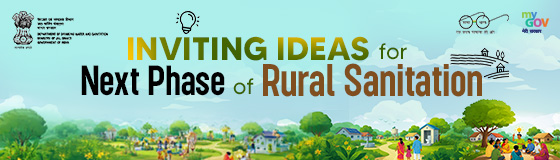
      Inviting Ideas for Next Phase of Rural Sanitation

      Facebook X
      Inviting Ideas for Next Phase of Rural Sanitation
      प्रारंभ तिथि 01/08/2026 - 11:49
      अंतिम तिथि 02/10/2026 - 23:45
      Time zone: IST (GMT +5.30 Hrs)
      Login to Participate
      क्षेत्र:
      Water & Sanitation
      Created : 1/08/2026
      527
      Total Comments
      373
      Users Participated

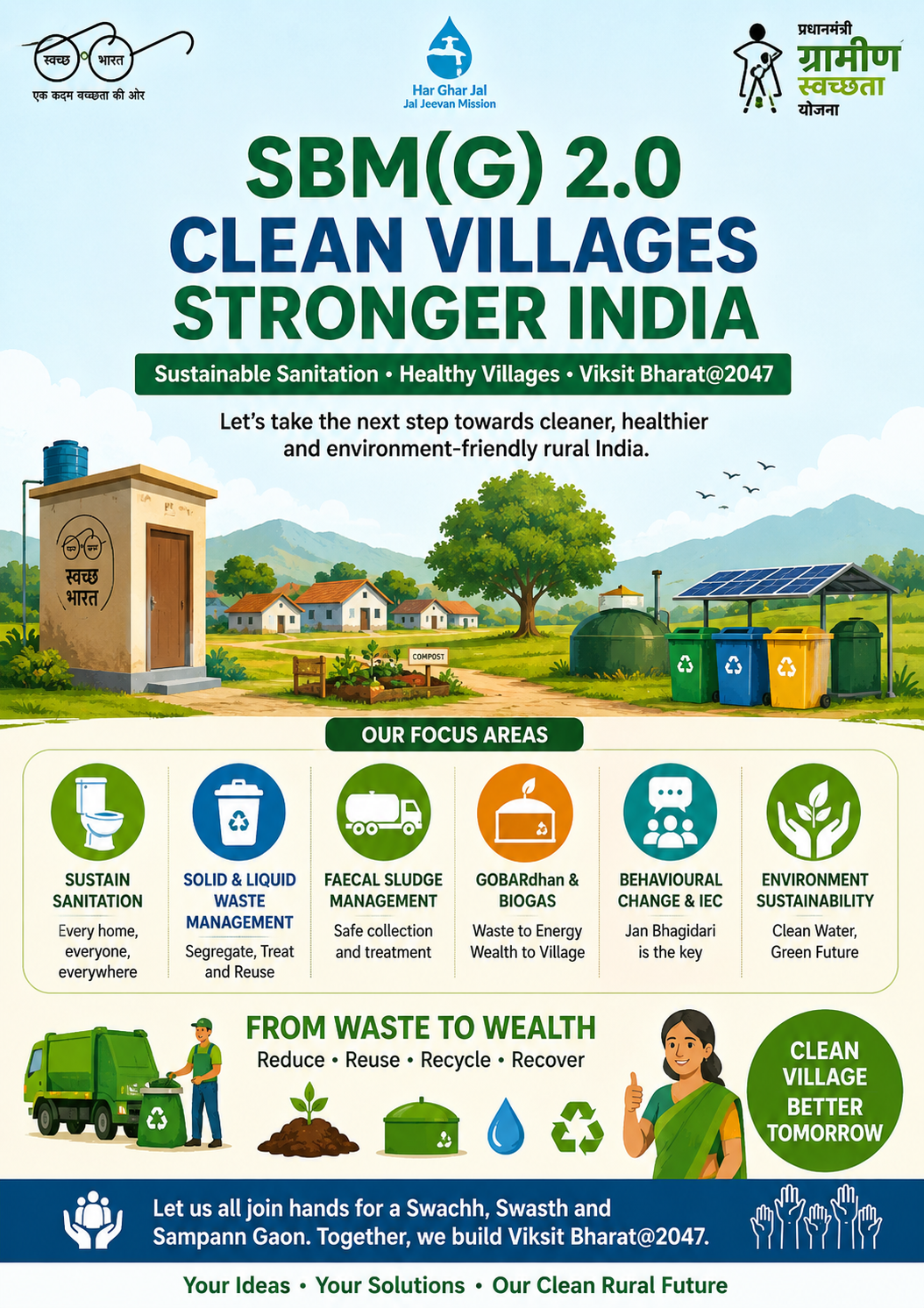
      In the last 12 years, SBM(G) has evolved from a sanitation programme into a nationwide movement that has improved public health, enhanced dignity of women, empowered communities and promoted sustainable rural development. Building on the achievement of Open Defecation Free (ODF) status, SBM(G) 2.0 has expanded its focus to sustaining sanitation outcomes through interventions such as Individual Household Latrines (IHHLs), Community Sanitary Complexes (CSCs), Solid and Liquid Waste Management, Plastic Waste Management, Faecal Sludge Management, GOBARdhan, Information, Education and Communication (IEC) and Capacity Building. The current phase of the Mission is scheduled to conclude in March 2027.

      As the Department prepares the roadmap for the next phase of rural sanitation, it seeks ideas from citizens to sustain and strengthen the gains achieved under SBM(G) while addressing emerging challenges related to waste management, resource recovery, environmental sustainability, Operation & Maintenance (O&M) and long-term community ownership of assets and outcomes. Innovative, practical and scalable solutions are required to enhance sanitation service delivery, strengthen waste management systems, promote behavioural change and accelerate the transition towards a circular waste-to-wealth economy. Given that the diversities of rural areas from urban cities, suggestions and ideas, specific to rural scenarios will be highly appreciated. Along with these, with peri-urban areas / villages also growing fast and having characteristics of urban centers, solutions specific for such areas are also being sought.

      The success of SBM(G) has been driven by the spirit of Jan Bhagidari (People's Participation). Citizens, Gram Panchayats, SHGs, youth, Swachhagrahis and other stakeholders have been at the forefront of transforming rural sanitation and their continued participation will remain critical for sustaining these achievements. 

      Accordingly, the Department of Drinking Water and Sanitation (DDWS), Ministry of Jal Shakti in collaboration with MyGov, invites citizens, youth, Gram Panchayats, SHGs, academic and research institutions, development partners and other stakeholders to share their suggestions and ideas for the next phase of rural sanitation programme on the following:

      1. Areas to be taken up (including existing areas where gaps may be remaining)
      2. New technological interventions for SWM, GWM, FSM.
      3. Rural Sanitation 
      4. Solutions for treating pollution in small nallahs/rivulets discharging into rivers in rural areas.
      5. Adoption of solutions based on traditional knowledge and ancient wisdom in new settings for rural India. 
      6. Any other area related to the programme.

      The suggestions received will help and guide the next phase of SBM(G) and contribute to building cleaner, healthier and environmentally sustainable villages that will be strong contributors for achieving the goal of Viksit Bharat@2047.

      Participation Guidelines 

      1. All Citizens, youth (including students), Gram Panchayats & SHGs, academic and research institutions, development partners, NGOs and other stakeholders are invited to contribute ideas for shaping the next phase of rural sanitation and solid-liquid waste management under Swachh Bharat Mission (Grameen).
      2. For detailed information about SBM(G) Phase II, applicants may visit the SBM(G) Phase II operational guidelines available on website of the Department (https://swachhbharatmission.ddws.gov.in). The guidelines can also be assessed through: https://swachhbharatmission.ddws.gov.in/sites/default/files/Guidelines/SBMG%20Phase-II%20Operational%20Guidelines.pdf 
      3. Suggestions may be submitted on any of the major components of SBM(G), including Individual Household Latrines (IHHLs), Community Sanitary Complexes (CSCs), Solid Waste Management, Liquid Waste Management, Plastic Waste Management, GOBARdhan, Faecal Sludge Management, Information, Education and Communication (IEC) and Capacity Building. Global best practices forming the bases of solution, may also duly mentioned and referred.
      4. Participants are encouraged to propose innovative, technology-driven, scientific, managerial, practical, feasible and scalable solutions to address rural sanitation challenges and strengthen long-term sustainability.
      5. Suggestions should focus on supporting the Department of Drinking Water and Sanitation (DDWS), Ministry of Jal Shakti, in developing the roadmap for the next phase of rural sanitation for India.
      6. Participants are required to register on the MyGov platform and submit their suggestions through the prescribed online form.
      swethakan3@gmail.com
      Swetha Kannan
      3 weeks ago

      3. Maintaining villages with plastic free, reduce, reuse, recycle, go green ways are possible ways to help to maintain greenery ways in villages. As Gandhiji said villages are very important ( maintaining the greenery ) for India's growth. Food cultivations happening in villages mostly I believe. So we have to maintain properly.

      Like 1
      Dislike 0
      • Reply
      Facebook X
      Malagope
      Malagope
      3 weeks ago

      India is the Our mother land and matri Bhumi We are very proud we are Birth in this land OurCountry AsDifferent langue and different uniform diffrent meal But we are Indian speak we are very proud Ours School collage Every Rivers ponds park play ground andRoads Swachha cleando it Ruaral and city Every space Swachha and clean do it Every citizens as Take the pleadgeOurs Matri Bhumi Every time swachha and clean

      Like 1
      Dislike 0
      • Reply
      Facebook X
      Shivabhadra
      Shivabhadra
      3 weeks ago

      It takes too time to make a poster But now the poster is next level sir

      comments image 168830
      Like 1
      Dislike 0
      • Reply
      Facebook X
      satheshkumar_1
      SATHESH KUMAR
      3 weeks ago

      Sir, May be use VBGRAMG 125 DAYS project workers in mass cleaning at school, PHC, STREETS at monthly once. Village secretary and assistant are to take responsibility to accumulate carbage in street, ponds, and lake. Advertisements for E waste, plastics, milk covers, to proper disposal.

      Like 1
      Dislike 0
      • Reply
      Facebook X
      alok deval_1
      alok deval_1
      3 weeks ago

      इस मॉडल से: गांवों में स्वच्छता व्यवस्था लंबे समय तक बनी रहेगी। कचरे की मात्रा कम होगी और recycling बढ़ेगी। Compost, biogas और recyclable material से पंचायत/SHG को आय होगी। महिला SHGs और युवाओं के लिए स्थानीय रोजगार के अवसर बढ़ेंगे। नालियों, तालाबों और नदियों में प्रदूषण कम होगा। पंचायतों की sanitation assets के Operation & Maintenance की क्षमता मजबूत होगी। ग्रामीण समुदाय में Jan Bhagidari और ownership की भावना बढ़ेगी। गांवों को Waste-to-Wealth और Circular Economy की दिशा में आगे बढ़ाया जा सकेगा। 6. निष्कर्ष SBM(G) के अगले चरण में प्रत्येक ग्राम पंचायत को केवल “स्वच्छता लाभार्थी” के रूप में नहीं बल्कि “स्वच्छता प्रबंधक और sanitation entrepreneur” के रूप में विकसित किया जाना चाहिए। स्थानीय परिस्थितियों के अनुसार तकनीक, पंचायत, SHGs, युवाओं और ग्रामीण समुदाय को एक साथ जोड़कर यह मॉडल कम लागत में scalable तरीके से पूरे देश में लागू किया जा सकता है। “कचरा कम करें, कचरे से कमाएं, पानी को साफ रखें और गांव को आत्मनिर्भर बनाएं।”

      Like 1
      Dislike 0
      • Reply
      Facebook X
      AJAYDEVANV
      AJAY DEVAN V
      3 weeks ago

      Hello

      Like 1
      Dislike 0
      • Reply
      Facebook X
      SHRAVAN_KUMAR
      SHRAVAN KUMAR
      3 weeks ago

      Gramin jivan swachh jivan

      Like 1
      Dislike 0
      • Reply
      Facebook X
      PadhiyarNaileshbhai
      PadhiyarNaileshbhai
      3 weeks ago

      Water solution: Clean the old and closed wells of the village and use them again as a source of water. Sanition: Sanitation Committee: Form a committee of village youth and women to monitor it."

      Like 1
      Dislike 0
      • Reply
      Facebook X
      Arnavkumar_1349
      Arnavkumar_1349
      3 weeks ago

      The next phase of rural sanitation should focus on making cleanliness a long-term habit rather than a one-time campaign. Villages can promote waste segregation, composting, plastic reduction, and proper wastewater management. Schools and local communities should conduct regular awareness programs to educate children and families about hygiene. Technology can also help through smart waste collection, digital reporting of sanitation problems, and community monitoring. Women, youth, self-help groups, and local leaders should be actively involved in planning and implementation. Most importantly, every village should work towards maintaining clean surroundings, safe toilets, proper drainage, and sustainable waste management. A clean village is the foundation of a healthy, dignified, and sustainable rural India.

      Like 1
      Dislike 0
      • Reply
      Facebook X
      oindrila roy_3
      oindrila roy_3
      3 weeks ago

      This proposal outlines a sustainable, community-scale sanitation model designed to convert human waste into renewable energy,recycle greywater,minimize pathogen transmission through touchless public infrastructure.Centralized Community Biogas Digester:Install one large-scale anaerobic digestor tank per village to aggregate human feces and urine.Renewable Biofuel Extraction: Capture the methane gas naturally produced during decomposition to supply clean cooking fuel or electricity for the local community.Slurry Filtration: Separate soapy residues,body wash,and chemical surfactants from bathing/handwashing wastewater.Channel the filtered water through (UV) radiation systems to eradicate bacteria, viruses, and remaining pathogens.Recycle the purified effluent for secondary agricultural irrigation, landscape maintenance+toilet flushing.Implement mechanical foot pedals for tap operation to prevent recontaminating clean hands(specially public toilet,school).Foot-Sensor Toilet Flushing.

      comments image 168324
      Like 1
      Dislike 0
      • Reply
      Facebook X
      • First page « पहला
      • Previous page ‹ पिछला
      • …
      • पृष्ठ 25
      • पृष्ठ 26
      • पृष्ठ 27
      • पृष्ठ 28
      • Current page 29
      • पृष्ठ 30
      • पृष्ठ 31
      • पृष्ठ 32
      • पृष्ठ 33
      • …
      • Next page अगला ›
      • Last page आखरी »
      Please Log In to submit a comment.
      शामिल हों
      • समूह
      • कार्य
      • चर्चा करें
      • ब्लॉग
      • जनमत/सर्वेक्षण
      • वार्ता
      • क्विज़
      • MG प्राइम
      • अभियान
      • शपथ
      • पॉडकास्ट
      • मीडिया
      • पत्रिकाएँ
      जानें
      • माईगव: अवलोकन
      • माईगव से संबद्ध करें
      • माईगव के साथ काम करें
      • सर्कुलर
      • पल्स न्यूजलेटर
      • टेंडर्स
      • साप्ताहिक समाचार पत्र
      • Meity डैशबोर्ड
      • सेक्टर्स
      • कौशल
      • रूचि के क्षेत्र
      • आयु वर्ग
      • राष्ट्रीय कार्यक्रम
      • आर्काइव साइट्स
      सहायता और समर्थन
      • संपर्क करें
      • FAQ
      • प्रतिक्रिया
      • मदद
      • हमसे जुड़ें
      • सार्वजनिक शिकायत
      • साइट मैप
      • नियम एवं शर्तें
      • आधार का इस्तेमाल
      • वेब सूचना प्रबंधक
      • ICC
      • MyGov सोशल
      • पॉइंट्स और बैज्स
      • वेबसाइट की पॉलिसी
      उपयोगी लिंक्स
      • MyGov Quiz MyGov Quiz
      • Transforming India ट्रांसफॉर्मिंग इंडिया
      • MyGov Innovation माईगव इनोवेशन
      • MyGov Pledge माईगव संकल्प
      • MyGov Blog माईगव ब्लॉग
      • Self4Society सेल्फ4सोसायटी
      • Campus Program कैंपस कार्यक्रम
      • MyGov Saathi साथी
      Follow us
      Twitter Twitter 33.11 + Lakh Followers Facebook Facebook 15.14 + Lakh Followers Instagram Instagram 30.73 + Lakh Followers YouTube YouTube 7.43 + Lakh Subscribers LinkedIn LinkedIn 1.63 + Lakh Followers Messenger Messenger 1.60 + Lakh Followers WhatsApp WhatsApp 910.05 + Lakh Followers DailyHunt DailyHunt 7.2 + K Followers Public Public 85.5 + K Followers ShareChat ShareChat 82.22K Followers Snapchat Snapchat View All
      QR Code

      Download the MyGov Mobile App Join us in building a New India on the move.

      App Store Play Store
      NIC logo

      © Content owned, updated and maintained by the MyGov Cell. This website belongs to MyGov, Ministry of Electronics & Information Technology, Government of India.
      Platform is designed, developed and hosted by National Informatics Centre.

      CQW - MyGov certificateCertified Quality Website
      • Meity
      • Digital India
      • National Portal of India
      • Data Portal

      Copyright © MyGov 2014

      secure-1 - Last Updated: May 7, 2026
      Top
      This website uses cookies to provide a better user experience.
      By clicking accept, you agree to the policies outlined in the Cookie Settings.