Government of IndiaGOVERNMENT OF INDIA
मुख्य सामग्री छोड़ें
हिन्दी language
  • English
  • हिन्दी
Accessibility
Accessibility Tools
Color Adjustment
Text Size
Navigation Adjustment
Screen Reader iconScreen Reader
MyGov Twitter
MyGov Facebook
MyGov Youtube
MyGov Instagram
MyGov Linkedin
MyGov Whatsapp
Meri Sarkar Logo

Recent Searches

      Close

      शामिल हों

      • समूह
      • कार्य
      • चर्चा करें
      • जनमत/सर्वेक्षण
      • ब्लॉग
      • वार्ता
      • क्विज़
      • MG प्राइम
      • अभियान
      • शपथ
      • पॉडकास्ट
      • मीडिया
      • पत्रिकाएँ

      माईगव राज्य

      • अंडमान-निकोबार द्वीप समूह
      • अरूणाचल प्रदेश
      • असम
      • चंडीगढ़
      • छत्तीसगढ़
      • दादरा और नगर हवेली और दमन और दीव
      • गोवा
      • गुजरात
      • हरियाणा
      • हिमाचल प्रदेश
      • जम्मू और कश्मीर
      • झारखण्‍ड
      • कर्नाटक
      • लद्दाख
      • मध्‍य प्रदेश
      • महाराष्ट्र
      • मणिपुर
      • मिजोरम
      • नागालैण्‍ड
      • राजस्थान
      • तमिलनाडु
      • त्रिपुरा
      • उत्तर प्रदेश
      • उत्तराखंड
      • लक्षद्वीप
      • ओडिशा
      • पुडुचेरी
      • सिक्किम

      माइक्रोसाइट्स

      • ब्लॉग
      • कैंपस
      • इनोवेट इंडिया
      • शपथ
      • क्विज़
      • साथी
      • सेल्फ4सोसायटी
      • ट्रांसफॉर्मिंग इंडिया
      • PM इवेंट्स

      जानें

      • माईगव: अवलोकन
      • माईगव से संबद्ध करें
      • माईगव के साथ काम करें
      • सर्कुलर
      • पल्स न्यूजलेटर
      • टेंडर्स
      • साप्ताहिक समाचार पत्र
      • Meity डैशबोर्ड
      • सेक्टर्स
      • कौशल
      • रूचि के क्षेत्र
      • आयु वर्ग
      • राष्ट्रीय कार्यक्रम
      • आर्काइव साइट्स

      मदद/प्रतिक्रिया

      • संपर्क करें
      • FAQ
      • प्रतिक्रिया
      • मदद
      • हमसे जुड़ें
      • सार्वजनिक शिकायत
      • साइट मैप
      • नियम एवं शर्तें
      • आधार का इस्तेमाल
      • वेब सूचना प्रबंधक
      • ICC
      • MyGov सोशल
      • पॉइंट्स और बैज्स
      • वेबसाइट की पॉलिसी
      user-profile
      Together, Let's Engage In Good Governance 
      Login/Register
      1. Home
      2. Discuss
      3. Inviting Ideas for Next Phase of Rural Sanitation

      Inviting Ideas for Next Phase of Rural Sanitation

      Facebook X
      Inviting Ideas for Next Phase of Rural Sanitation
      प्रारंभ तिथि 01/08/2026 - 11:49
      अंतिम तिथि 02/10/2026 - 23:45
      Time zone: IST (GMT +5.30 Hrs)
      Login to Participate
      क्षेत्र:
      Water & Sanitation
      Created : 1/08/2026
      529
      Total Comments
      373
      Users Participated

      In the last 12 years, SBM(G) has evolved from a sanitation programme into a nationwide movement that has improved public health, enhanced dignity of women, empowered communities and promoted sustainable rural development. Building on the achievement of Open Defecation Free (ODF) status, SBM(G) 2.0 has expanded its focus to sustaining sanitation outcomes through interventions such as Individual Household Latrines (IHHLs), Community Sanitary Complexes (CSCs), Solid and Liquid Waste Management, Plastic Waste Management, Faecal Sludge Management, GOBARdhan, Information, Education and Communication (IEC) and Capacity Building. The current phase of the Mission is scheduled to conclude in March 2027.

      As the Department prepares the roadmap for the next phase of rural sanitation, it seeks ideas from citizens to sustain and strengthen the gains achieved under SBM(G) while addressing emerging challenges related to waste management, resource recovery, environmental sustainability, Operation & Maintenance (O&M) and long-term community ownership of assets and outcomes. Innovative, practical and scalable solutions are required to enhance sanitation service delivery, strengthen waste management systems, promote behavioural change and accelerate the transition towards a circular waste-to-wealth economy. Given that the diversities of rural areas from urban cities, suggestions and ideas, specific to rural scenarios will be highly appreciated. Along with these, with peri-urban areas / villages also growing fast and having characteristics of urban centers, solutions specific for such areas are also being sought.

      The success of SBM(G) has been driven by the spirit of Jan Bhagidari (People's Participation). Citizens, Gram Panchayats, SHGs, youth, Swachhagrahis and other stakeholders have been at the forefront of transforming rural sanitation and their continued participation will remain critical for sustaining these achievements. 

      Accordingly, the Department of Drinking Water and Sanitation (DDWS), Ministry of Jal Shakti in collaboration with MyGov, invites citizens, youth, Gram Panchayats, SHGs, academic and research institutions, development partners and other stakeholders to share their suggestions and ideas for the next phase of rural sanitation programme on the following:

      1. Areas to be taken up (including existing areas where gaps may be remaining)
      2. New technological interventions for SWM, GWM, FSM.
      3. Rural Sanitation 
      4. Solutions for treating pollution in small nallahs/rivulets discharging into rivers in rural areas.
      5. Adoption of solutions based on traditional knowledge and ancient wisdom in new settings for rural India. 
      6. Any other area related to the programme.

      The suggestions received will help and guide the next phase of SBM(G) and contribute to building cleaner, healthier and environmentally sustainable villages that will be strong contributors for achieving the goal of Viksit Bharat@2047.

      Participation Guidelines 

      1. All Citizens, youth (including students), Gram Panchayats & SHGs, academic and research institutions, development partners, NGOs and other stakeholders are invited to contribute ideas for shaping the next phase of rural sanitation and solid-liquid waste management under Swachh Bharat Mission (Grameen).
      2. For detailed information about SBM(G) Phase II, applicants may visit the SBM(G) Phase II operational guidelines available on website of the Department (https://swachhbharatmission.ddws.gov.in). The guidelines can also be assessed through: https://swachhbharatmission.ddws.gov.in/sites/default/files/Guidelines/SBMG%20Phase-II%20Operational%20Guidelines.pdf 
      3. Suggestions may be submitted on any of the major components of SBM(G), including Individual Household Latrines (IHHLs), Community Sanitary Complexes (CSCs), Solid Waste Management, Liquid Waste Management, Plastic Waste Management, GOBARdhan, Faecal Sludge Management, Information, Education and Communication (IEC) and Capacity Building. Global best practices forming the bases of solution, may also duly mentioned and referred.
      4. Participants are encouraged to propose innovative, technology-driven, scientific, managerial, practical, feasible and scalable solutions to address rural sanitation challenges and strengthen long-term sustainability.
      5. Suggestions should focus on supporting the Department of Drinking Water and Sanitation (DDWS), Ministry of Jal Shakti, in developing the roadmap for the next phase of rural sanitation for India.
      6. Participants are required to register on the MyGov platform and submit their suggestions through the prescribed online form.
      HARIKRISHNAYADAV_10
      HARIKRISHNAYADAV_10
      2 weeks 6 days ago

      My Recommendations for Effective Solid and Liquid Waste Management 1. Segregation of Waste at Source 2. Fair and Adequate Payment to Waste Workers 3. Avoid Collection Charges at the Initial Stage 4. Solid Waste Management Should Be Based on Community Participation 5. Dedicated Fund for Vehicle and Shed Maintenance 6. Dedicated Facility for Composting Biodegradable Waste 7. Liquid Waste Management 8. Faecal Sludge and Septage Management.

      (0.01 MB)
      Like 1
      Dislike 0
      • Reply
      Facebook X
      Shrutikumari_1645
      Shrutikumari_1645
      2 weeks 6 days ago

      Bharat ek vikashsil desh hai isko digital banna hai.

      Like 1
      Dislike 0
      • Reply
      Facebook X
      ylawania@gmail.com
      Yogesh Lawania MyPromiseMyIndia
      3 weeks ago

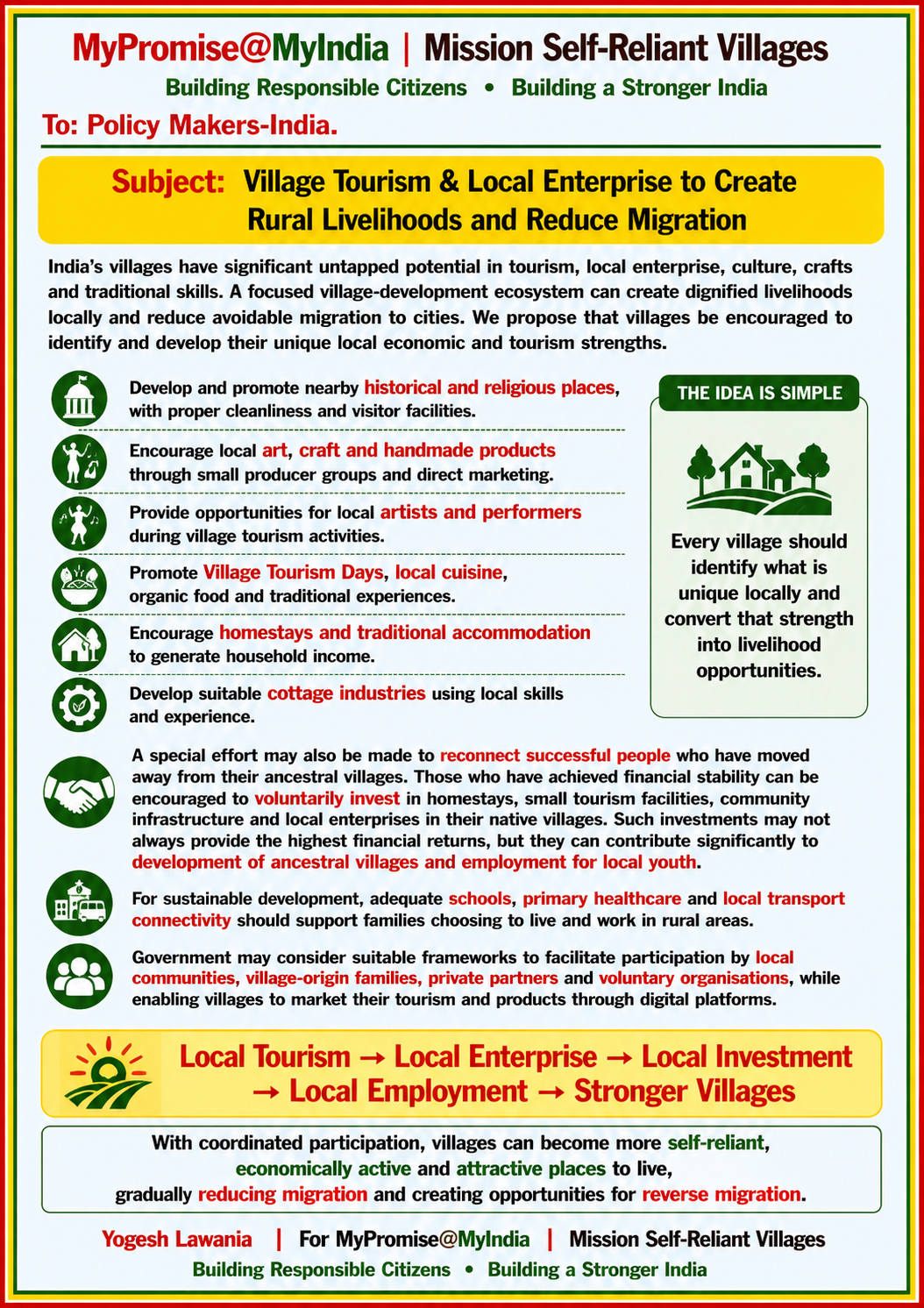
      To: Policy Makers-India. Subject: Village Tourism & Local Enterprise to Create Rural Livelihoods and Reduce Migration India’s villages have significant untapped potential in tourism, local enterprise, culture, crafts and traditional skills. A focused village-development ecosystem can create dignified livelihoods locally and reduce avoidable migration to cities. We propose that villages be encouraged to identify and develop their unique local economic and tourism strengths. •Develop and promote nearby historical and religious places, with proper cleanliness and visitor facilities. Provide opportunities for local artists and performers, Promote Village Tourism Days, local cuisine, organic food and traditional experiences. •Encourage homestays and traditional accommodation to generate household income. The idea is simple: every village should identify what is unique locally and convert that strength into livelihood opportunities.

      comments image 169389
      Like 1
      Dislike 0
      • Reply
      Facebook X
      Madhavi_1598
      Madhavi_1598
      3 weeks ago

      The next phase of SBM(G) should focus on sustainable sanitation, waste-to-wealth and strong community ownership. Every Gram Panchayat should promote simple segregation of wet, dry and plastic waste at source, with wet waste converted into compost/biogas and recyclable waste linked to authorised recycling centres. SHGs and local youth can be involved in collection, processing and maintenance, creating livelihood opportunities. Greater attention should be given to regular O&M of toilets, drainage, CSCs and wastewater systems. Low-cost technologies for greywater treatment and reuse should be encouraged, especially in water-stressed and peri-urban villages. Small drains and nallahs should be treated through local, nature-based solutions before they reach rivers and ponds. Schools, SHGs, youth and Swachhagrahis can lead awareness and monitoring. The focus should shift from creating assets to ensuring their long-term use, maintenance and measurable environmental impact.

      Like 2
      Dislike 0
      • Reply
      Facebook X
      Sachin Gavali
      Sachin Gavali
      3 weeks ago

      Suggestion: Sustainable Smart & Green Village – Next Phase of SBM(G) The next phase of SBM(G) should move beyond ODF/ODF Plus towards Sustainable, Smart, Green and Climate-Resilient Villages. Every Gram Panchayat may prepare a 5–10 year Sustainable Sanitation Plan covering SWM, Greywater Management, FSM, Plastic Waste Management, water conservation and long-term O&M of sanitation assets. Promote Zero/Minimum Waste, Waste-to-Wealth, Greywater Reuse, Plastic-Responsible Villages, Clean & Beautiful Public Spaces, Digital/AI-based monitoring and One Village–One Sanitation Innovation. Encourage women SHGs, youth and local entrepreneurs to create green jobs and sanitation enterprises. Introduce a Sustainable Village Rating and support scalable grassroots innovations through an Innovation Fund. The next phase should also recognise sanitation workers and the experienced contractual workforce who have served SBM(G) and rural sanitation programmes for 15–20 years.

      (0.16 MB)
      Like 2
      Dislike 0
      • Reply
      Facebook X
      IBrundha
      IBrundha
      3 weeks ago

      I want to introduce a new idea it was to implement that a water passport where it comes from where it includes the total usage of water and wher does it comes from and safe security card itself for each and every household activity innovative part is it gives points from the 1 to 100 by purification of water by functional toilet,safe drinking water,waste water management,waste water segregation and by this they can know which panchayat can face water shortage soon and a water passport can gives every rural family health record for their water and sanitation inititation allowing the village to identify problems eariler and they will take better initiative on this type of work we can call it as jal suraksha - gram ka raksha by the way reporting the problems only after something fails it is different from all this I think that knowing the damage before it happens is good this system is used to predict problems before by this we can know ground water level and water consumption too thanks.

      Like 2
      Dislike 0
      • Reply
      Facebook X
      misravivekmisra@gmail.com
      misravivekmisra
      3 weeks ago

      Respected Prime Minister Sir, With the utmost respect, humility, and reverence for your esteemed office, I humbly beg to place a brief submission before your gracious attention. Our beloved nation continues to face the twin challenges of severe flooding in states like Bihar, Assam, Uttar Pradesh, West Bengal, and Odisha, alongside severe drought conditions in regions across Rajasthan, Gujarat, Maharashtra, Karnataka, Madhya Pradesh, and Bundelkhand. It pains every citizen to see our brothers and sisters suffer from these recurring natural hardships. I am fully aware that under your visionary leadership, the government has given deep thought to national water integration. I humbly acknowledge the immense political and logistical complexities involved in large-scale infrastructure projects, particularly regarding land acquisition and public consensus. As a humble civil engineer devoted to the service of our motherland, I respectfully wish to share a technical concept

      (0.2 MB)
      Like 2
      Dislike 0
      • Reply
      Facebook X
      udhavshivajiphad
      udhavshivajiphad
      3 weeks ago

      Swachh Bharat: Experienced Workforce is Key to Success ​🎯Main Objective: To effectively implement Phase 3 of the 'Swachh Bharat Mission' for a clean, sustainable, and prosperous India by 2047. Evolving Role & Challenges ​In the next phase of rural sanitation, focus must shift beyond building toilets to: ​Sustainability: Long-term maintenance of created infrastructure. ​Behavior Change (IEC): Driving positive habits among citizens. ​Community Participation: Transforming sanitation into a public movement. ​ Value of Experienced Staff ​Contractual staff working at district and block levels for 10+ years have driven awareness, waste management (SLWM/FSM), and local guidance. ​ Key Note: Replacing them with new recruits wastes time, funds, and expertise. Their field knowledge is an invaluable asset. ​ Key Policy Recommendations ​Service Continuity: Formulate a dedicated policy to extend services of staff with 10+ years of tenure. ​Fair Compensation: Fix respectful honor

      Like 2
      Dislike 0
      • Reply
      Facebook X
      supriyadavatpure
      supriyadavatpure
      3 weeks ago

      The experience, skills, and ground-level knowledge developed over the last decade are an extremely valuable resource for the next phase. Replacing this experienced workforce with new personnel instead of utilizing them could lead to a loss of experience, as well as an increase in the time and resources required for training.

      Like 3
      Dislike 0
      • Reply
      Facebook X
      supriyadavatpure
      supriyadavatpure
      3 weeks ago

      Effective Utilization of Experienced Manpower for the Next Phase of Swachh Bharat ​Objective ​To effectively and sustainably implement the national movement of 'Swachh Bharat' to build a developed, sustainable, and prosperous India by 2047. ​1. Background & Context ​In the next phase of rural sanitation, alongside creating infrastructure, greater emphasis must be placed on the following aspects: ​Sustainability of infrastructure ​Behavioral change among citizens ​Broad public participation ​Effective and rapid implementation 2. Contribution & Importance of Experienced Manpower ​Contractual staff working at the district and taluka levels in the Swachh Bharat Mission for the past 10 years have consistently made significant contributions in the following areas: ​Public awareness and Information, Education, and Communication (IEC) ​Driving behavioral change and fostering public participation ​Guiding Gram Panchayats and executing sanitation campaigns slwm

      Like 3
      Dislike 0
      • Reply
      Facebook X
      • First page « पहला
      • Previous page ‹ पिछला
      • …
      • पृष्ठ 24
      • पृष्ठ 25
      • पृष्ठ 26
      • पृष्ठ 27
      • Current page 28
      • पृष्ठ 29
      • पृष्ठ 30
      • पृष्ठ 31
      • पृष्ठ 32
      • …
      • Next page अगला ›
      • Last page आखरी »
      Please Log In to submit a comment.
      शामिल हों
      • समूह
      • कार्य
      • चर्चा करें
      • ब्लॉग
      • जनमत/सर्वेक्षण
      • वार्ता
      • क्विज़
      • MG प्राइम
      • अभियान
      • शपथ
      • पॉडकास्ट
      • मीडिया
      • पत्रिकाएँ
      जानें
      • माईगव: अवलोकन
      • माईगव से संबद्ध करें
      • माईगव के साथ काम करें
      • सर्कुलर
      • पल्स न्यूजलेटर
      • टेंडर्स
      • साप्ताहिक समाचार पत्र
      • Meity डैशबोर्ड
      • सेक्टर्स
      • कौशल
      • रूचि के क्षेत्र
      • आयु वर्ग
      • राष्ट्रीय कार्यक्रम
      • आर्काइव साइट्स
      सहायता और समर्थन
      • संपर्क करें
      • FAQ
      • प्रतिक्रिया
      • मदद
      • हमसे जुड़ें
      • सार्वजनिक शिकायत
      • साइट मैप
      • नियम एवं शर्तें
      • आधार का इस्तेमाल
      • वेब सूचना प्रबंधक
      • ICC
      • MyGov सोशल
      • पॉइंट्स और बैज्स
      • वेबसाइट की पॉलिसी
      उपयोगी लिंक्स
      • MyGov Quiz MyGov Quiz
      • Transforming India ट्रांसफॉर्मिंग इंडिया
      • MyGov Innovation माईगव इनोवेशन
      • MyGov Pledge माईगव संकल्प
      • MyGov Blog माईगव ब्लॉग
      • Self4Society सेल्फ4सोसायटी
      • Campus Program कैंपस कार्यक्रम
      • MyGov Saathi साथी
      Follow us
      Twitter Twitter 33.11 + Lakh Followers Facebook Facebook 15.14 + Lakh Followers Instagram Instagram 30.73 + Lakh Followers YouTube YouTube 7.43 + Lakh Subscribers LinkedIn LinkedIn 1.63 + Lakh Followers Messenger Messenger 1.60 + Lakh Followers WhatsApp WhatsApp 910.05 + Lakh Followers DailyHunt DailyHunt 7.2 + K Followers Public Public 85.5 + K Followers ShareChat ShareChat 82.22K Followers Snapchat Snapchat View All
      QR Code

      Download the MyGov Mobile App Join us in building a New India on the move.

      App Store Play Store
      NIC logo

      © Content owned, updated and maintained by the MyGov Cell. This website belongs to MyGov, Ministry of Electronics & Information Technology, Government of India.
      Platform is designed, developed and hosted by National Informatics Centre.

      CQW - MyGov certificateCertified Quality Website
      • Meity
      • Digital India
      • National Portal of India
      • Data Portal

      Copyright © MyGov 2014

      secure-1 - Last Updated: May 7, 2026
      Top
      This website uses cookies to provide a better user experience.
      By clicking accept, you agree to the policies outlined in the Cookie Settings.