
Home | MyGov

Accessibility
ऐक्सेसिबिलिटी टूल
कलर एडजस्टमेंट
टेक्स्ट साइज़
नेविगेशन एडजस्टमेंट

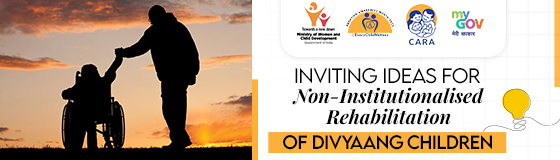
Inviting Ideas for Non-Institutionalised Rehabilitation of Divyaang Children

Inviting Ideas for Non-Institutionalised Rehabilitation of Divyaang Children
आरंभ करने की तिथि :
Oct 01, 2025
अंतिम तिथि :
Nov 30, 2025
17:30 PM IST (GMT +5.30 Hrs)
प्रस्तुतियाँ समाप्त हो चुके

In 2025, the Central Adoption Resource Authority (CARA) is placing special focus on promoting family-based care for children with special needs (Divyaang children). In ...

In 2025, the Central Adoption Resource Authority (CARA) is placing special focus on promoting family-based care for children with special needs (Divyaang children). In collaboration with MyGov, CARA invites all Indian citizens to participate in an important national discussion on the theme:
“Non-institutionalized Rehabilitation of Children with Special Needs (Divyaang Children)”

This initiative seeks to create a collaborative platform where citizens can:
1. Share insights on the challenges and barriers in the identification and adoption of children with special needs
2. Suggest innovative ideas, strategies, or solutions to strengthen the adoption ecosystem
3. Contribute to policy-making by offering actionable recommendations to ensure a loving family environment for every child, especially those currently residing in Specialized Adoption Agencies (SAAs) and Child Care Institutions (CCIs)

Your thoughtful suggestions can play a key role in shaping a more inclusive, compassionate, and efficient adoption framework for Divyaang children.

Who can participate?
All Indian citizens are welcome to join the conversation and submit their ideas.

Why participate?
Selected entries may be featured in national-level publications, exhibitions, and even considered in policy discussions aimed at improving the lives of children with special needs.

Let’s work together to ensure every child finds a loving family and a brighter future. Join the discussion today and be a voice for change!

फिर से कायम कर देना
777 सबमिशन दिखा रहा है
Mehul S Ganvit
Mehul S Ganvit 3 महीने 1 week पहले
1. Community-Based Rehabilitation (CBR) Clubs Weekly therapy and learning activities in community spaces; run by volunteers and therapists. 2. Home-Based Therapy Support Program Regular home visits to train parents in exercises, communication practices, and behaviour support. 3. Inclusive Education Support Cells Assistance with shadow teachers, learning aids, and teacher training for inclusive schooling. 4. Parent Empowerment Groups Support circles for parents focusing on early intervention, stress management, and rights awareness. 5. Livelihood & Pre-Vocational Training Skill-building for older children: digital literacy, handicrafts, packaging, kitchen skills. 6. Mobile Therapy Van Therapy-equipped van offering physiotherapy, speech therapy, counselling in rural areas. 7. Sensory Parks & Accessible Playgrounds Community play zones with sensory pathways, balance boards, and adaptive swings.
Venkatachalapathi
Venkatachalapathi 3 महीने 1 week पहले
Sir we proud to celebrate constitutional day with u. Honorable sir we are in safe hands and we are celebrating today real and a meaningful constitutional day because democracy is in right way real we are enjoying real democracy since 2014 every citizen is enjoying their lifes peacefully sir please dont disturb your minds for barking dogs you are a sevak to my nation please go ahead bring our nation in front line in the world we are all support u sir thank u sir
Vilop K G
Vilop K G 3 महीने 1 week पहले
It is unfortunate to bring the matter before Honble PM that, the postman of Krishna Layout, Hulimavu, Bengaluru 560076 is not delivering our letters. I had also raised complaint on PG portal, but the SSP and PMG replied stating that they will take necessary steps. But the same is continued. And the postman by name Amar is a alcoholic during the duty.
Karamdeep Kaur
Karamdeep Kaur 3 महीने 1 week पहले
This proposal emphasizes a comprehensive, community-based approach for the non-institutionalised rehabilitation of Divyaang children. It recommends strengthening educational support through trained special-education teachers, inclusive activities, and skill-based learning. Families adopting or fostering Divyaang children should receive financial assistance, free specialist check-ups, and government-provided assistive devices, supported by mandatory parent sensitivity training. Home-based early intervention, community volunteer engagement, accessible transport, and respite care services are essential for reducing dependency on institutions. A national helpline, mobile app, and simplified disability certification process will improve accessibility and guidance. The plan also highlights the need to promote Divyaang children’s talents in sports, arts, and vocational skills at all levels.
Karamdeep Kaur
Karamdeep Kaur 3 महीने 1 week पहले
This proposal emphasizes a comprehensive, community-based approach for the non-institutionalised rehabilitation of Divyaang children. It recommends strengthening educational support through trained special-education teachers, inclusive activities, and skill-based learning. Families adopting or fostering Divyaang children should receive financial assistance, free specialist check-ups, and government-provided assistive devices, supported by mandatory parent sensitivity training. Home-based early intervention, community volunteer engagement, accessible transport, and respite care services are essential for reducing dependency on institutions. A national helpline, mobile app, and simplified disability certification process will improve accessibility and guidance. The plan also highlights the need to promote Divyaang children’s talents in sports, arts, and vocational skills at all levels.
Karamdeep Kaur
Karamdeep Kaur 3 महीने 1 week पहले
This proposal emphasizes a comprehensive, community-based approach for the non-institutionalised rehabilitation of Divyaang children. It recommends strengthening educational support through trained special-education teachers, inclusive activities, and skill-based learning. Families adopting or fostering Divyaang children should receive financial assistance, free specialist check-ups, and government-provided assistive devices, supported by mandatory parent sensitivity training. Home-based early intervention, community volunteer engagement, accessible transport, and respite care services are essential for reducing dependency on institutions. A national helpline, mobile app, and simplified disability certification process will improve accessibility and guidance. The plan also highlights the need to promote Divyaang children’s talents in sports, arts, and vocational skills at all levels.
Karamdeep Kaur
Karamdeep Kaur 3 महीने 1 week पहले
This proposal emphasizes a comprehensive, community-based approach for the non-institutionalised rehabilitation of Divyaang children. It recommends strengthening educational support through trained special-education teachers, inclusive activities, and skill-based learning. Families adopting or fostering Divyaang children should receive financial assistance, free specialist check-ups, and government-provided assistive devices, supported by mandatory parent sensitivity training. Home-based early intervention, community volunteer engagement, accessible transport, and respite care services are essential for reducing dependency on institutions. A national helpline, mobile app, and simplified disability certification process will improve accessibility and guidance. The plan also highlights the need to promote Divyaang children’s talents in sports, arts, and vocational skills at all levels.
Shikha patel
Shikha patel 3 महीने 1 week पहले
This proposal emphasizes a comprehensive, community-based approach for the non-institutionalised rehabilitation of Divyaang children. It recommends strengthening educational support through trained special-education teachers, inclusive activities, and skill-based learning. Families adopting or fostering Divyaang children should receive financial assistance, free specialist check-ups, and government-provided assistive devices, supported by mandatory parent sensitivity training. Home-based early intervention, community volunteer engagement, accessible transport, and respite care services are essential for reducing dependency on institutions. A national helpline, mobile app, and simplified disability certification process will improve accessibility and guidance. The plan also highlights the need to promote Divyaang children’s talents in sports, arts, and vocational skills at all levels.
Shikha patel
Shikha patel 3 महीने 1 week पहले
For the non-institutionalised rehabilitation of Divyaang children, I suggest creating a strong community-based support system strengthened by data and policy integration. Schools and nearby educational institutions should have trained special-education teachers who include Divyaang children in activities, games, and skill-based learning to improve their physical, emotional, and social development and help them gain future earning skills. Families adopting or fostering Divyaang children should receive monthly financial support, free regular check-ups by specialists in government hospitals, and free assistive equipment such as wheelchairs, hearing aids, and learning tools. Parents should receive basic education and sensitivity training to understand the child’s needs. The government should launch home-based early intervention services, involve community volunteers, create a national helpline and mobile app for therapy and counselling, and provide accessible transport and respite care.