Home | MyGov

Accessibility
ऐक्सेसिबिलिटी टूल
कलर एडजस्टमेंट
टेक्स्ट साइज़
नेविगेशन एडजस्टमेंट

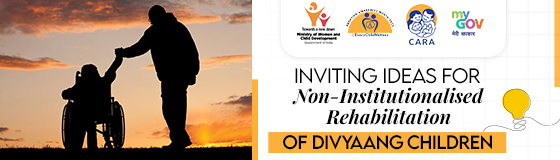
Inviting Ideas for Non-Institutionalised Rehabilitation of Divyaang Children

Inviting Ideas for Non-Institutionalised Rehabilitation of Divyaang Children
आरंभ करने की तिथि :
Oct 01, 2025
अंतिम तिथि :
Nov 30, 2025
17:30 PM IST (GMT +5.30 Hrs)
प्रस्तुतियाँ समाप्त हो चुके

In 2025, the Central Adoption Resource Authority (CARA) is placing special focus on promoting family-based care for children with special needs (Divyaang children). In ...

In 2025, the Central Adoption Resource Authority (CARA) is placing special focus on promoting family-based care for children with special needs (Divyaang children). In collaboration with MyGov, CARA invites all Indian citizens to participate in an important national discussion on the theme:
“Non-institutionalized Rehabilitation of Children with Special Needs (Divyaang Children)”

This initiative seeks to create a collaborative platform where citizens can:
1. Share insights on the challenges and barriers in the identification and adoption of children with special needs
2. Suggest innovative ideas, strategies, or solutions to strengthen the adoption ecosystem
3. Contribute to policy-making by offering actionable recommendations to ensure a loving family environment for every child, especially those currently residing in Specialized Adoption Agencies (SAAs) and Child Care Institutions (CCIs)

Your thoughtful suggestions can play a key role in shaping a more inclusive, compassionate, and efficient adoption framework for Divyaang children.

Who can participate?
All Indian citizens are welcome to join the conversation and submit their ideas.

Why participate?
Selected entries may be featured in national-level publications, exhibitions, and even considered in policy discussions aimed at improving the lives of children with special needs.

Let’s work together to ensure every child finds a loving family and a brighter future. Join the discussion today and be a voice for change!

फिर से कायम कर देना
777 सबमिशन दिखा रहा है
Sanapala Radhika
Sanapala Radhika 3 महीने 2 सप्ताह पहले
Thank you CARA, for listening the voice of people As a student studying Human development and family studies course, I feel this initiative helps a lot but what happens here is caregiver might feel burden and sometimes family may withdraw from community life due to stigmas or caregiver demands and also adequate knowledge is required for the caregiver to take proper care . To get rid of all these government should consider them and provide proper training for the members of the family and help them to feel stronger and support the child with needs and should also provide financial support in order get the necessities that their child requires and also if we analyze the situation properly here the sibling of the special child feels neglected and pressured and this impacts their own development thus the children who are in the condition should also be given proper awareness about situation.Any programme needs people's support for success thus guidance should be given .
Anjal kumari
Anjal kumari 3 महीने 2 सप्ताह पहले
1. Family and community empowerment parent training to conduct simple physiotherapy, speech exercises and other therapies at home community clubs: organize weekly clubs for activities like art music dance and inclusive sports to improve social interaction and build confidence 2. policy and funding support for families: ensure financial assistance and access to Government schemes for the family of divyang children Robust monitoring: establish a national tracking and monitoring system with community oversight to ensure quality control and accountability 3. Tele-rehabilitation: use virtual therapy sessions to connect children with specialists 4. integrate children into mainstream schools with flexible learning models and NEP-aligned curriculum 5. use mobile teams or door to door visits from therapists to provide services in remote areas
Rakesh gupta
Rakesh gupta 3 महीने 2 सप्ताह पहले
भारत में प्रत्येक 3 वर्ष बाद general election करवाने चाहिए सभी राज्यों के और केंद्र सरकार के चुनाव एक साथ प्रत्येक 3 वर्ष पश्चात
kunal kishore
kunal kishore 3 महीने 2 सप्ताह पहले
Divyaang children is a very big concern for our country.it should be shorted out through different channel .my view is to divyaang children trust had to be formed constitutionally.second tax rebate has been given for people who donate it.third a social awareness campaign has to be started for it.
RAJNI CHOPRA
RAJNI CHOPRA 3 महीने 2 सप्ताह पहले
Inviting Ideas for Non-Institutionalized Rehabilitation of Divyaang Children(500 Words) Effective non-institutionalized rehabilitation of Divyaang (children with disabilities) emphasizes family-based care, community engagement, and the creation of nurturing environments that promote inclusion and dignity. This approach addresses the unique needs of such children by moving beyond institutions toward holistic societal integration, drawing from best practices and innovative ideas supported by recent national campaigns and policy discussions���.Family-Based CarePrioritizing family-based care ensures Divyaang children experience love, warmth, and stability. Policy reforms must encourage and support families willing to adopt or foster children with special needs by offering financial assistance, health benefits (such as special health cards), and counseling services�. Training and sensitization programs for prospective adoptive parents and existing families can enhance understanding, empat
POOJA RAJVANSHI
POOJA RAJVANSHI 3 महीने 2 सप्ताह पहले
Non-installationalised rehabilitation, or family- and community-based rehabilitation, helps Devyang (children with disabilities) grow in loving, inclusive environments rather than institutions. Such approaches focus on empowering children, families, and communities to nurture abilities, independence, and dignity����.Key PrinciplesEvery child deserves love, care, and family—not just shelter�.The strategy shifts focus from charity or isolation to empowerment and inclusion in society�.Non-installationalised rehabilitation is rooted in early identification, accessible support, and community-based care�.Practical ModelsFamily-based care and support networks are promoted, including small groups of families meeting for therapy, play-based learning, and shared care activities�.Early screening and sensitization programs help identify needs quickly and encourage adoption and caring for special needs children within families�.Home-based and community-based rehabilitation is emphasized, such as oc