
Home | MyGov

Accessibility
ऐक्सेसिबिलिटी टूल
कलर एडजस्टमेंट
टेक्स्ट साइज़
नेविगेशन एडजस्टमेंट

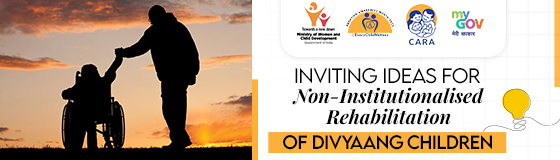
Inviting Ideas for Non-Institutionalised Rehabilitation of Divyaang Children

Inviting Ideas for Non-Institutionalised Rehabilitation of Divyaang Children
आरंभ करने की तिथि :
Oct 01, 2025
अंतिम तिथि :
Nov 30, 2025
17:30 PM IST (GMT +5.30 Hrs)
प्रस्तुतियाँ समाप्त हो चुके

In 2025, the Central Adoption Resource Authority (CARA) is placing special focus on promoting family-based care for children with special needs (Divyaang children). In ...

In 2025, the Central Adoption Resource Authority (CARA) is placing special focus on promoting family-based care for children with special needs (Divyaang children). In collaboration with MyGov, CARA invites all Indian citizens to participate in an important national discussion on the theme:
“Non-institutionalized Rehabilitation of Children with Special Needs (Divyaang Children)”

This initiative seeks to create a collaborative platform where citizens can:
1. Share insights on the challenges and barriers in the identification and adoption of children with special needs
2. Suggest innovative ideas, strategies, or solutions to strengthen the adoption ecosystem
3. Contribute to policy-making by offering actionable recommendations to ensure a loving family environment for every child, especially those currently residing in Specialized Adoption Agencies (SAAs) and Child Care Institutions (CCIs)

Your thoughtful suggestions can play a key role in shaping a more inclusive, compassionate, and efficient adoption framework for Divyaang children.

Who can participate?
All Indian citizens are welcome to join the conversation and submit their ideas.

Why participate?
Selected entries may be featured in national-level publications, exhibitions, and even considered in policy discussions aimed at improving the lives of children with special needs.

Let’s work together to ensure every child finds a loving family and a brighter future. Join the discussion today and be a voice for change!

फिर से कायम कर देना
777 सबमिशन दिखा रहा है
indhunatraj
indhunatraj 3 महीने 1 week पहले
I write this letter as a concerned parent, with both hope and trust. My child has ADHD (Attention Deficit Hyperactivity Disorder). He is not weak, not careless, not undisciplined — he is a child who learns and experiences the world in a different way. Every day, I see his heart full of potential. He is curious, energetic, creative and sensitive. But society often sees only his struggle: difficulty focusing, controlling impulses, or sitting still. The world calls it a “problem”; as a parent, I see it as a challenge that needs support, compassion and understanding. Children like mine are repeatedly misunderstood in schools. They are scolded for behaviour they cannot control, punished for attention they cannot maintain, and labelled before they are allowed to bloom. Parents silently carry this burden — not because we are ashamed, but because we do not know where to go for help.
Bheemaraju Rama Sagar
Bheemaraju Rama Sagar 3 महीने 1 week पहले
To provide Non-institutionalized rehabilitation of Divyaang children can be achieved through a multifaceted approach that incorporates family care, community-based rehabilitation, and access to therapy and counseling services. Inclusive education and skill based training programs can help Divyaang children develop confidence in their hearts. like self-expression and assistive technology can also enhance their quality of life. Support groups help families and children feel connected. And also home-based help enables families to support their child's growth. Community awareness campaigns promote understanding and acceptance, paving the way for inclusive environments. By working together, we can create opportunities for Divyaang children to thrive and reach their full potential.
Karamdeep Kaur
Karamdeep Kaur 3 महीने 1 week पहले
For the non-institutionalised rehabilitation of Divyaang children, I suggest creating a strong community-based support system strengthened by data and policy integration. Schools and nearby educational institutions should have trained special-education teachers who include Divyaang children in activities, games, and skill-based learning to improve their physical, emotional, and social development and help them gain future earning skills. Families adopting or fostering Divyaang children should receive monthly financial support, free regular check-ups by specialists in government hospitals, and free assistive equipment such as wheelchairs, hearing aids, and learning tools. Parents should receive basic education and sensitivity training to understand the child’s needs. The government should launch home-based early intervention services, involve community volunteers, create a national helpline and mobile app for therapy and counselling, and provide accessible transport and respite care.
Karamdeep Kaur
Karamdeep Kaur 3 महीने 1 week पहले
For the non-institutionalised rehabilitation of Divyaang children, I suggest creating a strong community-based support system strengthened by data and policy integration. Schools and nearby educational institutions should have trained special-education teachers who include Divyaang children in activities, games, and skill-based learning to improve their physical, emotional, and social development and help them gain future earning skills. Families adopting or fostering Divyaang children should receive monthly financial support, free regular check-ups by specialists in government hospitals, and free assistive equipment such as wheelchairs, hearing aids, and learning tools. Parents should receive basic education and sensitivity training to understand the child’s needs. The government should launch home-based early intervention services, involve community volunteers, create a national helpline and mobile app for therapy and counselling, and provide accessible transport and respite care.
Karamdeep Kaur
Karamdeep Kaur 3 महीने 1 week पहले
For the non-institutionalised rehabilitation of Divyaang children, I suggest creating a strong community-based support system strengthened by data and policy integration. Schools and nearby educational institutions should have trained special-education teachers who include Divyaang children in activities, games, and skill-based learning to improve their physical, emotional, and social development and help them gain future earning skills. Families adopting or fostering Divyaang children should receive monthly financial support, free regular check-ups by specialists in government hospitals, and free assistive equipment such as wheelchairs, hearing aids, and learning tools. Parents should receive basic education and sensitivity training to understand the child’s needs. The government should launch home-based early intervention services, involve community volunteers, create a national helpline and mobile app for therapy and counselling, and provide accessible transport and respite care.
Karamdeep Kaur
Karamdeep Kaur 3 महीने 1 week पहले
For the non-institutionalised rehabilitation of Divyaang children, I suggest creating a strong community-based support system strengthened by data and policy integration. Schools and nearby educational institutions should have trained special-education teachers who include Divyaang children in activities, games, and skill-based learning to improve their physical, emotional, and social development and help them gain future earning skills. Families adopting or fostering Divyaang children should receive monthly financial support, free regular check-ups by specialists in government hospitals, and free assistive equipment such as wheelchairs, hearing aids, and learning tools. Parents should receive basic education and sensitivity training to understand the child’s needs. The government should launch home-based early intervention services, involve community volunteers, create a national helpline and mobile app for therapy and counselling, and provide accessible transport and respite care.
Karamdeep Kaur
Karamdeep Kaur 3 महीने 1 week पहले
For the non-institutionalised rehabilitation of Divyaang children, I suggest creating a strong community-based support system strengthened by data and policy integration. Schools and nearby educational institutions should have trained special-education teachers who include Divyaang children in activities, games, and skill-based learning to improve their physical, emotional, and social development and help them gain future earning skills. Families adopting or fostering Divyaang children should receive monthly financial support, free regular check-ups by specialists in government hospitals, and free assistive equipment such as wheelchairs, hearing aids, and learning tools. Parents should receive basic education and sensitivity training to understand the child’s needs. The government should launch home-based early intervention services, involve community volunteers, create a national helpline and mobile app for therapy and counselling, and provide accessible transport and respite care.