
Home | MyGov

Accessibility
ऐक्सेसिबिलिटी टूल
कलर एडजस्टमेंट
टेक्स्ट साइज़
नेविगेशन एडजस्टमेंट

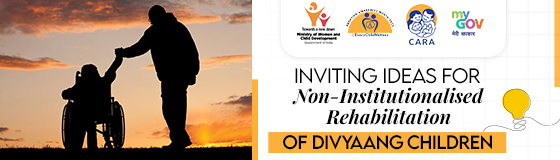
Inviting Ideas for Non-Institutionalised Rehabilitation of Divyaang Children

Inviting Ideas for Non-Institutionalised Rehabilitation of Divyaang Children
आरंभ करने की तिथि :
Oct 01, 2025
अंतिम तिथि :
Nov 30, 2025
17:30 PM IST (GMT +5.30 Hrs)
प्रस्तुतियाँ समाप्त हो चुके

In 2025, the Central Adoption Resource Authority (CARA) is placing special focus on promoting family-based care for children with special needs (Divyaang children). In ...

In 2025, the Central Adoption Resource Authority (CARA) is placing special focus on promoting family-based care for children with special needs (Divyaang children). In collaboration with MyGov, CARA invites all Indian citizens to participate in an important national discussion on the theme:
“Non-institutionalized Rehabilitation of Children with Special Needs (Divyaang Children)”

This initiative seeks to create a collaborative platform where citizens can:
1. Share insights on the challenges and barriers in the identification and adoption of children with special needs
2. Suggest innovative ideas, strategies, or solutions to strengthen the adoption ecosystem
3. Contribute to policy-making by offering actionable recommendations to ensure a loving family environment for every child, especially those currently residing in Specialized Adoption Agencies (SAAs) and Child Care Institutions (CCIs)

Your thoughtful suggestions can play a key role in shaping a more inclusive, compassionate, and efficient adoption framework for Divyaang children.

Who can participate?
All Indian citizens are welcome to join the conversation and submit their ideas.

Why participate?
Selected entries may be featured in national-level publications, exhibitions, and even considered in policy discussions aimed at improving the lives of children with special needs.

Let’s work together to ensure every child finds a loving family and a brighter future. Join the discussion today and be a voice for change!

फिर से कायम कर देना
777 सबमिशन दिखा रहा है
Gagandeep Kaur
Gagandeep Kaur 3 महीने 4 दिन पहले
Family First Support Ecosystem for Divyaang Children To promote non-institutional rehabilitation, India needs a unified and compassionate support system that empowers families caring for Divyaang children. I propose a combo model combining Technology + Community + Family Counseling: 1.Tech Support Platform A government mobile app that connects adoptive/foster families with therapists, doctors, special educators, and emergency assistance nearby. 2.Community Support Teams Trained local volunteers and professionals visiting homes regularly to support daily needs, learning activities, mobility tools, and emotional care. 3.Continuous Family Training & Counseling Workshops (online & offline) to guide families in understanding disabilities, communication, behaviour support, and government schemes. This hybrid model ensures every child grows in a loving home, with access to therapy, education, and social inclusion. It embodies the true spirit of “Family-based Care for All Divyaang Children
Gagandeep Kaur
Gagandeep Kaur 3 महीने 4 दिन पहले
Family First Support Ecosystem for Divyaang Children To promote non-institutional rehabilitation, India needs a unified and compassionate support system that empowers families caring for Divyaang children. I propose a combo model combining Technology + Community + Family Counseling: 1.Tech Support Platform A government mobile app that connects adoptive/foster families with therapists, doctors, special educators, and emergency assistance nearby. 2.Community Support Teams Trained local volunteers and professionals visiting homes regularly to support daily needs, learning activities, mobility tools, and emotional care. 3.Continuous Family Training & Counseling Workshops (online & offline) to guide families in understanding disabilities, communication, behaviour support, and government schemes. This hybrid model ensures every child grows in a loving home, with access to therapy, education, and social inclusion. It embodies the true spirit of “Family-based Care for All Divyaang Children
kunal kishore
kunal kishore 3 महीने 4 दिन पहले
Divyang children is big concern for our country.it has been proper arrangement of their rehabilitation.some suggestion has been given for it. 1 A proper rehabilitation centre has been opened for their proper care. 2 Every hospital has to be compulsory for specially ward reserve for divyaang children. 3 Social organisation will take responsibility for their proper care and given better environment. 4 Religious and spiritual organisation has to be act as a supportive role for their mental fitness. 5 A national rehabilitation plan has been enacted for regulate all activity for divyaang children.
Shailee Dahiya
Shailee Dahiya 3 महीने 4 दिन पहले
disabled children's who are not instutionalised are need attention from the society and peoples to grow healthy . they also have talent and with special care and the help of the community w can promote theirs mental and physical health . pramote tham to creat their own base and communication skills.
HardeviSharma
HardeviSharma 3 महीने 4 दिन पहले
दिव्यांग बच्चे हमारे समाज का अनमोल हिस्सा हैं और उन्हें भी सभी समान अवसर मिलना चाहिए। सरकार को चाहिए कि वे उनके लिए विशेष शिक्षा, स्वास्थ्य सुविधाएँ और खेल-कूद के अवसर उपलब्ध कराएँ, ताकि वे आत्मनिर्भर और आत्मविश्वासी बन सकें। समाज और परिवार को भी उनका सम्मान करना चाहिए, उनके प्रति धैर्य और सहानुभूति रखनी चाहिए, और उनकी प्रतिभा और क्षमता को पहचान कर प्रोत्साहित करना चाहिए। जब सरकार और समाज मिलकर दिव्यांग बच्चों के लिए सभी सुविधाएँ सुनिश्चित करेंगे, तभी वे अपने सपनों को पूरा कर पाएंगे और उनका स्वाभिमान बना रहेगा।
Gaurav Saini
Gaurav Saini 3 महीने 4 दिन पहले
To ensure non-institutionalised rehabilitation of Divyaang children, India must strengthen a family-first, community-based support system. Early identification through Anganwadi, ASHA and PHC screening should be linked with quick counselling, therapy guidance and government benefits. Every district should establish a Community Rehabilitation Hub using existing PHC/DDRC infrastructure to provide therapy, assistive devices and home-based plans. Schools and Anganwadis must adopt simple inclusive practices, prepare an Individualised Education Plan (IEP) for each child, and ensure support through trained resource teachers. For children without families, kinship care and foster care should be prioritised instead of large institutions. Local Community Rehabilitation Workers and awareness drives can reduce stigma and empower families. This model keeps children safe at home, promotes inclusion, and reduces unnecessary institutionalisation.